For most boaters, the Steiner Marine 7×50 is my best overall pick because its traditional 7×50 format favors steady viewing on a moving deck. The Nikon OceanPro 7×50 stands out for its illuminated compass, while the Steiner Military-Marine 8×30 offers a smaller carry option. The main tradeoffs are magnification versus image stability, built-in navigation aids versus simpler optics, and full-size viewing comfort versus compact handling. A 7×50 model is a practical starting point, but it is not automatically the right fit for every boat or user. Read on for the full comparison and advice on choosing the right pair for your time on the water.

Get sports gear delivered free with Prime
- Fast, free delivery on millions of items
- Prime Video, Amazon Music and more included
- Member-only deals all year
Complete the kit


Key Takeaways
- Steady viewing is the central advantage of the 7×50 format. Most picks use it, including the Steiner Marine, Nikon OceanPro and Bushnell Marine models, making them the most straightforward choices for use from a moving boat.
- Navigation features separate several similar-looking 7x50s. The Nikon adds an illuminated global compass, while AOMEKIE, HOOWAY and USCAMEL combine compass and rangefinder functions; buyers should choose these tools only if they will use them.
- Higher magnification brings a real handling tradeoff. The SIG SAUER ZULU6 HDX PRO 18×50 offers a different view from conventional marine binoculars, but its much higher power makes steady handheld use more demanding.
- Compactness comes with a different viewing experience. The Steiner Military-Marine 8×30 is easier to carry than full-size 7×50 models, while its smaller objectives and higher magnification change low-light and steadiness priorities.
- Several picks suit different budgets and levels of onboard simplicity. Bushnell H2O offers a basic waterproof 7×50 approach, while the Steiner Military-Marine 7×50 emphasizes rugged features and the Fujifilm Fujinon Mariner adds another established 7×50 alternative.
| Steiner Marine 7×50 Waterproof Binoculars |  | Best for Hands-Free, Fixed-Focus Viewing | Magnification: 7x | Objective lens diameter: 50 mm | Field of view: 354 ft at 1,000 yd | VIEW LATEST PRICE | See Our Full Breakdown |
| AOMEKIE 7×50 Marine Binoculars with Rangefinder and Compass |  | Best Value for Built-In Navigation Tools | Magnification: 7x | Objective lens diameter: 50 mm | Prism type: BAK4 Porro prism | VIEW LATEST PRICE | See Our Full Breakdown |
| SIG SAUER ZULU6 HDX PRO 18×50 Marine Binoculars |  | Best Premium Pick for Stabilized Long-Range Viewing | Magnification: 18x | Objective lens diameter: 50 mm | Prism type: Roof prism | VIEW LATEST PRICE | See Our Full Breakdown |
| Nikon OceanPro 7×50 Waterproof Marine Binoculars with Illuminated Global Compass |  | Best for Eyeglass Wearers and Global Navigation | Magnification: 7x | Objective lens diameter: 50 mm | Field of view: 7.2° | VIEW LATEST PRICE | See Our Full Breakdown |
| Bushnell Marine 7×50 Waterproof Binoculars with Compass |  | Best for Compass and Range-Finding Reticle | Magnification: 7x | Objective lens diameter: 50 mm | Field of view: 350 ft at 1,000 yd (6.84°) | VIEW LATEST PRICE | See Our Full Breakdown |
| HOOWAY 7×50 Waterproof Marine Binoculars with Compass and Rangefinder |  | Best Value Navigation Features | Magnification: 7x | Objective lens diameter: 50 mm | Prisms and coating: BAK4 Porro prisms; fully multi-coated | VIEW LATEST PRICE | See Our Full Breakdown |
| Steiner Military-Marine 7x50mm Binoculars |  | Best for Rugged, Fast Tracking | Magnification: 7x | Objective lens diameter: 50 mm | Prism type: Porro prism | VIEW LATEST PRICE | See Our Full Breakdown |
| USCAMEL 10×50 Marine Binoculars with Compass and Rangefinder |  | Best for Extra Reach | Magnification: 10x | Objective lens diameter: 50 mm | Prisms and coating: BAK4 Porro prism; fully multi-coated | VIEW LATEST PRICE | See Our Full Breakdown |
| Bushnell Marine 7×50 Waterproof Binoculars, Blue |  | Best Simple Marine Optics | Magnification: 7x | Objective lens diameter: 50 mm | Prisms and coating: BaK-4 Porro prisms; fully multi-coated | VIEW LATEST PRICE | See Our Full Breakdown |
| Fujifilm Fujinon Mariner 7×50 WPC-XL Porro Prism Binocular |  | Best for Nighttime Compass Readings | Magnification: 7x | Objective lens diameter: 50 mm | Prism type: Porro prism | VIEW LATEST PRICE | See Our Full Breakdown |
| Steiner Military-Marine 8×30 Binoculars |  | Best Compact Marine Pick | Magnification: 8x | Objective lens diameter: 30 mm | Weight: 17.1 oz | VIEW LATEST PRICE | See Our Full Breakdown |
| Bushnell H2O 7×50 Waterproof Porro Binoculars |  | Best Bright-View Value | Magnification: 7x | Objective lens diameter: 50 mm | Prism type and material: Porro; BAK-4 | VIEW LATEST PRICE | See Our Full Breakdown |
| marine binocular | Magnification | Objective lens diameter | Field of view | Water resistance |
|---|---|---|---|---|
| Steiner Marine 7×50 Waterproof | 7x | 50 mm | 354 ft at 1,000 yd | Waterproof |
| AOMEKIE 7×50 Marine Binoculars | 7x | 50 mm | — | Waterproof; fogproof |
| SIG SAUER ZULU6 HDX PRO 18×50 | 18x | 50 mm | — | IPX7 waterproof; nitrogen-filled, fogproof housing |
| Nikon OceanPro 7×50 Waterproof | 7x | 50 mm | 7.2° | Waterproof |
| Bushnell Marine 7×50 Waterproo | 7x | 50 mm | 350 ft at 1,000 yd (6.84°) | Waterproof |
| HOOWAY 7×50 Waterproof Marine | 7x | 50 mm | 396 ft at 1,000 yd | — |
| Steiner Military-Marine 7x50mm | 7x | 50 mm | 387 ft | Waterproof |
| USCAMEL 10×50 Marine Binocular | 10x | 50 mm | 396 ft at 1,000 yd | — |
| Bushnell Marine 7×50 Waterproo | 7x | 50 mm | — | — |
| Fujifilm Fujinon Mariner 7×50 | 7x | 50 mm | 7 degrees | Waterproof; nitrogen-filled |
| Steiner Military-Marine 8×30 B | 8x | 30 mm | 362 ft | Waterproof |
| Bushnell H2O 7×50 Waterproof P | 7x | 50 mm | 113 m | — |
More Details on Our Top Picks
Steiner Marine 7×50 Waterproof Binoculars
The Steiner Marine 7×50 is the strongest fit here for boaters who want to pick up the binoculars and follow activity without repeatedly turning a focus wheel. After eye calibration, its Sports-Autofocus keeps subjects sharp from 20 yards to infinity, unlike the manual central focus on the Nikon OceanPro 7×50 and Bushnell Marine 7×50. Its 7x magnification and 50 mm objectives make a practical marine combination, while multicoated optics and BAK-4 prisms support clear viewing. Waterproof, shock-resistant construction and rubber armor suit life aboard, but the 37-ounce weight is noticeable on longer outings. The fixed-focus approach also takes setup: it is less convenient if different people share the binoculars or you often switch between nearby and distant subjects.
Pros:- Sports-Autofocus maintains sharp viewing from 20 yards to infinity after calibration.
- Waterproof, shock-resistant housing with rubber armor is suited to boat use.
- Multicoated optics and BAK-4 prisms support clear, bright views.
- 20 mm eye relief accommodates a comfortable viewing position.
Cons:- Sports-Autofocus must be calibrated to the user’s eyes.
- At 37 ounces, it can feel heavy during extended handheld use.
Best for: Boaters who want a rugged 7×50 binocular for tracking distant shorelines or vessels without adjusting focus each time.
Not ideal for: Shared-use crews who need quick focus changes for close objects, or anyone seeking a lighter binocular for long periods of handheld viewing.
- Magnification:7x
- Objective lens diameter:50 mm
- Field of view:354 ft at 1,000 yd
- Prism type:Porro BAK-4
- Focus type:Sports-Autofocus
- Eye relief:20 mm
- Water resistance:Waterproof
- Weight:37 oz
Our verdict“Choose the Steiner for rugged, low-adjustment viewing aboard, but pick a manually focused model if several people will share it or frequent focus changes matter.”
AOMEKIE 7×50 Marine Binoculars with Rangefinder and Compass
The AOMEKIE 7×50 combines a compass and rangefinder in a floating, waterproof and fogproof design, making it a practical choice for boaters who want navigation aids built into one pair. Its illuminated compass and independent diopter adjustment give it a different emphasis from the Steiner Marine 7×50, which favors set-and-follow autofocus, and the Nikon OceanPro 7×50, whose compass is specified as global with automatic declination. Fully multi-coated lenses and BAK4 Porro prisms are intended to support bright, high-contrast views. The tradeoff is a 1.1 kg carry weight, and its individual focus may slow quick changes between near and far subjects. The listed field-of-view figure is unusual, so I would verify that specification with the seller before relying on it.
Pros:- Floating, waterproof and fogproof design suits use around water.
- Built-in illuminated compass and rangefinder add navigation functions.
- Fully multi-coated lenses and BAK4 Porro prisms are designed for bright, high-contrast viewing.
- Independent ±5 diopter adjustment allows personalized focus.
Cons:- At 1.1 kg, it is heavy for prolonged handheld carrying.
- Individual focus is less convenient when switching quickly between distances.
- The stated field of view of 396 miles is unusual and should be checked before purchase.
Best for: Boaters and anglers who want a floating 7×50 with an illuminated compass and rangefinder integrated into the binoculars.
Not ideal for: Users who prioritize low weight, fast focus changes, or a clearly stated field of view for comparing viewing coverage.
- Magnification:7x
- Objective lens diameter:50 mm
- Prism type:BAK4 Porro prism
- Lens coating:Fully multi-coated
- Compass:Built-in, illuminated
- Rangefinder:Built-in
- Water resistance:Waterproof; fogproof
- Weight:1.1 kg
Our verdict“Pick the AOMEKIE if built-in navigation tools and flotation matter more than a lighter carry or quick focusing.”
SIG SAUER ZULU6 HDX PRO 18×50 Marine Binoculars
The SIG SAUER ZULU6 HDX PRO takes a different route from the 7×50 binoculars in this group: its 18× magnification brings distant targets closer, while OmniScan image stabilization is designed to counter movement and vibration aboard a vessel. That makes it the specialist choice for identifying far-off landmarks or vessels, rather than the easy, wide-area scanning offered by the Nikon OceanPro 7×50 or Bushnell Marine 7×50. HDX PRO ED glass, an integrated polarized objective cover and an IPX7-rated, fogproof housing add useful support for bright, wet conditions. The tradeoffs are real: 18x magnification is demanding without stabilization, and its 2.78 mm exit pupil is smaller than the 7×50 models’ roughly 7 mm exit pupils. It also needs AA power, which is not specified as included.
Pros:- OmniScan image stabilization is designed to steady high-magnification views on moving vessels.
- 18x magnification brings distant objects closer than the 7×50 models.
- IPX7 waterproof and nitrogen-filled fogproof construction suits wet marine conditions.
- Polarized flip-back objective cover helps reduce glare from reflective water.
Cons:- The 2.78 mm exit pupil is smaller than those of the 7×50 alternatives, limiting light delivered to the eye.
- Requires AA batteries, and the product data does not specify that they are included.
- High magnification makes stabilization especially important for usable handheld viewing.
Best for: Experienced boaters who need to inspect distant targets and want image stabilization to help manage vessel movement.
Not ideal for: Buyers seeking a simple, wide-field binocular for general scanning, low-light use, or operation without batteries.
- Magnification:18x
- Objective lens diameter:50 mm
- Prism type:Roof prism
- Exit pupil diameter:2.78 mm
- Image stabilization:OmniScan
- Optical glass:HDX PRO ED
- Water resistance:IPX7 waterproof; nitrogen-filled, fogproof housing
- Power options:Rechargeable AA cells or standard AA cells
Our verdict“Choose the SIG SAUER for stabilized inspection of distant targets, but favor a 7×50 model for broad scanning and a larger exit pupil.”
Nikon OceanPro 7×50 Waterproof Marine Binoculars with Illuminated Global Compass
The Nikon OceanPro 7×50 is the most comfortable navigation-oriented option for eyeglass wearers in this group, pairing 22.7 mm eye relief with an illuminated global compass that automatically accounts for declination in both hemispheres. That compass distinction matters beside the Bushnell Marine 7×50, which has an illuminated compass and range-finding reticle but does not list automatic global declination. Its 7×50 format, multicoated Eco-glass optics and floating strap suit broad scanning from a boat, while central focus makes adjustments straightforward compared with individual-focus systems. There is no rangefinder listed, and manual focus means it lacks the Steiner Marine’s set-and-follow Sports-Autofocus. The 1-year limited warranty is also shorter than the Steiner’s stated lifetime warranty against defects, so this pick is strongest when eye comfort and compass functionality lead the decision.
Pros:- 22.7 mm eye relief supports comfortable viewing for many eyeglass wearers.
- Illuminated global compass includes automatic declination for both hemispheres.
- Waterproof, fogproof, rubber-armored body is designed for marine conditions.
- Floating nylon strap can help keep the binoculars close if dropped overboard.
Cons:- Manual central focus requires user adjustment.
- No rangefinder is listed, unlike the Bushnell Marine and AOMEKIE options.
- The 1-year limited warranty is shorter than the Steiner Marine’s stated lifetime defect warranty.
Best for: Eyeglass-wearing boaters who navigate in either hemisphere and want a floating strap with an illuminated global compass.
Not ideal for: Buyers who want autofocus, a built-in rangefinder, or a longer stated warranty.
- Magnification:7x
- Objective lens diameter:50 mm
- Field of view:7.2°
- Eye relief:22.7 mm
- Prism type:Porro prism
- Focus type:Manual central focus
- Compass:Illuminated global compass with automatic declination
- Water resistance:Waterproof
Our verdict“Pick the Nikon if long eye relief and a global compass are your priorities; choose the Bushnell Marine if you also want a range-finding reticle.”
Bushnell Marine 7×50 Waterproof Binoculars with Compass
The Bushnell Marine 7×50 combines the familiar, steady 7×50 format with an illuminated compass and range-finding reticle, giving boaters two onboard reference tools without moving up to the heavier AOMEKIE. Fully multi-coated optics and BaK-4 Porro prisms support bright viewing, while nitrogen purging, waterproof construction and floatable rubber armor address wet, salty use. Compared with the Nikon OceanPro 7×50, Bushnell adds a range-finding reticle, while Nikon offers longer eye relief and a compass specified for global declination. Bushnell’s center focus is more direct than the Steiner Marine’s calibration-based Sports-Autofocus, but it still requires adjustment. At 37 ounces it is not light, and its 18 mm eye relief is shorter than the Nikon’s, which may make viewing less comfortable for some eyeglass wearers.
Pros:- Illuminated compass and range-finding reticle provide useful onboard reference aids.
- Nitrogen-purged, waterproof construction is designed to resist internal fogging.
- Floatable, non-slip rubber armor is built for impact and saltwater exposure.
- Fully multi-coated optics and BaK-4 Porro prisms support bright viewing.
Cons:- At 37 ounces, it can be tiring to carry or hold for long periods.
- Manual center focus requires adjustment when viewing at different distances.
- 18 mm eye relief is shorter than the Nikon OceanPro’s 22.7 mm.
Best for: Boaters and anglers who want a traditional 7×50 marine binocular with an illuminated compass, range-finding reticle and floatable armor.
Not ideal for: Eyeglass wearers who need longer eye relief, or users who want autofocus or a lighter binocular.
- Magnification:7x
- Objective lens diameter:50 mm
- Field of view:350 ft at 1,000 yd (6.84°)
- Prism type:BaK-4 Porro prism
- Focus type:Center focus, manual
- Eye relief:18 mm
- Water resistance:Waterproof
- Weight:37 oz
Our verdict“Choose the Bushnell for its combination of marine-ready armor, compass and range-finding reticle, but opt for the Nikon if eye relief is a higher priority.”
HOOWAY 7×50 Waterproof Marine Binoculars with Compass and Rangefinder
The HOOWAY 7×50 combines the steady, familiar magnification of marine binoculars with an illuminated compass and internal rangefinder. Its 7x power is easier to hold steady on a moving boat than the USCAMEL’s 10x magnification, while the 50 mm objectives and fully multi-coated BAK4 optics are suited to low-light scanning. Waterproof construction, nitrogen purging, and flotation address the practical risks of use over water. The tradeoff is its 2.2 lb weight, which can feel cumbersome during extended handheld viewing, and individual focus means setting each eyepiece separately. Compared with the Fujinon Mariner, it adds a rangefinder, but the listed 22 mm eye relief is more generous than the Fujinon’s 18 mm. I’d choose it for feature-rich navigation, not for a lightweight carry.
Pros:- Built-in illuminated compass and rangefinder support onboard navigation and distance estimation.
- Waterproof, nitrogen-purged construction resists water intrusion and internal fogging.
- 7x magnification is steadier to hold on a moving boat than the USCAMEL’s 10x power.
- 22 mm eye relief and tripod fitting support comfortable or mounted viewing.
Cons:- At 2.2 lb, it is heavy for extended handheld scanning.
- Individual manual focus requires adjusting each eyepiece separately.
- Its feature-rich design may be unnecessary for buyers who only need basic marine viewing.
Best for: Boaters who want a compass and rangefinder, steady 7x viewing, and a binocular designed to float if dropped.
Not ideal for: People who prioritize a light handheld setup or prefer a single center-focus control over individually adjusted eyepieces.
- Magnification:7x
- Objective lens diameter:50 mm
- Prisms and coating:BAK4 Porro prisms; fully multi-coated
- Field of view:396 ft at 1,000 yd
- Eye relief:22 mm
- Marine protection:Waterproof, floats in water, nitrogen-purged
- Navigation features:Illuminated compass and internal rangefinder
- Focus and weight:Individual manual focus; 2.2 lb
Our verdict“Choose the HOOWAY if you want steady 7x marine viewing with both a compass and rangefinder and can accept its weight.”
Steiner Military-Marine 7x50mm Binoculars
The Steiner Military-Marine is the pick here for boaters who value rugged construction and quick target acquisition over onboard measuring tools. Its Sports-Auto-Focus system lets you set each eyepiece to your vision, then track objects from about 20 yards to infinity without repeatedly turning a focus wheel. That is useful when scanning moving vessels or shoreline markers, and its 7x magnification is naturally steadier on the water than the USCAMEL’s 10x. The Makrolon housing, impact-absorbing floating prism system, and waterproof build suit rough handling. Unlike the HOOWAY and Fujinon Mariner, however, this model has no listed compass or rangefinder, so navigation has to come from separate instruments. I’d favor it for durability and action, but not for buyers who need integrated bearing or distance readings.
Pros:- Sports-Auto-Focus reduces repeated adjustment while tracking moving targets.
- Waterproof housing and impact-absorbing floating prism system are suited to rough handling.
- 7x magnification provides a steadier handheld view than the USCAMEL’s 10x.
- Rubber armoring offers a non-slip grip in wet conditions.
Cons:- No built-in compass or rangefinder, unlike the HOOWAY and Fujinon Mariner.
- Individual eyepiece calibration takes setup and may not suit users who prefer center focus.
- At 387 ft at 1,000 yd, the listed field of view is slightly narrower than the HOOWAY’s 396 ft.
Best for: Boaters who scan moving targets in rough conditions and want a durable 7×50 with minimal refocusing.
Not ideal for: Navigators who want an integrated compass or rangefinder, or users who need close focusing more often than its auto-focus design allows.
- Magnification:7x
- Objective lens diameter:50 mm
- Prism type:Porro prism
- Exit pupil:7.1 mm
- Field of view:387 ft
- Water resistance:Waterproof
- Focus:Sports-Auto-Focus
- Housing:Makrolon chassis with NBR rubber armoring
Our verdict“Pick the Steiner for durable, low-fuss tracking on the water, but choose the HOOWAY or Fujinon Mariner if integrated navigation aids matter.”
USCAMEL 10×50 Marine Binoculars with Compass and Rangefinder
The USCAMEL is the higher-magnification choice in this group: 10x brings distant shoreline details closer than the 7x HOOWAY, Steiner Military-Marine, or Fujinon Mariner. That extra reach can help when identifying far-off objects from a stable deck or tripod, and the illuminated compass and rangefinder keep navigation aids built in. IPX7 waterproofing, O-ring seals, nitrogen purging, and BAK4 prisms with fully multi-coated lenses give it a credible marine feature set. The tradeoff is that 10x magnification tends to make hand movement more visible on a moving boat, so the tripod compatibility matters more than it does with the 7x models. Its listed 7.1 mm eye relief may also be restrictive for some glasses wearers. I’d pick it for reach, not for the steadiest handheld view.
Pros:- 10x magnification reveals more distant detail than the 7x HOOWAY and Steiner Military-Marine.
- Illuminated compass and rangefinder provide onboard direction and distance references.
- IPX7 waterproofing, O-ring seals, and nitrogen purging protect the optics in wet conditions.
- Tripod compatibility can help steady the higher magnification.
Cons:- 10x magnification is harder to keep steady handheld on a moving boat than 7x models.
- Listed 7.1 mm eye relief may be uncomfortable or limiting for some glasses wearers.
- Individual manual focus requires setting each eyepiece separately.
Best for: Boaters viewing distant buoys, shore features, or vessels from a stable position who want integrated navigation aids.
Not ideal for: People who mostly scan handheld from a moving boat, or glasses wearers who need generous eye relief.
- Magnification:10x
- Objective lens diameter:50 mm
- Prisms and coating:BAK4 Porro prism; fully multi-coated
- Field of view:396 ft at 1,000 yd
- Eye relief:7.1 mm
- Exit pupil:5 mm
- Water protection:IPX7 waterproof, O-ring sealed, nitrogen-purged
- Navigation and mounting:Illuminated compass and rangefinder; tripod compatible
Our verdict“Choose the USCAMEL when distant detail matters more than a steady handheld image and you can use a stable viewing position.”
Bushnell Marine 7×50 Waterproof Binoculars, Blue
The Bushnell Marine 7×50 suits buyers who want straightforward, sealed marine optics rather than integrated navigation electronics. Its 7x power and 7.1 mm exit pupil are a familiar combination for steady viewing and low-light use, while BaK-4 prisms and fully multi-coated lenses support clear images. Hermetic sealing, waterproof construction, corrosion resistance, and rubber armor address the conditions that distinguish boat binoculars from general-purpose models. Compared with the HOOWAY and Fujinon Mariner, this Bushnell has no listed compass or rangefinder; it keeps the setup simpler but leaves navigation to other instruments. The center-focus specification is convenient for changing distances, although the product data also lists fixed focus, so the focusing details are not entirely consistent. Its 1.02 kg weight is another reason to favor it for shorter scans or supported viewing.
Pros:- Hermetically sealed, waterproof construction is designed for marine conditions.
- Corrosion-resistant build and non-slip rubber armor suit wet handling.
- BaK-4 prisms and fully multi-coated optics support clear, bright viewing.
- 7x magnification is easier to hold steady than the USCAMEL’s 10x.
Cons:- No built-in compass or rangefinder, unlike the HOOWAY and Fujinon Mariner.
- Weighs 1.02 kg, which can tire users during extended handheld scanning.
- Provided specifications conflict on whether focusing is center-focus or fixed.
Best for: Boaters who want conventional 7×50 viewing with sealed, corrosion-resistant construction and do not need a built-in compass.
Not ideal for: Navigators seeking integrated compass and rangefinder functions, or users who want a lightweight binocular for long handheld sessions.
- Magnification:7x
- Objective lens diameter:50 mm
- Prisms and coating:BaK-4 Porro prisms; fully multi-coated
- Exit pupil:7.1 mm
- Eye relief:18 mm
- Water and corrosion protection:Waterproof, hermetically sealed, corrosion-resistant
- Focus:Center focus listed; product data also describes fixed focus
- Weight:1.02 kg
Our verdict“Choose this Bushnell for uncomplicated, sealed 7×50 marine viewing, but look to the HOOWAY or Fujinon Mariner for built-in navigation aids.”
Fujifilm Fujinon Mariner 7×50 WPC-XL Porro Prism Binocular
The Fujinon Mariner stands out for pairing a built-in compass and reticle with a push-button LED nightlight, making it a considered choice for boaters who need to read bearings after dark. Its 7×50 format offers the steady handheld view common to marine binoculars, while 18 mm eye relief is more accommodating for glasses than the USCAMEL’s listed 7.1 mm. A flotation neck strap helps recover the binoculars if they go overboard, though the product description attributes flotation to the strap rather than the binocular body. Compared with the HOOWAY, it has the nightlight and a stated five-year limited warranty, but no listed rangefinder. Individual focus also suits set-and-scan use better than frequent distance changes. I’d favor it for compass use at night, not for buyers who need distance estimates or center-focus adjustment.
Pros:- Built-in compass and reticle have an LED nightlight for low-light readings.
- 18 mm eye relief is more accommodating than the USCAMEL’s listed 7.1 mm.
- Flotation neck strap can help recover the binoculars if dropped overboard.
- 7x magnification offers steadier handheld viewing than the USCAMEL’s 10x.
Cons:- No listed rangefinder, unlike the HOOWAY and USCAMEL.
- Individual focus is less convenient than center focus when viewing objects at changing distances.
- Flotation depends on the supplied neck strap rather than a stated floating binocular body.
Best for: Boat operators who need a compass visible in low light and value longer eye relief and a flotation strap.
Not ideal for: Buyers who want a built-in rangefinder, center-focus adjustment, or flotation from the binocular body without relying on the strap.
- Magnification:7x
- Objective lens diameter:50 mm
- Prism type:Porro prism
- Eye relief:18 mm
- Field of view:7 degrees
- Water resistance:Waterproof; nitrogen-filled
- Compass illumination:Built-in LED nightlight
- Focus and flotation:Individual manual focus; flotation neck strap
Our verdict“Choose the Fujinon Mariner if nighttime compass visibility and comfortable eye relief matter more than a built-in rangefinder.”
Steiner Military-Marine 8×30 Binoculars
The 8×30 format makes this the more portable choice beside the larger Bushnell H2O 7×50, especially when you want binoculars that are easier to carry on deck or pack for shore excursions. Steiner’s Sports-Auto-Focus lets you adjust each eyepiece for your vision, then view subjects from 20 yards to infinity without repeatedly refocusing. That can be useful when tracking moving boats, though the initial setup takes more effort than the Bushnell’s manual center-focus system.
Its waterproof, shock-resistant housing, rubber armor, and floating prism system suit rough outdoor handling. The tradeoff is a smaller 30 mm objective lens, which gathers less light than the Bushnell’s 50 mm lenses, so this is a less compelling pick for dim conditions. Fixed 8x magnification also means no zoom, and the eyepieces need individual calibration.
Pros:- Lightweight 17.1-ounce construction is easier to carry than the Bushnell H2O 7×50
- Sports-Auto-Focus holds focus from 20 yards to infinity after eyepiece setup
- Waterproof, shock-resistant housing with oil, petroleum, and chemical resistance
- Floating prism system helps protect internal optics from impact
Cons:- 30 mm objective lenses gather less light than the Bushnell H2O’s 50 mm lenses
- Each eyepiece must be calibrated to the user’s vision before use
- Fixed 8x magnification provides no zoom adjustment
Best for: Boaters and coastal travelers who prioritize a lightweight, rugged pair for daytime viewing and frequent carrying
Not ideal for: Buyers who often observe at dawn or dusk, want large 7×50-style lenses, or prefer quick center-focus adjustments for multiple users
- Magnification:8x
- Objective lens diameter:30 mm
- Weight:17.1 oz
- Focus system:Sports-Auto-Focus
- Focus range:20 yards to infinity
- Field of view:362 ft
- Water resistance:Waterproof
- Housing:Makrolon polycarbonate with NBR Long Life rubber armor
- Warranty:Transferable lifetime warranty
Our verdict“Choose the Steiner if portability and rugged, low-refocus viewing matter more to you than the light-gathering capacity of a full-size 7×50.”
Bushnell H2O 7×50 Waterproof Porro Binoculars
The 7×50 configuration favors a steady, bright view over compactness: its 7 mm exit pupil and 50 mm objective lenses are better suited to low-light boat watching than the smaller Steiner Military-Marine 8×30. Fully multi-coated optics and BAK-4 prisms support bright, high-contrast images, while the lower 7x magnification can make handheld viewing feel steadier than a higher-power option. Its manual center focus is familiar and adjustable, but it requires ongoing refocusing rather than the Steiner’s set-once Sports-Auto-Focus approach.
The Bushnell’s IPX7 waterproofing and nitrogen purging offer protection against submersion and internal fogging, and the rubber grip helps when hands are wet. The main compromise is substantial: at 1361 g, it is much heavier than the Steiner and less appealing for long periods of carrying. It also lacks zoom and is physically large, though tripod compatibility can help during extended observation.
Pros:- 50 mm objective lenses and a 7 mm exit pupil support bright viewing in dimmer conditions
- Fully multi-coated optics and BAK-4 prisms support high-contrast images
- IPX7 waterproofing and nitrogen purging help protect against water entry and internal fogging
- Textured rubber grip and tripod compatibility suit wet or extended viewing
Cons:- At 1361 g, it is much heavier than the Steiner Military-Marine 8×30
- Fixed 7x magnification provides no zoom adjustment
- Large 8.75 × 8.75 in dimensions make it less convenient to pack and carry
Best for: Boat owners who want bright, steady 7×50 viewing, waterproof protection, and a tripod-compatible option for extended observation
Not ideal for: Day hikers, lightweight-gear sailors, or anyone who needs compact binoculars that are comfortable to carry for long stretches
- Magnification:7x
- Objective lens diameter:50 mm
- Prism type and material:Porro; BAK-4
- Optical coating:Fully multi-coated
- Exit pupil:7 mm
- Field of view:113 m
- Water protection:IPX7 waterproof; nitrogen-purged
- Weight:1361 g
- Mount:Tripod compatible
Our verdict“Pick the Bushnell H2O if bright, stable 7×50 viewing and water protection outweigh the burden of carrying a full-size, heavy binocular.”
How We Picked
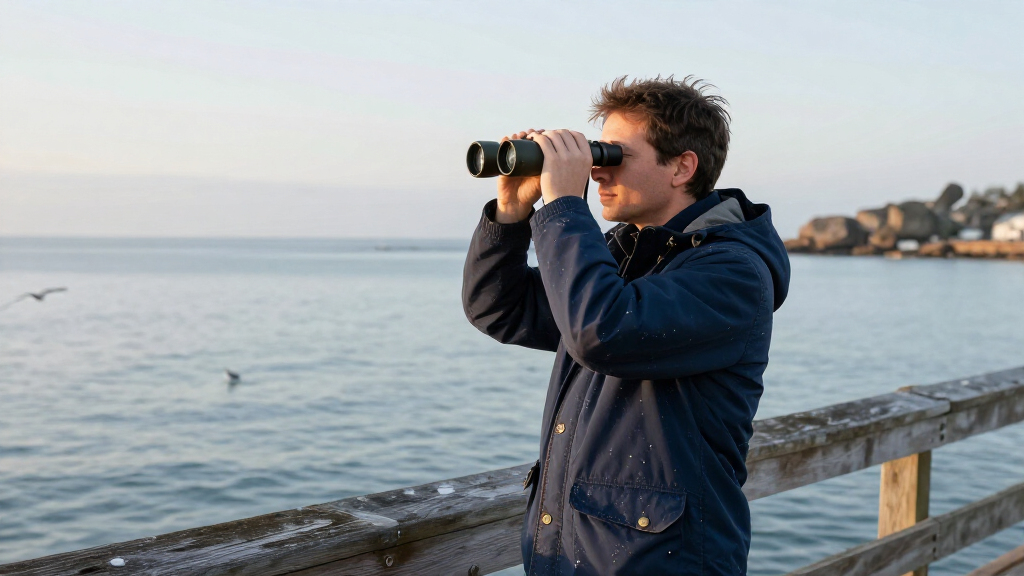
I ranked these marine binoculars by how well their design fits real onboard viewing, not by feature count alone. I gave priority to magnification and handling that can help keep a distant marker or shoreline in view as a boat moves, along with waterproof construction, useful field features and ease of use. Compass and rangefinder models earned attention when those additions plausibly support navigation, but extra controls did not automatically place them above simpler options.
The ranking also reflects the tradeoffs between full-size 7x50s, compact 8x30s and higher-power 18×50s. I favored versatile models for the top positions, then placed more specialized or stripped-back options lower for buyers with narrower needs. Where products share a format, distinctions such as an illuminated compass, compact body or tactical-style construction matter more than small naming differences; buyers should still verify current specifications and intended use before purchase.
| marine binocular | Prism type | Water resistance |
|---|---|---|
| Steiner Marine 7×50 Waterproof | Porro BAK-4 | Waterproof |
| AOMEKIE 7×50 Marine Binoculars | BAK4 Porro prism | Waterproof; fogproof |
| SIG SAUER ZULU6 HDX PRO 18×50 | Roof prism | IPX7 waterproof; nitrogen-filled, fogproof housing |
| Nikon OceanPro 7×50 Waterproof | Porro prism | Waterproof |
| Bushnell Marine 7×50 Waterproo | BaK-4 Porro prism | Waterproof |
| HOOWAY 7×50 Waterproof Marine | — | — |
| Steiner Military-Marine 7x50mm | Porro prism | Waterproof |
| USCAMEL 10×50 Marine Binocular | — | — |
| Bushnell Marine 7×50 Waterproo | — | — |
| Fujifilm Fujinon Mariner 7×50 | Porro prism | Waterproof; nitrogen-filled |
| Steiner Military-Marine 8×30 B | — | Waterproof |
| Bushnell H2O 7×50 Waterproof P | — | — |
Factors to Consider When Choosing Marine Binoculars
Choosing marine binoculars is less about finding the longest list of features and more about matching the optics to the boat, the conditions and the person holding them. These factors help clarify which compromises matter before comparing model names.
Choose Magnification for a Moving Platform
On a boat, a higher number does not automatically mean a more useful view: it also makes hand movement more apparent. A 7x model is a common marine choice because its lower magnification is generally easier to keep steady than 10x or 18x. Higher power may help distinguish distant details in calm conditions, but it can frustrate users trying to follow a buoy from a rocking deck. Do not compare magnification without considering how you will support the binoculars. If you routinely view from a stable position or can use a mount, more power may make sense. For casual handheld use, steadiness often matters more than extra reach.
Treat Objective Size as a Balance, Not a Score
The second number in a binocular specification refers to the objective lens diameter in millimeters, so a 7×50 has 50 mm objectives. Larger objectives can gather more light, which may help at dawn, dusk or under overcast skies, but they also add bulk. A compact 8×30 is easier to stow and carry, yet it presents a different low-light compromise from a full-size 7×50. Think about when you actually scan: daytime coastal trips place less emphasis on low-light viewing than early departures or night watches. A large lens cannot compensate for poor handling or unsuitable optics. Choose the size you can keep accessible and use comfortably.
Decide Whether a Compass or Rangefinder Will Earn Its Place
Built-in navigation aids can be handy when you need a quick bearing or an estimate of an object’s distance, but they add controls and can raise the learning curve. A compass is most useful when you know how you will read and apply its bearing; illumination can help when ambient light is low. A rangefinder scale requires the user to understand its markings and make a calculation, so it is not an instant distance readout. If your boat already has dependable navigation instruments, simpler binoculars may be easier to use and maintain. Before paying for onboard features, check that the layout is readable and practical for the way you hold the binoculars. Choose tools you will use, rather than treating them as automatic upgrades.
Check Waterproofing and the Care the Binoculars Need
Marine use exposes binoculars to spray, rain, damp storage and occasional knocks, so waterproof construction is more relevant than a general outdoor label. Product descriptions can differ on sealing, fog resistance and construction, so verify the manufacturer’s stated protection rather than assuming every waterproof model offers the same safeguards. Salt deposits can affect surfaces and moving parts even when the body is sealed. Rinse or wipe the exterior as directed, dry the binoculars before storage and avoid touching lens coatings with abrasive material. Also check whether the focus and eyecup arrangement is manageable with wet hands or gloves. A durable body helps, but it does not remove the need for routine care.
Match Focus and Controls to How You Observe
Marine binoculars vary in how users bring subjects into focus and adjust the view, and the best arrangement depends on whether you track changing distances or scan from a fixed position. A simple control layout can be easier for occasional users, while specialized focus systems may suit those who prefer fewer adjustments once set. Check whether eyeglass wearers can see the full field through the eyecups, and whether controls are easy to reach without losing sight of the target. If several people will share the binoculars, adjustable settings are useful but can add steps between users. Try to assess ergonomics in person when possible, or check return terms before buying. Clear, quick handling can matter more aboard than a feature that looks impressive on a specification sheet.
Consider Size, Storage and How the Binoculars Will Be Secured
Full-size 7×50 binoculars can be comfortable for scanning but take more room in a cockpit bag or locker than compact alternatives. A smaller model may get used more often if it is easy to carry, though compact dimensions can come with reduced objective size or a narrower viewing experience. Decide where the binoculars will live and how quickly you need to reach them. On a moving boat, a suitable strap or other secure carrying arrangement can reduce the chance of dropping them overboard. Check what is included and whether the carrying setup suits your vessel, rather than assuming the package covers every need. Storage and access are practical parts of the choice, not afterthoughts.
Frequently Asked Questions
Are 7×50 binoculars a better choice than 10×50 for boating?
For many handheld boating situations, 7×50 is the easier format to keep steady because its lower magnification makes movement less pronounced. A 10×50 can show more detail on distant subjects, but that advantage is harder to use if the image jitters on a moving deck. The 7×50 format also pairs relatively large objectives with modest magnification, a combination suited to broad scanning. If you mostly observe from a stable position or have a way to support the binoculars, 10×50 may still fit your needs. Choose based on how steady your viewing position is, not just the desire for more magnification.
Do I need a built-in compass in marine binoculars?
A built-in compass can provide a quick bearing while you are viewing a landmark or vessel, but it is useful only if you know how to interpret that bearing and connect it to your navigation routine. It does not replace a chartplotter, compass or other primary navigation equipment. An illuminated compass can be easier to read in dim conditions, while a simpler binocular avoids an extra feature to learn and maintain. If you already have reliable navigation instruments within reach, the compass may be redundant. Pick a compass model when its placement and readability suit your use, not just because it is included.
Can I use 18×50 binoculars handheld on a boat?
You can hold them, but 18x magnification makes small hand movements and boat motion much more visible than with a 7x marine binocular. This can make it harder to locate or follow a target without a steady support. Higher magnification is more appealing when you can brace the binoculars or observe from a stable position. Consider how often you need to scan quickly, since a narrow, shaky view can slow that task. For routine handheld scanning underway, a lower-power model is usually the simpler fit.
Is a compact 8×30 a sensible main pair for a boat?
It can be, particularly if portability and easy storage are more important to you than the full-size feel of a 7×50. The smaller objectives and higher magnification create different low-light and steadiness tradeoffs, so a compact pair may be less suited to dim conditions or prolonged scanning from a moving deck. Think about whether the binoculars will serve as an everyday carry pair or your primary tool for navigation and watchkeeping. If you regularly observe at dawn or dusk, compare full-size alternatives before choosing compactness. A smaller pair is most satisfying when its convenience matches your actual use.
Are rangefinder markings useful if I do not know an object’s height?
A rangefinder scale generally depends on knowing or estimating an object’s size and using the scale to calculate distance, rather than displaying distance automatically. If you do not know the target’s height or another required measurement, the markings may offer little practical help. Learning the method beforehand matters, especially if you expect to use it quickly aboard. For many buyers, a compass or plain waterproof binocular may be more useful than a rangefinder they rarely consult. Check the instructions for the specific model to understand what measurements and calculations it requires.
Conclusion
For a versatile primary pair, I would start with the Steiner Marine 7×50 as the best overall choice: its conventional format suits steady, broad scanning from a boat. For buyers seeking a best value basic waterproof option, the Bushnell H2O 7×50 keeps the setup simple. The Steiner Military-Marine 7×50 is my best premium-style pick for buyers who want rugged, specialized construction, while the Bushnell Marine 7×50 is a straightforward option for beginners who do not need extra navigation controls. For specific needs, choose the Nikon OceanPro for an illuminated compass, the AOMEKIE, HOOWAY or USCAMEL for compass-and-rangefinder functions, the Steiner Military-Marine 8×30 for compact carry, or the SIG SAUER ZULU6 HDX PRO 18×50 when high magnification matters more than easy handheld steadiness. The right choice is the one whose viewing style, controls and size fit your boat and how you actually observe.