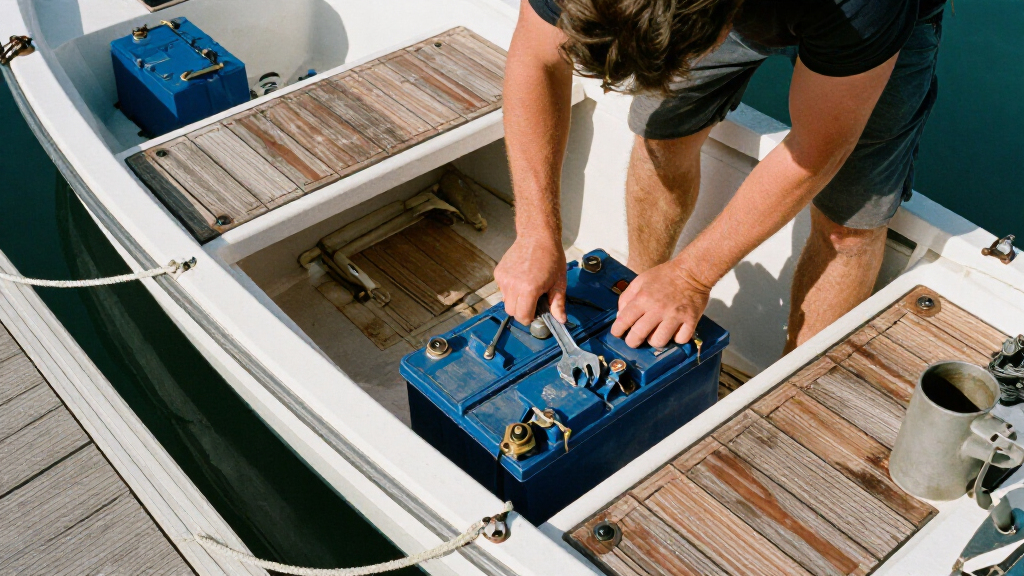
The best marine boat battery depends on whether you need engine-starting current, steady deep-cycle power, or both. I would put the Interstate Marine/RV 12V 100Ah AGM Group 31 first for its versatile balance of capacity and marine/RV use. The LiTime 12V 100Ah Group 31 LiFePO4 stands out for a trolling-motor setup that benefits from lithium, while the UPLUS Group 24M Dual-Purpose AGM suits buyers who want one battery for starting and onboard loads. The main tradeoffs are AGM’s familiar charging and lower upfront complexity versus lithium’s lower weight and usable capacity, plus the fit and starting-power limits set by your boat. Read on for the full breakdown and a buyer’s guide to matching battery type, size, and performance to your setup.

Get sports gear delivered free with Prime
- Fast, free delivery on millions of items
- Prime Video, Amazon Music and more included
- Member-only deals all year
Complete the kit



Key Takeaways
- AGM remains the most straightforward all-around choice: the Interstate 100Ah Group 31 balances deep-cycle capacity with a familiar marine/RV format, while the Group 31M model adds a stated 825 CCA for stronger starting needs.
- Lithium is most compelling for sustained trolling-motor use: the LiTime 100Ah Group 31 is purpose-built for that role, but buyers must verify charger compatibility and the boat’s charging system before changing chemistry.
- Dual-purpose labels do not mean every battery suits every boat: UPLUS, Mighty Max, and OPTIMA models combine starting and house-power aims, but buyers still need to compare CCA, capacity, and case size against their actual loads.
- Group size narrows the choice before brand does: Group 24, 27, 31, and 34 models are not automatic substitutes; tray dimensions, hold-downs, terminal layout, and cable reach can rule out a battery even when its voltage matches.
- More capacity is not always the best fit: the 165Ah LiTime targets longer runtime and adds Bluetooth and self-heating, while smaller-capacity options such as the Newport 50Ah can suit lighter loads where space and power demand are limited.






| marine boat batterie | Voltage | Capacity | Weight | Group size |
|---|---|---|---|---|
| Interstate Batteries Marine/RV | 12V | 100Ah | 60 lb | 31 |
| UPLUS Group 24M Dual-Purpose A | 12V | 79Ah at the 20-hour rate | 39 lb | BCI Group 24M |
| Newport 12V 50Ah Deep Cycle AG | 12V | 50Ah | 32 lb | — |
| SUPER EMPOWER 12.8V 100Ah LiFe | 12.8V per battery | 100Ah per battery | 21.6 lb per battery | BCI Group 24 |
| Interstate Batteries Marine/RV | 12V | 62Ah | 47.6 lb | 34M |
| Interstate Batteries Marine/RV | 12V | 100Ah | 64.5 lb | 31M |
| LiTime 12V 100Ah Group 31 LiFe | 12.8V | 100Ah | 22.2 lb | Group 31 |
| Mighty Max Battery MM-G27M 12V | 12V | 100Ah | 70.5 lb | 27M |
| UPLUS BCI Group 27M Dual-Purpo | 12V | 92Ah | 49 lb | BCI Group 27M |
| LiTime 12V 165Ah Dual-Purpose | 12.8V | 165Ah | 33.5 lb | Group 31 |
| OPTIMA 34M BlueTop Sealed AGM | 12 volts | 50Ah (C20) | 38.4 pounds | — |
| Interstate Batteries Marine/RV | 12V | 70Ah | 44.6 pounds | 24M |
| OPTIMA D34M BlueTop Dual-Purpo | 12V | 55Ah (C20) | 43.5 pounds | — |
| LiTime 12.8V 100Ah Bluetooth L | 12.8V per battery | 100Ah per battery | 22.2 pounds per battery | — |
| SUPER EMPOWER 12.8V 100Ah LiFe | 12.8V | 100Ah | 21.6 pounds | BCI Group 24 |
More Details on Our Top Picks
Interstate Batteries Marine/RV 12V 100Ah AGM Battery (Group 31, Part #31-AGM5)
I’d put this Group 31 AGM near the top for boaters who need one battery to start an engine and support frequent accessory use. Its 925 CCA and 100Ah capacity give it a stronger starting profile than the UPLUS Group 24M, while the larger Group 31 format offers more capacity than that smaller dual-purpose option. Thick plates are intended to handle repeated discharge and recharge cycles, a useful fit for boats running electronics alongside the motor. The tradeoff is weight: at 60 pounds, it is harder to install or move than the 39-pound UPLUS. I’d choose it for a compatible Group 31 tray and substantial starting demands, but skip it if easy handling or a lighter installation matters more.
Pros:- 925 CCA and 1,110 CA provide strong engine-starting capability.
- 100Ah capacity supports onboard accessories as well as starting duties.
- Thick-plate design is intended for frequent discharge and recharge cycles.
- Marine terminals and a recycling program support marine use and end-of-life handling.
Cons:- At 60 pounds, installation and carrying are difficult.
- Group 31 dimensions may not fit boats designed for smaller battery groups.
- Lead-acid AGM is heavier than the 21.6-pound SUPER EMPOWER lithium batteries.
Best for: Boat owners with a Group 31 battery compartment who want strong engine-starting power alongside deep-cycle capacity for onboard accessories.
Not ideal for: Boaters who need a lightweight battery, have a smaller battery tray, or want a dedicated deep-cycle lithium setup rather than lead-acid AGM.
- Voltage:12V
- Capacity:100Ah
- Cold cranking amps:925 CCA
- Cranking amps:1,110 CA
- Group size:31
- Battery type:Lead-acid AGM
- Terminal type:Marine terminal
- Weight:60 lb
Our verdict“Choose this Interstate when a Group 31 fit and high cranking output matter more than minimizing battery weight.”
UPLUS Group 24M Dual-Purpose AGM Marine Battery, 12V, 79Ah, 550 CCA
The UPLUS Group 24M is a practical middle ground for boaters who want starting and accessory power in one AGM battery but have less room than a Group 31 setup allows. Its 79Ah capacity and 150-minute reserve rating provide useful support for electronics and other loads, while 550 CCA suits compatible engines within its stated 70–350 hp range. Compared with the Interstate 31-AGM5, it is 21 pounds lighter and takes a smaller group size, but gives up substantial cranking output and capacity. The sealed, vibration-resistant design is suited to marine movement; still, this is not a featherweight battery, and its vehicle-specific fit calls for a careful tray and terminal check before purchase.
Pros:- Dual-purpose design combines engine starting and deep-cycle use in one battery.
- 150-minute reserve capacity supports accessory use between charging periods.
- Sealed AGM construction is designed to resist vibration.
- 39-pound weight is lower than the Interstate 31-AGM5.
Cons:- 550 CCA is substantially lower than the 925 CCA of the Interstate 31-AGM5.
- At 39 pounds, it still takes effort to lift and install.
- Vehicle-specific fit means group size, terminals, and boat requirements need checking.
Best for: Owners of compatible boats with a Group 24M tray who want one AGM battery for engine starting and moderate accessory loads.
Not ideal for: Boaters with high engine-starting demands, heavy continuous accessory use, or a setup requiring the higher capacity and cranking output of a Group 31 battery.
- Voltage:12V
- Capacity:79Ah at the 20-hour rate
- Cold cranking amps:550 CCA
- Reserve capacity:150 minutes
- Group size:BCI Group 24M
- Battery type:AGM dual-purpose marine
- Weight:39 lb
- Warranty:2 years
Our verdict“Pick the UPLUS for a compatible Group 24M boat needing balanced starting and accessory power without a Group 31 battery.”
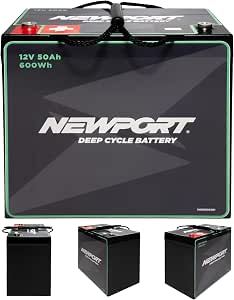
Newport 12V 50Ah Deep Cycle AGM Marine Battery
For a small boat or kayak with a trolling motor and a few 12V electronics, I’d favor the Newport’s dedicated deep-cycle design over a larger starting-and-accessory battery. Its 50Ah capacity is well below the UPLUS Group 24M’s 79Ah and the Interstate 31-AGM5’s 100Ah, but that smaller output can suit a lighter-duty setup where a large starting reserve is unnecessary. The sealed, maintenance-free AGM construction keeps routine battery care simple, and the carry handle helps with transport. At 32 pounds, though, it is not especially light for a battery intended for smaller craft. It also requires compatible 12V equipment, so I’d skip it if the boat needs engine-cranking power or long runtimes from multiple accessories.
Pros:- Dedicated deep-cycle design suits repeated discharge and recharge.
- Sealed, maintenance-free AGM construction simplifies routine care.
- Carry handle aids transport and placement in small watercraft.
- Designed for trolling motors and compatible 12V marine electronics.
Cons:- 50Ah capacity is lower than the UPLUS Group 24M and Interstate Group 31 options.
- At 32 pounds, it may still be cumbersome to carry in a kayak or small boat.
- It is intended for compatible 12V equipment, not a broad range of electrical systems.
Best for: Kayak and small-boat owners running a compatible 12V trolling motor or modest marine electronics who want a compact deep-cycle AGM.
Not ideal for: Boaters seeking engine-starting capability, extended accessory runtime, or a particularly lightweight battery for frequent carrying.
- Voltage:12V
- Capacity:50Ah
- Battery type:Lead-acid AGM
- Design:Sealed deep cycle
- Terminal type:Marine terminal
- Compatible vehicle type:Boat
- Maintenance:Maintenance-free
- Weight:32 lb
Our verdict“Choose the Newport for a small craft’s trolling motor or modest 12V loads, not for engine starting or high-capacity power needs.”
SUPER EMPOWER 12.8V 100Ah LiFePO4 Deep-Cycle Batteries, Group 24, 2-Pack
This two-pack is the clear choice here for buyers prioritizing lightweight deep-cycle storage over engine starting. Each Group 24 LiFePO4 battery provides 100Ah at 12.8V and weighs 21.6 pounds, making each unit far easier to handle than the 60-pound Interstate 31-AGM5. The integrated 100A BMS and temperature protections add safeguards for a lithium setup, and the batteries can be expanded in series or parallel up to 4S4P. Unlike the AGM choices in this group, these are explicitly not suitable for cranking an engine, so a separate starting battery may be needed. Charging below 32°F is disabled, and a compatible lithium charger or charging controller is required; this makes the pack less convenient for buyers keeping a conventional AGM charging system.
Pros:- Each battery provides 100Ah capacity at 12.8V.
- At 21.6 pounds per battery, each is much lighter than the AGM options listed.
- 100A BMS includes overcurrent, short-circuit, and temperature protections.
- Supports expansion up to 4S4P for larger configured banks.
Cons:- Not suitable for engine starting or cranking.
- Charging requires compatible LiFePO4 equipment rather than a non-lithium charger.
- Charging stops below 32°F and resumes only above 41°F.
Best for: Boat owners building a lightweight deep-cycle bank for trolling motors or onboard loads who already have, or can add, compatible lithium charging equipment.
Not ideal for: Boaters looking for a single battery to start an engine, those who charge in freezing conditions, or owners unwilling to adapt their charging system for LiFePO4.
- Battery chemistry:LiFePO4
- Pack quantity:2
- Voltage:12.8V per battery
- Capacity:100Ah per battery
- Energy capacity:1,280Wh per battery
- Group size:BCI Group 24
- Weight:21.6 lb per battery
- Maximum configuration:4S4P
- Warranty:5 years
Our verdict“Choose this two-pack for expandable, lightweight deep-cycle boat power if you can supply a separate starting battery and lithium-compatible charging.”
Interstate Batteries Marine/RV AGM Battery, 12V, 62Ah, 800 CCA, Group 34M
This Group 34M Interstate is a starting-focused dual-purpose AGM for boaters who need robust cranking in a smaller format than the Group 31 31-AGM5. Its 800 CCA is strong relative to its 62Ah capacity, making it a better fit for engine starts plus moderate accessory loads than for extended deep-cycle demand. The 31-AGM5 offers 100Ah and higher CCA, so it is the better match when the boat has room and needs more reserve. Compared with the UPLUS Group 24M, this Interstate has greater stated cranking output but weighs 8.6 pounds more and provides less capacity. Its pure-lead construction and thick plates are intended to support repeated recharging, though 47.6 pounds and Group 34M fit requirements limit its appeal for weight-sensitive or differently sized installations.
Pros:- 800 CCA offers strong starting output for its 62Ah capacity.
- Dual-purpose design serves engine starting and accessory loads.
- Pure-lead construction and thick plates are intended for repeated recharging.
- Three-year performance warranty is specified.
Cons:- 62Ah capacity is lower than the 79Ah UPLUS Group 24M and 100Ah Interstate Group 31.
- At 47.6 pounds, it is heavier than the UPLUS Group 24M.
- Group 34M sizing and marine terminals may not fit other battery setups.
Best for: Owners with a Group 34M marine battery space who prioritize strong engine starting and need moderate deep-cycle power for onboard accessories.
Not ideal for: Boaters needing long accessory runtimes, a lighter battery, or a Group 24M or Group 31 fit for their existing battery tray.
- Voltage:12V
- Capacity:62Ah
- Cold cranking amps:800 CCA
- Group size:34M
- Battery type:AGM lead-acid
- Terminal type:Marine terminal
- Weight:47.6 lb
- Warranty:3-year performance warranty
Our verdict“Choose this Interstate when a Group 34M battery with high cranking output suits your boat better than a higher-capacity Group 31.”
Interstate Batteries Marine/RV AGM Battery, 12V, 100Ah, 825 CCA, Group 31M
I’d choose this Group 31M AGM when one battery needs to start an engine and run boat accessories, without moving to lithium. Its 100Ah capacity and 825 CCA give it a useful balance of house power and starting output, while the thick-plate, pure-lead construction is intended for repeated recharging. Compared with the UPLUS Group 27M, it offers more stated capacity and slightly higher cranking output, but it also weighs substantially more at 64.5 pounds. The sealed AGM format suits buyers who want a rugged, maintenance-free setup, though its weight can make installation and seasonal removal harder. I’d skip it if low carry weight or maximum energy per pound matters more than a familiar dual-purpose lead-acid design.
Pros:- Dual-purpose design combines engine-starting and deep-cycle use.
- 100Ah capacity and 825 CCA suit mixed onboard loads.
- Thick plates are designed for repeated discharge and recharge cycles.
- Sealed AGM construction fits rugged marine and RV use.
Cons:- At 64.5 pounds, it is cumbersome to lift and install.
- Lead-acid chemistry is much heavier than the LiTime 100Ah LiFePO4 option.
- Its marine and RV focus may not suit buyers seeking a general-purpose battery.
Best for: Boat and RV owners who want one rugged AGM battery for engine starting and regular accessory use.
Not ideal for: Buyers who need a lightweight battery for frequent removal, or trolling-motor users prioritizing lithium’s lower weight.
- Battery type:Sealed lead-acid AGM
- Voltage:12V
- Capacity:100Ah
- Cold cranking amps:825 CCA
- Group size:31M
- Terminal type:Marine terminal
- Weight:64.5 lb
- Warranty:2 years
Our verdict“Choose this Interstate if you want a substantial dual-purpose AGM for starting and accessory loads and can accommodate its weight.”
LiTime 12V 100Ah Group 31 LiFePO4 Trolling Motor Battery
For a trolling motor or other steady marine load, I’d favor this 22.2-pound LiFePO4 battery over the heavier AGM options here. It provides 100Ah in a Group 31 form factor, with a 100A BMS and protection against charging below 32°F. The claimed cycle life makes it a better fit for repeated deep discharges than the lead-acid Mighty Max MM-G27M, which is rated for up to 700 cycles at 50% depth of discharge. The tradeoff is a firm use boundary: this model is not intended for engine starting, and cold-weather charging is disabled rather than supported by a heater. It also lacks Bluetooth monitoring. I’d pick it for a dedicated trolling-motor circuit, not as a single battery expected to crank an outboard.
Pros:- At 22.2 pounds, it is far lighter than the AGM batteries in this group.
- 100Ah LiFePO4 capacity suits extended trolling-motor use.
- Low-temperature charging and discharging cutoffs provide battery protection.
- Supports expansion up to a 4P4S configuration.
Cons:- Not intended for engine starting.
- Charging stops below 32°F, with no self-heating feature.
- Bluetooth monitoring is not available.
Best for: Anglers who want a lightweight Group 31 battery dedicated to a trolling motor or other deep-cycle marine loads.
Not ideal for: Boat owners seeking one battery for outboard starting and accessories, or those who need to charge below freezing.
- Battery chemistry:LiFePO4
- Voltage:12.8V
- Capacity:100Ah
- BMS current:100A
- Group size:Group 31
- Weight:22.2 lb
- Dimensions:13 × 6.77 × 8.5 in
- Low-temperature charging cutoff:Below 32°F
- Water and dust protection:IP65
Our verdict“Pick this LiTime for lightweight deep-cycle trolling-motor duty, but use a separate starting battery for the engine.”
Mighty Max Battery MM-G27M 12V 100Ah Group 27M Dual-Purpose Marine AGM Battery
The Mighty Max MM-G27M is a straightforward choice for boaters who want starting and deep-cycle capability in one sealed AGM battery. Its 100Ah capacity, 800 CCA, and 850 MCA cover mixed engine and accessory demands, while the ABS case is designed to handle impact, heat, and vibration. Compared with the UPLUS Group 27M, it lists 8Ah more capacity and a higher MCA figure, but the Mighty Max is heavier at 70.5 pounds versus 49 pounds. That weight is a real installation penalty, especially in a smaller boat. The warranty information also conflicts: the description states two years, while manufacturer details list one year. I’d choose it for a fixed installation where rugged casing matters more than easy handling, but verify warranty terms before buying.
Pros:- Dual-purpose design pairs 100Ah deep-cycle capacity with starting output.
- 800 CCA and 850 MCA provide useful engine-starting capability.
- Spill-proof, maintenance-free AGM construction.
- ABS case is designed to resist impacts, heat, and vibration.
Cons:- At 70.5 pounds, it is the heaviest option among these five.
- The listing gives conflicting one-year and two-year warranty information.
- Its stated cycle life is up to 700 cycles at 50% depth of discharge.
Best for: Owners of boats with room for a heavy Group 27M AGM who want both engine-starting and accessory power.
Not ideal for: Small-boat owners who need to lift the battery often, or buyers who require clear, consistent warranty terms.
- Battery type:Lead-acid AGM
- Voltage:12V
- Capacity:100Ah
- Group size:27M
- Cold cranking amps:800 CCA
- Marine cranking amps:850 MCA
- Reserve capacity:170 RC
- Weight:70.5 lb
- Dimensions:12.06 × 6.62 × 9.25 in
Our verdict“Choose the Mighty Max for a rugged, fixed Group 27M installation, provided its weight and warranty ambiguity are acceptable.”
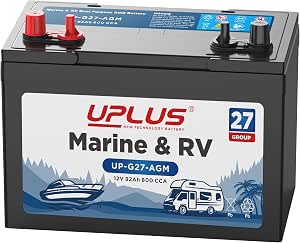
UPLUS BCI Group 27M Dual-Purpose AGM Marine Battery, 12V 92Ah 800CCA
I’d shortlist the UPLUS Group 27M when a boat needs one AGM battery for starting and onboard accessories, but the heaviest Group 27 option is a poor fit. It weighs 49 pounds, considerably less than the 70.5-pound Mighty Max MM-G27M, while still offering 800 CCA and 175 minutes of reserve capacity. The compromise is capacity: its 92Ah rating trails the Mighty Max’s 100Ah, so buyers running substantial accessory loads may prefer the extra reserve. Its sealed AGM construction and vibration-resistant design suit marine use, and the listing states compatibility with engines up to 350 hp. It remains a lead-acid battery, however, and 49 pounds is not truly lightweight. This is a more manageable dual-purpose AGM, not a substitute for the much lighter LiTime lithium option.
Pros:- 800 CCA supports engine starting.
- 92Ah capacity combines starter and deep-cycle functions in one battery.
- Weighs 49 pounds, substantially less than the Mighty Max MM-G27M.
- Sealed AGM construction is designed to resist marine vibration.
Cons:- Its 92Ah capacity is lower than the 100Ah Interstate and Mighty Max options.
- At 49 pounds, it is still heavy compared with LiFePO4 alternatives.
- Dual-purpose use may require load compromises during long accessory sessions.
Best for: Boat owners who want a Group 27M dual-purpose AGM with strong starting output and less weight than the Mighty Max.
Not ideal for: Boaters who need the highest capacity for long accessory sessions or want a genuinely lightweight battery.
- Battery type:AGM dual-purpose
- Voltage:12V
- Capacity:92Ah
- Cold cranking amps:800 CCA
- Reserve capacity:175 minutes
- Group size:BCI Group 27M
- Weight:49 lb
- Warranty:2 years
Our verdict“Pick the UPLUS if you want a comparatively easier-to-handle Group 27M AGM with starting power and moderate house capacity.”
LiTime 12V 165Ah Dual-Purpose LiFePO4 Marine Battery with Bluetooth and Self-Heating
This LiTime is the most capable all-in-one option here for boaters whose outboard is confirmed compatible and who want substantial house capacity as well as starting power. Its 165Ah capacity, 1200 CCA, and 2112Wh energy rating exceed the 100Ah AGM choices, while its 33.5-pound weight is far below the Interstate 100Ah AGM. Bluetooth monitoring gives a quick view of battery status, and automatic heating supports charging in cold conditions—an advantage over the smaller LiTime trolling-motor battery, which stops charging below 32°F. Compatibility limits are serious: it does not support LiveScope system chargers, unregulated outboards, MerCruiser engines, or inboard systems. I’d confirm the engine and charger match before buying; this is a premium fit-specific choice, not a universal marine replacement.
Pros:- 165Ah capacity and 2112Wh provide more energy than the 100Ah options.
- 1200 CCA and dual-purpose design combine starting with accessory power.
- Bluetooth 5.0 allows battery monitoring through the LiTime app.
- Self-heating supports cold-weather charging.
Cons:- Compatibility exclusions rule it out for several engine and charger setups.
- Discharge protection stops operation at -4°F.
- At 33.5 pounds, it is heavier than the LiTime 100Ah trolling-motor battery.
Best for: Owners of supported outboards who want high-capacity lithium power for starting and marine electronics, plus app monitoring and cold-weather heating.
Not ideal for: Owners of MerCruiser or inboard systems, unregulated outboards, or LiveScope fish finder system chargers.
- Battery chemistry:LiFePO4
- Voltage:12.8V
- Capacity:165Ah
- Energy:2112Wh
- Starting power:1200 CCA at 14°F; 1300 MCA at 32°F
- Group size:Group 31
- Weight:33.5 lb
- Cold-weather heating:Activates below 32°F and heats to 50°F
- Connectivity:Bluetooth 5.0
Our verdict“Choose this LiTime for high-capacity lithium starting and house power only after confirming your outboard and charging equipment are compatible.”
OPTIMA 34M BlueTop Sealed AGM Dual-Purpose Marine Battery
The OPTIMA 34M BlueTop is the starting-focused pick among these dual-purpose AGM batteries: its 800 CCA and 1,000 MCA give it more stated cranking power than the OPTIMA D34M, while its 50Ah capacity is lower than the Interstate 70Ah Group 24. That balance suits boaters who want confident engine starts and some reserve for onboard accessories, rather than a battery dedicated to long trolling-motor runs. Its spillproof, maintenance-free spiral-cell design also allows flexible mounting and is built to handle vibration. The tradeoff is limited capacity relative to higher-Ah options, plus a 38.4-pound package that still takes effort to install. I’d check the required group size and tray fit before choosing it.
Pros:- 800 CCA and 1,000 MCA provide the strongest listed cranking figures among the two OPTIMA models here.
- Dual-purpose design covers engine starting and moderate deep-cycle use.
- Spillproof construction permits mounting in a wide range of positions.
- Dual SAE and stainless-steel stud terminals offer connection flexibility.
Cons:- 50Ah capacity is lower than the Interstate 70Ah AGM, limiting accessory runtime.
- At 38.4 pounds, it is not a lightweight installation.
- Vehicle-specific fit means dimensions and terminal clearance need checking.
Best for: Boat owners who prioritize engine-cranking strength and need one AGM battery for starting plus moderate accessory use.
Not ideal for: Trolling-motor users who need longer deep-cycle runtime, or buyers whose battery tray requires a different group size or footprint.
- Battery type:Lead-acid AGM
- Voltage:12 volts
- Cold cranking amps:800 CCA
- Marine cranking amps:1,000 MCA
- Capacity:50Ah (C20)
- Reserve capacity:100 minutes
- Dimensions:10.06 × 6.88 × 7.94 inches
- Weight:38.4 pounds
Our verdict“Choose the 34M if starting output and flexible mounting matter more than maximizing deep-cycle capacity.”
Interstate Batteries Marine/RV AGM Battery, 12V, 70Ah, 750 CCA, Group 24
The Interstate Group 24 AGM makes a practical middle ground for boats that need both engine starts and power for lights, pumps, or other accessories. Its 70Ah capacity exceeds the 50Ah OPTIMA 34M and the 55Ah OPTIMA D34M, giving it more stated storage for onboard loads; the OPTIMA 34M, however, has higher cranking figures. Thick plates and pure-lead construction are intended to support repeated recharging, while the marine terminals suit a boat installation. At 44.6 pounds, it is the heaviest of those three AGM choices here, and its Group 24 vehicle-specific fit calls for a careful tray check. This is a sensible capacity-first AGM option, but not the strongest pick for buyers prioritizing maximum cranking output or lighter handling.
Pros:- 70Ah capacity exceeds both OPTIMA BlueTop options in this batch.
- Dual-purpose design supplies starting power and energy for accessories.
- Thick plates and pure-lead construction are designed for repeated recharging.
- Includes a two-year free-replacement warranty.
Cons:- At 44.6 pounds, it is heavy to lift and install.
- 750 CCA is below the OPTIMA 34M’s 800 CCA.
- Group 24 fit and marine-terminal layout must match the boat’s battery compartment and cables.
Best for: Boat owners who want a Group 24 AGM for engine starts and regular accessory use, with more capacity than the compact OPTIMA options.
Not ideal for: Boaters seeking a lightweight battery, high cranking figures, or a dedicated high-capacity trolling-motor battery.
- Battery type:Sealed lead-acid AGM
- Voltage:12V
- Capacity:70Ah
- Cold cranking amps:750 CCA
- Group size:24M
- Dimensions:6.81 × 11 × 8.98 inches
- Weight:44.6 pounds
- Warranty:2-year free replacement
Our verdict“Pick this Interstate when added AGM capacity for mixed boat use matters more than weight or the highest cranking output.”
OPTIMA D34M BlueTop Dual-Purpose AGM Battery for Boats and RVs
The OPTIMA D34M BlueTop trades some cranking output for more reserve than the 34M: it lists 120 minutes of reserve capacity and 55Ah, compared with the 34M’s 100 minutes and 50Ah. That makes it the better fit of the two for a boat that needs a little more time powering accessories between charges, while still retaining dual-purpose starting capability. Its spillproof spiral-cell AGM construction supports flexible mounting and is designed for vibration-heavy use. The limit is scale: 55Ah is still modest beside the 70Ah Interstate Group 24, and the D34M’s 750 CCA and 870 MCA trail the 34M’s figures. At 43.5 pounds, it also gives up some portability. I’d choose it for reserve over peak cranking power.
Pros:- 120-minute reserve capacity is higher than the OPTIMA 34M’s 100 minutes.
- Dual-purpose design supports starting and deep-cycle applications.
- Spillproof case allows flexible mounting positions.
- Dual SAE and stainless-steel stud terminals support different connection needs.
Cons:- 55Ah capacity remains below the Interstate Group 24 AGM’s 70Ah.
- 750 CCA and 870 MCA are lower than the OPTIMA 34M’s cranking figures.
- Weighs 43.5 pounds, making handling less convenient.
Best for: Boaters who want an AGM dual-purpose battery with more reserve than the OPTIMA 34M for moderate accessory loads.
Not ideal for: Owners who need the highest available starting output in this OPTIMA pair or substantially more capacity for extended trolling-motor use.
- Battery type:Sealed AGM lead-acid
- Voltage:12V
- Cold cranking amps:750 CCA
- Marine cranking amps:870 MCA
- Capacity:55Ah (C20)
- Reserve capacity:120 minutes
- Dimensions:10.06 × 6.88 × 7.94 inches
- Weight:43.5 pounds
Our verdict“Choose the D34M if you want more reserve than the 34M provides and can accept lower cranking output.”
LiTime 12.8V 100Ah Bluetooth LiFePO4 Trolling Motor Battery, 2-Pack
For a boat built around electric propulsion or substantial onboard loads, this LiTime two-pack offers a different kind of capacity from the AGM picks: two 100Ah LiFePO4 batteries provide 200Ah combined, with Bluetooth status checks and a stated cycle life above 4,000 deep cycles. Each weighs about 22.2 pounds, far less than the 44.6-pound Interstate Group 24 AGM, so handling two separate units can be easier than moving one heavy lead-acid battery. The tradeoff is a firm use boundary: these batteries are not intended for engine starting, so a boat needing cranking power requires a separate starting battery. Cold-temperature safeguards also stop charging below 32°F, and Bluetooth may need activation with a compatible charger or MPPT controller. This is a deep-cycle system, not an all-in-one replacement.
Pros:- Two 100Ah batteries provide 200Ah combined capacity.
- Bluetooth monitoring offers battery-status checks by phone.
- Each battery weighs about 22.2 pounds, substantially less than the Interstate Group 24 AGM.
- Low-temperature safeguards and IP65 dust and water resistance suit outdoor marine use.
Cons:- Not designed for engine starting, so a separate cranking battery may be needed.
- Charging is disabled below 32°F.
- Bluetooth monitoring may require activation with a lithium-compatible charger or MPPT controller.
Best for: Trolling-motor boaters and accessory-heavy users who want substantial LiFePO4 capacity, phone monitoring, and two separate batteries.
Not ideal for: Owners seeking a single dual-purpose battery for engine cranking, or those who regularly need to charge below freezing.
- Battery chemistry:LiFePO4
- Quantity:2 batteries
- Voltage:12.8V per battery
- Capacity:100Ah per battery
- Energy:1,280Wh per battery
- Weight:22.2 pounds per battery
- Cycle life:4,000+ deep cycles
- Low-temperature protection:Stops charging below 32°F and discharging below -4°F
Our verdict“Choose this two-pack for high-capacity trolling-motor and accessory loads, but pair it with a separate starting battery.”
SUPER EMPOWER 12.8V 100Ah LiFePO4 Deep Cycle Battery, Group 24
The SUPER EMPOWER Group 24 LiFePO4 is the single-battery alternative to LiTime’s two-pack: it supplies 100Ah and 1,280Wh in a 21.6-pound case sized for many Group 24 battery spaces. That makes it a more direct fit for boaters replacing one deep-cycle battery, while the LiTime set provides twice the stated capacity and Bluetooth monitoring. A 100A BMS and cold-temperature cutoffs add protection, but this battery is not for engine starting; keep a separate cranking battery in the system. Charging also requires a compatible lithium profile, and the built-in cutoff pauses charging below 32°F until temperatures rise above 41°F. Group 24 dimensions help with fit, though they do not guarantee compatibility with every tray, cable, or marine system.
Pros:- 100Ah capacity and 1,280Wh energy in a 21.6-pound battery.
- Group 24 dimensions are designed to suit many standard battery spaces.
- 100A BMS provides electrical and temperature protection.
- Supports system expansion up to 4S4P.
Cons:- Not suitable for engine starting or cranking.
- Charging stops below 32°F and resumes only above 41°F.
- Requires a compatible LiFePO4 charger or controller.
Best for: Boat owners replacing a single Group 24 deep-cycle battery who want a lighter lithium option for trolling motors or onboard loads.
Not ideal for: Boaters who need engine cranking from the same battery, require two-battery capacity, or cannot use a lithium-compatible charging system.
- Battery chemistry:LiFePO4
- Voltage:12.8V
- Capacity:100Ah
- Energy capacity:1,280Wh
- Group size:BCI Group 24
- Dimensions:6.49 × 10.24 × 8.98 inches
- Weight:21.6 pounds
- Low-temperature charging cutoff:32°F; resumes above 41°F
Our verdict“Choose this single Group 24 lithium battery for lighter deep-cycle service, but not as a cranking battery or a two-battery system.”
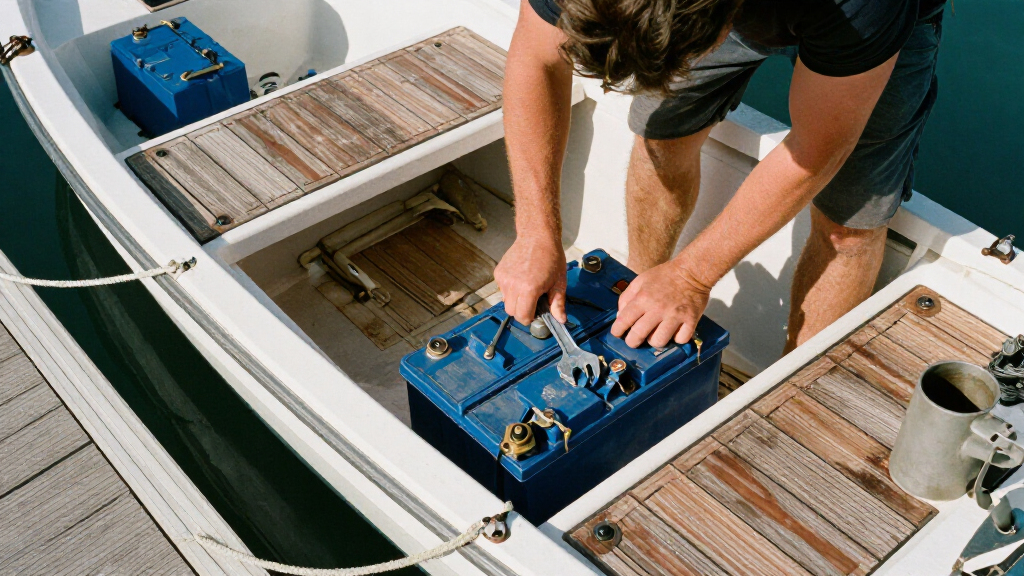
How We Picked
I compared these marine boat batteries by the job they are designed to do: start an engine, supply steady deep-cycle power, or handle both roles. Capacity, stated cold-cranking amps, battery chemistry, group size, and listed features such as Bluetooth or self-heating shaped the comparison. I treated stated specifications as fit indicators, not proof that any battery will work with every boat or charging system.
The ranking favors useful versatility and a clear match to common marine setups, then separates options by their strongest use case. That puts the Interstate 100Ah AGM Group 31 first as a broadly applicable option, while specialized lithium picks rank higher for buyers whose needs match their design. I also weighed practical drawbacks: AGM’s weight and capacity limits, lithium charging requirements, and the risk of choosing a group size or starting rating that does not match the boat. A battery should not be ranked highly for a buyer whose engine, charger, tray, or electrical demands are incompatible with it.
| marine boat batterie | Battery type |
|---|---|
| Interstate Batteries Marine/RV | Lead-acid AGM |
| UPLUS Group 24M Dual-Purpose A | AGM dual-purpose marine |
| Newport 12V 50Ah Deep Cycle AG | Lead-acid AGM |
| SUPER EMPOWER 12.8V 100Ah LiFe | — |
| Interstate Batteries Marine/RV | AGM lead-acid |
| Interstate Batteries Marine/RV | Sealed lead-acid AGM |
| LiTime 12V 100Ah Group 31 LiFe | — |
| Mighty Max Battery MM-G27M 12V | Lead-acid AGM |
| UPLUS BCI Group 27M Dual-Purpo | AGM dual-purpose |
| LiTime 12V 165Ah Dual-Purpose | — |
| OPTIMA 34M BlueTop Sealed AGM | Lead-acid AGM |
| Interstate Batteries Marine/RV | Sealed lead-acid AGM |
| OPTIMA D34M BlueTop Dual-Purpo | Sealed AGM lead-acid |
| LiTime 12.8V 100Ah Bluetooth L | — |
| SUPER EMPOWER 12.8V 100Ah LiFe | — |
Factors to Consider When Choosing Marine Boat Batteries
Before choosing from this lineup, I would work outward from the boat’s electrical system rather than starting with a battery brand. The right battery has to fit the physical space, meet engine-starting demands if applicable, and work with the charging equipment already aboard. These broader checks can prevent a capable battery from becoming an expensive mismatch.
Separate Starting Power From House Loads
An engine starter needs a short burst of high current, while lights, electronics, and a trolling motor draw power over longer periods. A dual-purpose battery can cover both jobs, but combining them may leave less reserve for overnight or extended use. Start by listing which devices run while the engine is off and how long they typically operate. Check the engine maker’s starting requirement against the battery’s stated CCA rather than assuming a high amp-hour figure covers starting. For boats with substantial house loads, separate starting and deep-cycle batteries can protect engine-starting reserve. The tradeoff is added weight, wiring, and space, so a single dual-purpose battery may still suit a simpler setup.
Match Capacity to Real Runtime
Amp-hour capacity gives a useful comparison, but it does not directly tell you how long every boat can run. Actual runtime changes with current draw, temperature, battery age, and how deeply the battery can be discharged. Estimate the daily load by adding each device’s draw multiplied by its hours of use, then add a reserve for conditions that are harder than expected. Avoid choosing a battery solely because its Ah number is larger; a higher-capacity case may not fit, and the charging system must be able to replenish it. Lithium batteries often provide a different usable-capacity profile than AGM, so compare manufacturer guidance for the exact model and chemistry. If your load estimate is uncertain, reducing simultaneous loads can be a safer first step than buying capacity blindly.
Check Chemistry Against Your Charger
AGM and LiFePO4 batteries can call for different charging profiles, so a charger that works with one chemistry may not be suitable for the other. Before switching to lithium, check the onboard charger, alternator setup, and any solar controller for explicit compatibility with the battery’s charging requirements. A battery’s built-in protection features do not make an incompatible charging system compatible. Cold-weather behavior also differs; some lithium models list self-heating, but buyers still need to follow the maker’s temperature and charging instructions. Keeping AGM may be the simpler route when existing equipment is fixed or difficult to replace. Paying more for lithium makes more sense when its weight and usable energy advantages justify the system changes.
Verify Group Size, Terminals, and Installation
Group numbers describe a general case-size class, not a guarantee that every battery will fit your tray or connect to your cables. Measure the available length, width, and height, including clearance for terminals, lids, and hold-down hardware. Compare terminal locations and polarity with the existing battery before ordering, since short cables can make a physically fitting battery unusable. Also check the battery’s weight against the mount and the boat’s placement requirements. A larger group may offer more capacity, but forcing it into a tight compartment can compromise restraint and access. Confirm the specific model dimensions and installation guidance rather than relying on the group label alone.
Decide Whether One Battery Should Do Both Jobs
A dual-purpose battery reduces the number of batteries and can simplify a small boat’s layout, but it also makes engine starting and house loads compete for the same reserve. If electronics or a trolling motor run for long stretches, separating those loads can reduce the chance of draining the starting battery. A dedicated deep-cycle battery may be a better match for repeated discharge, while a starting battery should be selected around the engine’s requirements. Battery switches and charging arrangements add complexity, so the best layout depends on how the boat is used and maintained. Frequent short trips, long days at anchor, and trolling-heavy outings create different demands. Choose the simplest setup that still preserves enough starting reserve for your normal use.
Plan for Charging, Storage, and Maintenance
Battery ownership includes more than installation: charging habits and off-season storage affect reliability and service life. Follow the model’s charging instructions, keep connections clean and secure, and inspect the case and mounting hardware as part of routine checks. AGM batteries are sealed, but that does not remove the need for correct charging and safe ventilation practices specified by the manufacturer. Lithium batteries may offer lower weight and app-based monitoring on some models, yet their electronics and charging limits call for careful setup. If the boat sits unused for long periods, ask how the selected battery should be stored and whether it needs a maintenance charge. A battery that fits the budget but clashes with your storage routine can be a poor long-term match.
Frequently Asked Questions
Can I replace my boat’s AGM battery with a LiFePO4 battery?
Possibly, but matching voltage and group size alone is not enough. Check whether the onboard charger, alternator, and any solar controller support the LiFePO4 battery’s required charging profile. Confirm that the battery’s starting capability suits the engine if it will serve as a starting battery, since many lithium models are aimed at deep-cycle use. Also verify dimensions, terminal placement, and temperature limits for the exact model. If the charging system cannot be adapted, staying with AGM may be the more dependable choice.
Should I choose a dual-purpose battery or separate starting and deep-cycle batteries?
A dual-purpose model can simplify a smaller boat when starting and onboard loads are moderate. Separate batteries make more sense when a trolling motor or electronics run for long periods, because house loads are less likely to drain the battery reserved for starting. The split setup takes more space and calls for suitable wiring and charging arrangements. Compare your engine’s required starting current with your expected house-load use before deciding. If losing engine-starting reserve would create a safety concern, separation is often worth the added system complexity.
Does a Group 31 battery always provide more useful power than a Group 24?
Not automatically. Group size points to a general physical size, while the battery’s stated capacity, chemistry, and intended role determine its electrical fit. A Group 31 may offer more capacity in some models, but it can be too large or heavy for a Group 24 tray and may not match the boat’s hold-downs or cables. Compare each battery’s specifications rather than treating the group number as a performance rating. Measure the compartment and check terminal layout before choosing a different group size.
How much battery capacity do I need for a trolling motor?
Estimate the motor’s draw at the speeds you use and multiply that by expected operating time, then include capacity for other devices and a reserve. Maximum draw is not always the motor’s typical draw, so use manufacturer data and realistic trip habits rather than guessing from the highest setting alone. Battery chemistry also affects usable capacity and charging needs, making equal Ah figures an incomplete comparison. Check the trolling motor maker’s voltage and battery guidance, especially if considering a lithium model. If long operating time matters, a dedicated deep-cycle battery is often easier to size than a shared starting battery.
Can a dual-purpose AGM battery power both my engine and electronics overnight?
It may, but the answer depends on the electronics’ total draw, the battery’s capacity, the engine’s starting needs, and how much reserve you want at daybreak. Add the expected load across the full overnight period and compare it with the battery’s usable capacity guidance, not just its nominal Ah rating. Leaving little reserve can make a successful night at anchor an unreliable plan for restarting the engine. A separate house battery can reduce that risk on boats with heavier overnight loads. The UPLUS and other dual-purpose options in this roundup are candidates for combined use, not a substitute for sizing the system around your actual loads.
Conclusion
For the best overall fit, I would start with the Interstate Marine/RV 12V 100Ah AGM Group 31 if its size matches your tray and you want a broadly useful AGM option. For a value-minded buyer comparing familiar AGM formats, the Mighty Max MM-G27M 100Ah is a dual-purpose alternative, while the UPLUS Group 24M is a more compact choice with stated starting output. Beginners who want to keep a conventional charging setup should look first at AGM and confirm group size before buying. For a premium lithium setup with longer-runtime features, the LiTime 165Ah Dual-Purpose LiFePO4 is aimed at buyers who can support its charging requirements; for trolling-motor use, the LiTime 100Ah Group 31 is the more focused pick. Choose the SUPER EMPOWER two-pack when a matched pair suits your system, and choose the Newport 50Ah when loads are modest and a smaller deep-cycle battery fits the job. Before ordering, I would verify charger compatibility, engine starting requirements, terminal layout, and compartment measurements against the exact model.
Black Friday Picks

KitchenAid Classic Series 4.5-Quart Tilt-Head Stand Mixer, Onyx Black
As an affiliate, we earn on qualifying purchases.