A marine VHF base station kit is a fixed-mount radio setup for boaters who want dependable ship-to-ship and ship-to-shore communication, rather than a portable handheld. My three picks suit different priorities: the Standard Horizon GX1850 leads for waterproofing and marine-network connectivity; the Uniden UM385BK is my value-oriented choice for weather alerts and broad channel support; and the Standard Horizon GX1410B makes a strong case for straightforward controls and Class D DSC.

Get sports gear delivered free with Prime
- Fast, free delivery on millions of items
- Prime Video, Amazon Music and more included
- Member-only deals all year
The main tradeoff is not simply range: installation, antenna placement, GPS connection, network compatibility, and water resistance shape how useful a fixed radio will be aboard your boat. These are radios, not complete antenna-and-cable bundles, so I would confirm what installation hardware is included before treating any one as a full kit. I rank the GX1850 first for its IPX8 rating and dual NMEA support, while the Uniden offers a wider channel set and local weather alerts. The GX1410B provides a clear, capable alternative, but still needs GPS input for position details in distress calls.
Complete the kit


Key Takeaways
- The Standard Horizon GX1850 is the strongest match for boats with NMEA 2000 or NMEA 0183 electronics and a priority on IPX8-rated water protection.
- The Uniden UM385BK combines 25-watt output, 40 channels, triple watch, Class D DSC, and S.A.M.E. weather alerts, but full DSC position reporting needs an external GPS receiver.
- The Standard Horizon GX1410B pairs Class D DSC with microphone controls and an adjustable display; connect GPS if you want location and time included in distress transmissions.
- All three are fixed-mount radios, so none replaces a handheld VHF or avoids the work of mounting, wiring, and fitting a suitable antenna.
- Treat advertised maximum range as a best-case figure: antenna height, installation, terrain, and operating conditions matter more than a headline range number.
| Standard Horizon GX1850 Fixed Mount VHF Radio |  | Best Overall for Networked Boats | Model: GX1850B | Radio type: Fixed-mount marine VHF | Water resistance: IPX8 | VIEW ON AMAZON | See Our Full Breakdown |
| Uniden UM385BK 25 Watt Fixed Mount Marine VHF Radio |  | Best Value for Weather Alerts and Channel Coverage | Model: UM385BK | Transmit power: 25 watts | Water resistance: IPX4 | VIEW ON AMAZON | See Our Full Breakdown |
| Standard Horizon GX1410B Eclipse Series 25W Fixed-Mount VHF Radio, Black |  | Best for Straightforward Controls and Class D DSC | Model: GX1410B | Transmit power: 25 watts | DSC: Class D, ITU-R M493-16; separate Channel 70 receiver | VIEW ON AMAZON | See Our Full Breakdown |
| marine vhf base station kit | Model | Water resistance | Maximum talking range listed | Weight |
|---|---|---|---|---|
| Standard Horizon GX1850 Fixed | GX1850B | IPX8 | 36 miles | 16 ounces |
| Uniden UM385BK 25 Watt Fixed M | UM385BK | IPX4 | 25 miles | 3.3 pounds |
| Standard Horizon GX1410B Eclip | GX1410B | IPX8, specified to 15 meters for 30 minutes | 30 miles | 5 pounds |
More Details on Our Top Picks
Standard Horizon GX1850 Fixed Mount VHF Radio
I rank the GX1850 first for boat owners who want a fixed VHF that can fit into a wider marine-electronics setup. Its support for both NMEA 2000 and NMEA 0183 gives it a more flexible connection profile than the Uniden UM385BK, whose listed connectivity is NMEA 0183. That difference matters when a boat already has a network and the owner wants to check compatibility before adding another device.
The other standout is its IPX8 waterproof rating, which is stronger on paper than the Uniden’s IPX4 splash-resistance rating. The GX1410B also carries an IPX8 rating, so the GX1850 does not win by water protection alone. Its edge is the combination of that rating, lightweight listed weight, and dual-protocol integration. Its stated maximum range is 36 miles, but I would not choose it based on that number alone: VHF range depends heavily on antenna height and installation.
There are limits. The product details list 16 channels, fewer than the Uniden’s 40 and the GX1410B’s 25, so channel count is not its strongest selling point. Remote operation also calls for compatible accessories, rather than being an automatic benefit of the radio alone. I would choose this model when network fit and water protection rank ahead of channel breadth; for weather alerts or a more expansive listed channel set, the Uniden is the better match.
Pros:- IPX8 waterproof rating for greater water exposure tolerance than the Uniden UM385BK’s IPX4 rating.
- Supports both NMEA 2000 and NMEA 0183 marine electronics connections.
- Compact, lightweight listed design at 16 ounces.
- Compatible with specified remote-access microphone accessories.
Cons:- The listed 16 channels are fewer than the 25 on the GX1410B and 40 on the Uniden.
- Remote functionality depends on compatible microphones or accessories.
- The stated maximum range is not a dependable prediction of real-world coverage.
Best for: Boat owners who want IPX8 water resistance and NMEA 2000 or NMEA 0183 connectivity in a compact fixed-mount radio.
Not ideal for: Buyers who need the broadest listed channel count, built-in local weather alert features, or remote microphone functionality without adding compatible accessories.
- Model:GX1850B
- Radio type:Fixed-mount marine VHF
- Water resistance:IPX8
- Channels listed:16
- Maximum talking range listed:36 miles
- Connectivity:NMEA 2000 and NMEA 0183
- Weight:16 ounces
- Compatible devices:CT-100, SSM-70H, RAM4 wired remote access microphone
Our verdict“I would choose the GX1850 for a networked boat where IPX8 protection and dual NMEA connectivity matter more than channel count or built-in weather alerts.”
Uniden UM385BK 25 Watt Fixed Mount Marine VHF Radio
The Uniden UM385BK is my pick for boaters who want useful safety and weather features without making network integration their main priority. Its listed 40 channels exceed both Standard Horizon models in this comparison, and its S.A.M.E. Weather Alert feature is a clear differentiator. For a recreational boater who wants local weather messages alongside marine communication, those features may be more useful than the GX1850’s NMEA 2000 support.
It also includes Class D DSC with a dedicated distress button, plus triple watch and support for USA, International, and Canadian marine channels. Those capabilities give it a broad practical role, while its 25-watt output matches the GX1410B’s stated transmit power. The radio’s IPX4 rating, however, only indicates resistance to splashes and rain; it does not match the IPX8 ratings listed for either Standard Horizon. I would not pick it for an installation where submersion protection is the leading concern.
The main setup caveat is GPS for position reporting. The radio can support DSC, but full position details in a distress call require an external GPS receiver; the product information names compatibility with the Uniden MRN-GPSK. The GX1410B has a similar GPS dependency, while the GX1850’s supplied details emphasize network protocols instead. The UM385BK is also fixed-mount and needs permanent installation, so it is not a portable backup radio. Its strongest case is feature breadth, weather alerts, and channel support—not maximum water protection.
Pros:- S.A.M.E. Weather Alert helps identify local weather messages.
- Class D DSC includes a dedicated distress button.
- Supports 40 channels and USA, International, and Canadian channel sets.
- Triple watch and NMEA 0183 connectivity add practical functions.
Cons:- IPX4 protection is less suited to heavy water exposure than the IPX8-rated Standard Horizon models.
- Full DSC position reporting requires an external GPS receiver.
- Fixed installation means it is not a portable radio for use away from the boat.
Best for: Recreational boaters who want S.A.M.E. local weather alerts, triple watch, broad channel support, and a 25-watt fixed radio.
Not ideal for: Owners who need an IPX8-rated radio, want NMEA 2000 support, or expect DSC position reporting without adding a GPS source.
- Model:UM385BK
- Transmit power:25 watts
- Water resistance:IPX4
- Channels:40
- Maximum talking range listed:25 miles
- Voltage:12 volts
- Connectivity:DSC and NMEA 0183
- Dimensions:5 x 6.3 x 2.6 inches
- Weight:3.3 pounds
Our verdict“I would pick the UM385BK when weather alerts and channel breadth outweigh the GX1850’s network support and stronger water-resistance rating.”
Standard Horizon GX1410B Eclipse Series 25W Fixed-Mount VHF Radio, Black
The GX1410B is a good fit for buyers who want a compact fixed radio with an emphasis on accessible controls and distress-call capability. Its Class D DSC and separate Channel 70 receiver distinguish its listed safety setup, while microphone controls and an adjustable bright backlight make the interface a key part of its appeal. Compared with the Uniden UM385BK, it gives up S.A.M.E. weather alerts and a larger channel count, but it offers IPX8 water resistance like the GX1850.
Its product details specify IPX8 submersion protection up to 15 meters for 30 minutes, a useful distinction for buyers comparing the Uniden’s IPX4 rating. The stated maximum range is 30 miles, between the GX1850’s 36-mile figure and the Uniden’s 25-mile figure. These are maximum claims rather than guaranteed boat-to-boat distances, so I would put more weight on a suitable antenna, placement, and installation than on the difference between those numbers.
The GX1410B lands third because its strengths are focused rather than broad: it does not list the GX1850’s NMEA 2000 connectivity or the Uniden’s S.A.M.E. alert feature. It also needs a GPS connection to include latitude, longitude, and time in a distress transmission. Like the other picks, it is fixed-mount and requires boat installation. I would choose it over the Uniden when IPX8 protection and its control layout matter more than local weather alerts, but select the GX1850 if network integration is a priority.
Pros:- Class D DSC with a separate Channel 70 receiver.
- IPX8 rating specified for submersion up to 15 meters for 30 minutes.
- High-resolution display has an adjustable bright backlight.
- Menu and microphone controls support straightforward operation.
Cons:- GPS is required to include coordinates and time in a distress transmission.
- No NMEA 2000 support is listed, unlike the GX1850.
- Fixed-mount installation limits use away from the boat.
Best for: Boaters who want an IPX8-rated fixed VHF with Class D DSC, a separate Channel 70 receiver, and microphone-based controls.
Not ideal for: Buyers who need NMEA 2000 connectivity, S.A.M.E. weather alerts, or DSC location reporting without a connected GPS source.
- Model:GX1410B
- Transmit power:25 watts
- DSC:Class D, ITU-R M493-16; separate Channel 70 receiver
- Water resistance:IPX8, specified to 15 meters for 30 minutes
- Channels:25
- Maximum talking range listed:30 miles
- Voltage:13.8 V DC
- Weight:5 pounds
- Included components:VHF radio, microphone, mounting bracket, user manual
Our verdict“I would choose the GX1410B for its controls, display, and IPX8 protection, but the GX1850 is a stronger fit for networked electronics.”
How We Picked
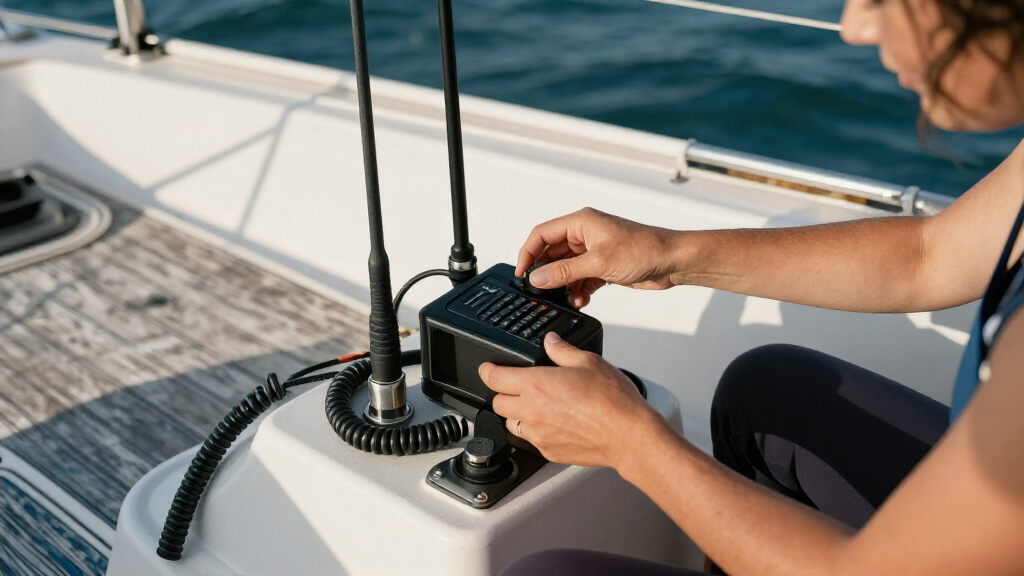
I compared these three products as fixed-mount marine VHF radio options, not as interchangeable handhelds or complete, ready-to-install antenna kits. I gave the most weight to safety communication features, water resistance, channel support, and the practical connections a boat may need. Those details influence whether a radio fits the vessel’s existing electronics and whether a buyer can use its emergency functions as intended.
I also looked at differences that affect day-to-day ownership. The Uniden’s 40-channel support and S.A.M.E. alerts give it a specific weather-and-channel advantage. The GX1850 stands out for its IPX8 rating and NMEA 2000/NMEA 0183 connectivity. The GX1410B earns its place with a distinct control layout, display, and Class D DSC. I did not treat claimed maximum range as a guarantee; VHF performance depends on antenna position and conditions.
The ranking reflects fit rather than a claim that one radio suits every boat. I put the GX1850 first for buyers who value water resistance and integration, the Uniden next for broader channel coverage and weather alerts, and the GX1410B as a focused alternative for buyers who prefer its controls and display. I also flag GPS and accessory requirements, since a radio’s emergency and remote features can depend on equipment beyond the radio itself.
| marine vhf base station kit | Model | Water resistance | Connectivity |
|---|---|---|---|
| Standard Horizon GX1850 Fixed | GX1850B | IPX8 | NMEA 2000 and NMEA 0183 |
| Uniden UM385BK 25 Watt Fixed M | UM385BK | IPX4 | DSC and NMEA 0183 |
| Standard Horizon GX1410B Eclip | GX1410B | IPX8, specified to 15 meters for 30 minutes | — |
Factors to Consider When Choosing Marine Vhf Base Station Kit
For a fixed VHF, I would choose around the boat and the radio’s connections—not just its stated range. Before deciding, check how the unit will be mounted, what antenna and cabling your setup needs, whether GPS is available for DSC, and which marine-electronics protocols your vessel uses.
Treat a base radio and a complete kit as different things
These products are fixed-mount radios; that does not automatically mean the box contains every part needed for a complete communications installation. The GX1410B listing names a radio, microphone, mounting bracket, and manual, while the information supplied for the other models does not establish a full antenna-and-cable bundle. I would check the included parts and installation requirements before ordering. A fixed radio also needs a suitable antenna and a place to mount it, so account for wiring access and antenna position rather than assuming the radio alone provides a finished setup.
Match water resistance to the mounting location
The UM385BK carries an IPX4 rating, described as protection from rain and splashing. The GX1850 and GX1410B list IPX8; the GX1410B’s details specify submersion up to 15 meters for 30 minutes. That makes the Standard Horizon pair more compelling for a location where substantial water exposure is a concern. Still, a water-resistance rating does not replace correct installation or care. If your radio is mounted in a sheltered cabin, the Uniden’s weather-alert and channel features may matter more than the rating difference.
Plan for DSC and GPS before an emergency
DSC can send a digital distress call, but the usefulness of the position information depends on a GPS source being connected and configured. The Uniden states that full DSC position reporting needs an external GPS receiver, and the GX1410B needs GPS to include latitude, longitude, and time with a distress transmission. I would check your current chartplotter or GPS outputs and confirm compatibility before purchase. Do not assume that a distress button alone means your coordinates will be transmitted automatically.
Choose network support for the boat you have
The GX1850 supports both NMEA 2000 and NMEA 0183, giving it the clearest fit for buyers checking network integration across this group. The UM385BK lists NMEA 0183, while the GX1410B’s supplied details do not list either connection protocol. Check the exact connections on your existing electronics and the radio documentation; a protocol name alone does not confirm that every device will share the data you want. If you do not need a network connection, the Uniden’s weather alerts or the GX1410B’s interface may carry more weight.
Use range claims carefully
The listed maximum range figures are 36 miles for the GX1850, 30 miles for the GX1410B, and 25 miles for the UM385BK. I treat these as maximum claims, not promises of everyday coverage. VHF communication is affected by antenna height and placement, the other station’s antenna, obstructions, and conditions. A well-positioned antenna and sound installation can matter more than small differences in product-page range figures. For safety planning, keep a separate handheld or other backup method if your boating demands one.
Compare channel and alert needs
For channel breadth, the Uniden lists 40 channels, ahead of the GX1410B’s 25 and the GX1850’s 16. It also adds S.A.M.E. Weather Alert and triple watch, making it the most clearly specified choice for those functions. The Standard Horizon models have other strengths: the GX1850’s network compatibility and the GX1410B’s display and control approach. I would decide which functions you will use and verify channel requirements for your area rather than treating the largest count as an automatic win.
Frequently Asked Questions
Is a marine VHF base station kit the same as a handheld VHF radio?
No. These three options are fixed-mount radios intended for installation on a boat, while a handheld is portable and can be carried away from its charging base. A fixed radio is built around a boat installation and a suitable antenna, so it is not a substitute for a portable backup. Check what accessories are included before assuming a product is a complete kit.
Which of these radios has the strongest listed water resistance?
The Standard Horizon GX1850 and GX1410B both list IPX8 water resistance. The GX1410B details specify submersion up to 15 meters for 30 minutes. The Uniden UM385BK is rated IPX4 for rain and splashing, so I would favor either Standard Horizon model when water exposure is a leading concern. Ratings do not remove the need for careful mounting and installation.
Do I need GPS for DSC distress calls?
For a distress call to include your location, the radio needs access to a GPS position. The UM385BK requires an external GPS receiver for full DSC position reporting, and the GX1410B needs GPS to add latitude, longitude, and time to a distress transmission. Before buying, check whether your boat’s existing GPS or chartplotter can provide compatible data, then confirm the connection and setup instructions for the radio.
Which model makes the most sense for a boat with NMEA 2000 electronics?
The GX1850 is the clearest match in this comparison because its listed connectivity includes both NMEA 2000 and NMEA 0183. The UM385BK lists NMEA 0183, and the supplied GX1410B details do not specify NMEA connectivity. I would still verify the exact devices and data-sharing needs before purchase, since a shared protocol does not by itself confirm every desired function will work.
Can I rely on the advertised maximum talking range?
No listed maximum should be treated as a guaranteed operating distance. VHF performance depends on antenna height, placement, installation quality, obstructions, and the receiving station’s setup. The GX1850 lists 36 miles, the GX1410B 30 miles, and the UM385BK 25 miles, but those figures are not enough by themselves to predict coverage on a particular boat. I would prioritize antenna installation and treat range claims as a rough comparison point.
Conclusion
For a boat with compatible marine electronics, I would start with the Standard Horizon GX1850: its IPX8 rating and NMEA 2000/NMEA 0183 support make it the most adaptable pick here. Choose the Uniden UM385BK if local weather alerts, triple watch, and a wider listed channel set fit your priorities better than submersion-rated protection. The GX1410B is the better fit for buyers who value its display, microphone controls, and Class D DSC with a separate Channel 70 receiver. Whichever you choose, confirm antenna and wiring needs, check GPS compatibility for DSC position reporting, and remember that none of these fixed radios is a portable backup.