Choosing a marine LED searchlight means balancing beam reach, aiming control, power draw, and how you will operate it from the helm. My strongest picks split into distinct uses: the ACR RCL-95 for its stated 4,501-foot maximum beam distance and dual controls, the ACR RCL-100 for rugged aluminum construction and 360-degree rotation, and the SEAFLO 360° 28W for broad voltage compatibility and a long-range wireless remote.

Get sports gear delivered free with Prime
- Fast, free delivery on millions of items
- Prime Video, Amazon Music and more included
- Member-only deals all year
Those strengths are not interchangeable. The RCL-95 has the strongest stated reach, but needs 12-volt power; the RCL-100 trades the RCL-95’s listed intensity for a weatherproof wired control system and marine-minded metal housing. The SEAFLO models give buyers flexible movement and remote operation, while the RCL-85 favors a concentrated beam and high candela output. I rank these options by how clearly their specifications serve practical boat-searchlight needs, while calling out limits such as narrow beam spread, mounting uncertainty, and power requirements.
Complete the kit

Key Takeaways
- ACR RCL-95: Choose it for the longest stated beam distance, 135-degree tilt, and the choice of handheld wireless or wired dash controls.
- ACR RCL-100: Its die-cast aluminum housing and 360-degree continuous rotation make it the most marine-focused construction pick, though the remote is wired.
- SEAFLO 28W: Its 10–30V DC input and remote range up to 164 feet suit boats that need flexible power compatibility and stand-off control.
- ACR RCL-85: Its 240,000-candela output and 90-degree tilt suit buyers who want a concentrated search beam, but its 8-degree beam is narrow.
- SEAFLO 25W: Its 75-degree sweep, IP65 rating, and broad 10–30V input make it the more compact SEAFLO alternative, but check the exact installation and supply requirements.
| ACR RCL-95 LED Searchlight |  | Best Overall for Maximum Stated Reach and Control Choice | Intensity: 460,000 candela | Maximum beam distance: 4,501 feet (1,372 m) | Movement: 360° continuous rotation; 135° tilt | VIEW ON AMAZON | See Our Full Breakdown |
| ACR RCL-100 LED Marine Searchlight with Wired Remote | 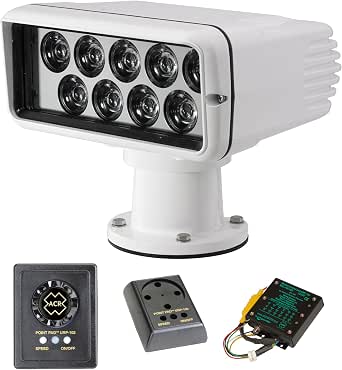 | Best for Marine-Ready Housing and Continuous Rotation | Intensity: 200,000 candela | LED array: 9 LEDs | Movement: 360° continuous rotation | VIEW ON AMAZON | See Our Full Breakdown |
| SEAFLO 360° Rotating LED Marine Searchlight with Wireless Remote |  | Best for Flexible Voltage and Long-Range Wireless Control | Power: 28W; 2.8A | Brightness: Up to 2,700 lumens | Beam distance: 984–1,312 feet (300–400 m) | VIEW ON AMAZON | See Our Full Breakdown |
| ACR RCL-85 LED Searchlight |  | Best for a Concentrated High-Intensity Beam | LEDs: Six 30-watt LEDs | Intensity: 240,000 candela | Visibility range: More than 0.5 nautical mile | VIEW ON AMAZON | See Our Full Breakdown |
| SEAFLO 360° Rotating Remote Control LED Marine Searchlight – 25W, 2000 Lumens, 1968 ft Beam Distance, IP65 Waterproof, Suitable for Trucks, Vehicles, Boats, CE & RoHS Certified |  | Best for Cross-Vehicle Use and Broad Sweep | Power: 25W | Brightness: 2,000 lumens | Beam distance: 1,968 feet | VIEW ON AMAZON | See Our Full Breakdown |
| marine searchlight led | Movement | Power | Intensity | Weight |
|---|---|---|---|---|
| ACR RCL-95 LED Searchlight | 360° continuous rotation; 135° tilt | 12 volts; 50 watts | 460,000 candela | 4.2 pounds |
| ACR RCL-100 LED Marine Searchl | 360° continuous rotation | 12V or 24V DC | 200,000 candela | 7.2 pounds |
| SEAFLO 360° Rotating LED Marin | 360° horizontal rotation; 60° vertical tilt | 28W; 2.8A | — | — |
| ACR RCL-85 LED Searchlight | — | — | 240,000 candela | — |
| SEAFLO 360° Rotating Remote Co | 360° horizontal rotation | 25W | — | 5.5 pounds |
More Details on Our Top Picks
ACR RCL-95 LED Searchlight
The ACR RCL-95 earns my top position because it combines the most ambitious stated beam distance in this group with genuinely useful aiming options. Its listed maximum reach of 4,501 feet and 460,000-candela intensity put it ahead of the other products on the supplied output figures. It also turns continuously through 360 degrees and tilts 135 degrees, giving an operator more vertical coverage than the RCL-85’s 90-degree tilt or either SEAFLO model’s listed sweep.
Control flexibility is another separator: the RCL-95 includes both a wireless handheld remote and a wired dash joystick. That gives a buyer a mobile control option alongside a fixed helm control, unlike the wireless-only SEAFLO units or wired-only RCL-100. Its 12-volt requirement is more restrictive than the 10–30V input on the SEAFLO lights and the 12–24V support on the RCL-85 and RCL-100. The stated waterproof design and 4.2-pound weight are useful, but I would still confirm mounting strength and installation details for the intended boat.
The main caveat is that maximum beam distance alone does not tell you the usable width of the beam or how it performs in weather, spray, or haze. The RCL-85 also lists high candela and is a plausible alternative when its simpler control setup meets the need. I would pick the RCL-95 when range and helm flexibility lead the decision, not simply because its number is largest.
Pros:- Highest stated maximum beam distance in this comparison at 4,501 feet
- 360-degree continuous rotation and 135-degree tilt
- Includes wireless handheld and wired dash joystick controls
- Waterproof design and compatibility with several vehicle types
Cons:- Requires a 12-volt power supply
- Maximum range does not specify beam width or guarantee visibility in operating conditions
- Its 4.2-pound weight calls for a suitable mounting setup
Best for: Boat owners who want the longest stated beam distance in this group, broad tilt, and both handheld and helm-based control.
Not ideal for: Buyers who need a 24-volt-compatible unit or want a smaller, simpler fixture with minimal installation work.
- Intensity:460,000 candela
- Maximum beam distance:4,501 feet (1,372 m)
- Movement:360° continuous rotation; 135° tilt
- Controls:Wireless handheld remote and wired dash joystick
- Power:12 volts; 50 watts
- Weight:4.2 pounds
- Water protection:Waterproof design
- Dimensions:5.9 × 7.1 × 7.5 inches
Our verdict“I recommend the RCL-95 for buyers who put stated reach and two control options ahead of flexible voltage compatibility.”
ACR RCL-100 LED Marine Searchlight with Wired Remote
Where the RCL-95 leads with range and control choice, the ACR RCL-100 makes a stronger case through its stated construction. Its die-cast aluminum housing is triple-primed and UV-stabilized, details that matter for a fixture expected to live in sun and marine exposure. It supports 12V or 24V DC, so it is easier to match to more boat electrical systems than the RCL-95, which is listed for 12 volts only.
The RCL-100’s 200,000-candela, nine-LED array and 360-degree continuous rotation make it a capable all-around searchlight on paper. Its stated 40,000-hour performance life offers a useful comparison point, though that figure is not a promise of full-fixture service life under every installation. Compared with the RCL-85, it gives up the higher listed candela figure and wireless handheld control; compared with the SEAFLO 28W, it gives up remote range convenience but gains the more explicitly marine-focused metal housing.
The tradeoff is a wired weatherproof remote, which means the installation needs a route for its cable and the control is less portable than the wireless options. The product is also specifically presented for boat and marine use, so buyers looking for a light to move among vehicles may prefer the RCL-95 or SEAFLO 25W. I would choose this model when durable housing and dual-voltage support outweigh wireless convenience.
Pros:- Die-cast aluminum housing is triple-primed and UV-stabilized
- 360-degree continuous rotation
- Supports both 12V and 24V DC systems
- Weatherproof wired remote and stated 40,000-hour performance life
Cons:- Remote is wired rather than wireless
- Listed intensity is lower than the RCL-85 and RCL-95
- Marine-focused design may be less suitable for cross-vehicle use
Best for: Boat owners prioritizing a UV-stabilized metal housing, continuous rotation, and 12V/24V compatibility.
Not ideal for: Buyers who need a wireless remote, the longest stated reach, or a light intended to move between boats and land vehicles.
- Intensity:200,000 candela
- LED array:9 LEDs
- Movement:360° continuous rotation
- Power:12V or 24V DC
- Housing:Die-cast aluminum, triple-primed and UV-stabilized
- Remote:Wired, weatherproof
- Performance life:40,000 hours
- Weight:7.2 pounds
Our verdict“I favor the RCL-100 when housing details and 12V/24V support matter more than wireless control or maximum listed reach.”
SEAFLO 360° Rotating LED Marine Searchlight with Wireless Remote
The SEAFLO 28W is my pick for buyers who want a wireless operator position and a wide input-voltage range without stepping up to the more specialized ACR control arrangements. Its 10–30V DC input covers a wider stated range than the RCL-95’s 12-volt-only supply, and the included remote is listed to work up to 164 feet away. That distance can help when the person aiming the light is not stationed right beside the fixture.
With up to 2,700 lumens, a stated 984–1,312-foot beam distance, 360-degree horizontal rotation, and 60-degree vertical tilt, it is aimed at broad, adjustable illumination rather than the RCL-95’s exceptionally long listed reach. The 60-degree tilt is also less than the RCL-85’s 90 degrees and the RCL-95’s 135 degrees. Its ASA plastic housing, 2.8-amp draw, and four-year limited warranty help describe the package, but they do not replace checking the boat’s mounting surface and wiring plan.
This is not a cordless light: it needs a corded electrical supply, and the listed mounting type is table mount, an installation detail that may not suit every boat. The RCL-100 is the stronger choice if metal housing is the priority; the SEAFLO is the more convenient fit if wireless aiming and broad voltage compatibility matter more. I would verify that the supplied mount and cable arrangement match the intended location before choosing it.
Pros:- Wireless remote range listed up to 164 feet
- 10–30V DC input supports a broad range of supply voltages
- 360-degree horizontal rotation and 60-degree tilt
- ASA plastic housing and four-year limited warranty
Cons:- Requires a corded electrical power source
- Table-mount listing may not match every vessel installation
- Stated beam distance is shorter than the RCL-95’s listed maximum
Best for: Owners seeking a wireless remote with a stated range up to 164 feet and 10–30V DC compatibility.
Not ideal for: Buyers needing battery-powered operation, a narrow long-range beam, or a clearly specified permanent marine mounting arrangement.
- Power:28W; 2.8A
- Brightness:Up to 2,700 lumens
- Beam distance:984–1,312 feet (300–400 m)
- Voltage:10–30V DC
- Movement:360° horizontal rotation; 60° vertical tilt
- Remote range:Up to 164 feet (50 m)
- Housing:ASA plastic
- Warranty:4-year limited warranty
Our verdict“I recommend this SEAFLO when remote reach and voltage flexibility matter more than the longest beam claim or metal construction.”
ACR RCL-85 LED Searchlight
The ACR RCL-85 takes a different approach from the SEAFLO models: its listed 240,000 candela and 8-degree beam favor a concentrated spot rather than broad illumination. Its stated visibility range exceeds half a nautical mile, which makes it a strong candidate for picking out a distant point when a tighter beam is useful. The RCL-95 claims higher intensity and a longer maximum distance, but the RCL-85 may be a better match for buyers who want a focused beam without the RCL-95’s dual-control package.
This light uses six 30-watt LEDs, operates on 12–24 volts, and tilts up to 90 degrees. That tilt beats the SEAFLO 28W’s 60-degree vertical movement, although it falls short of the RCL-95’s 135 degrees. The light head has an IP68 water-resistance rating, a useful specification for exposed conditions, but the supplied detail applies to the head rather than explicitly establishing the same rating for every part of the installation.
The central drawback is beam width. An 8-degree spread can make aiming more exacting and cover less area than a broader light, so it may frustrate buyers who need to scan a wide shoreline or deck. It requires a 12–24V connection, not a battery, and its listed dimensions are unusually large at 20 inches on each side; I would confirm actual mounting clearances before choosing it. This is the focused-beam alternative, not the most flexible all-rounder.
Pros:- 240,000-candela output and stated visibility beyond half a nautical mile
- 8-degree beam concentrates light on a target
- Tilts up to 90 degrees
- IP68 water-resistant light head and 12–24V operation
Cons:- Narrow 8-degree beam covers less area and demands precise aiming
- Requires a 12–24V power connection
- Listed dimensions call for careful clearance checks
Best for: Boaters who want a concentrated beam for spotting distant objects and need 12V/24V compatibility.
Not ideal for: Buyers who want wide-area scanning, the broadest tilt range, or a compact fixture with plainly stated installation dimensions.
- LEDs:Six 30-watt LEDs
- Intensity:240,000 candela
- Visibility range:More than 0.5 nautical mile
- Beam angle:8 degrees
- Tilt:Up to 90 degrees
- Voltage:12–24V
- Water resistance:IP68 light head
- Dimensions:20 × 20 × 20 inches
Our verdict“I would choose the RCL-85 for focused spotting, but not for buyers who need a broad scanning beam.”
SEAFLO 360° Rotating Remote Control LED Marine Searchlight – 25W, 2000 Lumens, 1968 ft Beam Distance, IP65 Waterproof, Suitable for Trucks, Vehicles, Boats, CE & RoHS Certified
This SEAFLO 25W is the most explicitly cross-purpose option in the lineup, with stated use across trucks, vehicles, and boats. Its 10–30V input gives it the same broad voltage range as the 28W SEAFLO, while its 75-degree beam angle and 360-degree horizontal rotation suggest a useful sweep for scanning. Compared with the 28W model, it lists fewer lumens—2,000 versus up to 2,700—but a longer stated beam distance of 1,968 feet. Those figures describe different aspects of output and should not be treated as a direct performance test.
The light is listed at IP65 waterproof, made from corrosion-resistant ASA material, and supplied with a remote control. That combination supports a versatile installation case, but the supplied description does not state the remote’s range or give a separate vertical-tilt figure; the 75-degree value is listed as beam angle, not as tilt. I would not assume it has the 28W model’s 60-degree vertical movement or 164-foot remote range without confirming those details.
At 5.5 pounds, it is the heaviest option by the supplied weight figures, so the mounting point deserves extra attention. The description also cautions about its 10–30V power source, while that range includes 12 volts; because electrical compatibility can depend on the system and installation, I would confirm the manufacturer’s wiring guidance rather than infer incompatibility from the listing language. This unit ranks fifth because its application is broad, but control and movement details are less complete than for the other models.
Pros:- 360-degree horizontal rotation and 75-degree listed beam angle
- IP65 waterproof rating and ASA material
- Remote control included
- 10–30V input and stated use across boats and vehicles
Cons:- At 5.5 pounds, it needs a sturdy mounting point
- Remote range and vertical tilt are not specified in the supplied details
- Lists 2,000 lumens, below the 28W SEAFLO’s stated 2,700 lumens
Best for: Buyers who want a remote-controlled light for boat or vehicle use and value IP65 protection with a wide listed sweep.
Not ideal for: Boaters who need clearly specified vertical tilt, remote operating distance, the lightest fixture, or stronger marine-specific housing details.
- Power:25W
- Brightness:2,000 lumens
- Beam distance:1,968 feet
- Voltage:10–30V
- Movement:360° horizontal rotation
- Beam angle:75°
- Water protection:IP65
- Weight:5.5 pounds
Our verdict“I would choose this SEAFLO for cross-vehicle flexibility, after confirming its mounting, remote, and aiming specifications.”
How We Picked
I ranked these five lights around the requirements that separate a useful marine searchlight from a bright lamp with limited aiming options: stated beam reach or intensity, movement range, control method, voltage compatibility, and environmental protection. Beam figures are not perfectly comparable: some listings give candela, others give a distance, and a quoted maximum range does not describe how wide or usable the illuminated area will be. I treat each number as a product specification, not as a guarantee of real-world visibility.
For a boat, controls and installation matter alongside output. A wireless remote can make aiming more convenient, while a wired remote may suit a fixed helm setup but needs a cable route. I also gave weight to rotation and tilt because a high-output light is less useful when it cannot point where the operator needs it. Housing details and water-resistance claims inform the marine-use assessment, but the supplied descriptions do not establish equal protection across the full fixture, mount, wiring, and controls.
The order reflects use-case clarity rather than a claim that one beam spec tells the whole story. The RCL-95 ranks first for its combination of the longest stated reach, broad movement, and dual controls. The RCL-100 follows for marine-oriented housing and continuous rotation. The SEAFLO 28W stands out for its voltage range and remote distance, while the RCL-85 is compelling for a more concentrated beam. The SEAFLO 25W rounds out the list as a versatile, lighter-duty option, with its mounting and power details worth confirming before purchase.
Factors to Consider When Choosing Marine Searchlight Led
I would choose a marine searchlight by matching its output and controls to the job on the water, then checking that the power and mount suit the boat. The same light can be a poor fit if its beam is too narrow, its remote cannot reach the helm, or its installation conflicts with the vessel’s electrical system.Read beam figures as different measures
Candela, lumens, beam angle, and stated distance describe different things. Candela indicates intensity in a direction; lumens describe total light output; beam angle describes spread; and a listed distance is a stated reach figure. The RCL-95 has the longest specified maximum distance here, while the RCL-85’s 8-degree beam is notably narrow. The SEAFLO 28W gives lumens and a distance range. I would not compare these as though they were the same test, and I would check whether the intended task is spotting far ahead or lighting a broader area.
Choose controls for your helm setup
Wireless and wired controls solve different installation problems. The RCL-95 includes both a handheld wireless remote and a wired dash joystick, while the RCL-100 uses a wired weatherproof remote. SEAFLO’s 28W model lists a wireless range up to 164 feet; the 25W model states that it includes a remote but does not give a range in the supplied specifications. A cable can suit a fixed helm and avoid relying on a wireless link, but requires routing. A handheld remote offers flexibility, provided its operating range suits the boat layout.
Match voltage before comparing wattage
Confirm the vessel’s DC system and the manufacturer’s wiring requirements first. The RCL-95 is listed for 12 volts, the RCL-85 and RCL-100 support 12–24 volts, and both SEAFLO options list 10–30V. These ranges can affect which model fits a boat without additional electrical changes. Wattage and current draw also help with circuit planning: the 28W SEAFLO specifies 2.8 amps, and the RCL-85 lists current draw at both 12V and 24V. Check circuit capacity, wire sizing, protection, and installation instructions with a qualified marine installer when needed.
Consider protection and mounting as a system
A light’s rating does not automatically describe every part of its installation. The RCL-85 specifies an IP68 light head, the SEAFLO 25W lists IP65, and the RCL-100 describes a weatherproof remote and UV-stabilized aluminum housing. The RCL-95 and 28W SEAFLO also state waterproof or ASA-housing details. Look at the complete fixture, connector, control, and cable protection, then follow the maker’s mounting instructions. Weight is another practical filter: the 25W SEAFLO is listed at 5.5 pounds, the RCL-100 at 7.2 pounds, and a secure mount matters more as fixture weight rises.
Separate rotation from vertical tilt
Full horizontal rotation does not tell you how far a light can aim up or down. All-around rotation helps scan around the boat, but the listed vertical figures vary: 60 degrees for the 28W SEAFLO, 90 degrees for the RCL-85, and 135 degrees for the RCL-95. The RCL-100 lists continuous rotation but no tilt figure in the supplied details. The 25W SEAFLO’s 75-degree figure is presented as a beam angle, so I would not treat it as vertical movement. Check the actual aiming range if dockside, close-in, or elevated targets are part of the job.
Frequently Asked Questions
Which marine LED searchlight has the longest stated beam distance here?
The ACR RCL-95 lists a maximum beam distance of 4,501 feet (1,372 m), the longest stated figure in this group. That number does not indicate beam width or promise visibility in every weather condition. For a focused-beam alternative, the RCL-85 specifies visibility beyond half a nautical mile, while the SEAFLO 28W lists a 984–1,312-foot distance range.
Which options work with both 12-volt and 24-volt systems?
The ACR RCL-85 and RCL-100 are specified for 12–24V power, and both SEAFLO models list a 10–30V input range. The RCL-95 is listed for 12 volts only. I would confirm the product’s wiring instructions and your vessel’s electrical setup before installation rather than relying on a voltage range alone.
Is a wireless remote always the better choice?
No. A wireless remote can make it easier to aim the light from different positions, and the SEAFLO 28W lists a range up to 164 feet. A wired control, such as the RCL-100’s weatherproof remote, can suit a fixed helm installation but requires cable routing. The RCL-95 offers both a wireless handheld remote and a wired dash joystick, which gives buyers the most control-format choice in this lineup.
What is the practical difference between the RCL-85 and RCL-95 beams?
The RCL-85 specifies an 8-degree beam, a relatively narrow spread suited to concentrated spotting, and lists 240,000 candela. The RCL-95 lists 460,000 candela and a maximum distance of 4,501 feet, as well as 135 degrees of tilt. Those figures point to different strengths, but they are not a controlled comparison of beam width or performance; choose based on whether a focused spot or greater stated reach and aiming range better fits the task.
What should I check before mounting a marine searchlight?
Check the fixture’s weight and dimensions against the mounting surface, verify the specified DC voltage and current needs, and plan a protected route for the power cable and any wired control. Confirm the model’s horizontal and vertical aiming range, and read the maker’s installation guidance for the fixture, fasteners, connectors, and water exposure. If the product lists a water rating for only the light head, do not assume that rating applies to the whole installation.
Conclusion
My choice depends on the boat’s actual job and electrical setup. For the longest stated reach and two control methods, I would start with the ACR RCL-95. For UV-stabilized metal housing and 12V/24V support, the RCL-100 is the more construction-focused pick. The SEAFLO 28W suits buyers who value a long-range wireless remote and 10–30V input, while the RCL-85 fits a need for a concentrated beam. Choose the SEAFLO 25W for broader vehicle use and IP65 protection, but verify its mount and unspecified control range and tilt before ordering. Across all five, I would make voltage, mount compatibility, and beam spread decisive checks rather than relying on a single range figure.