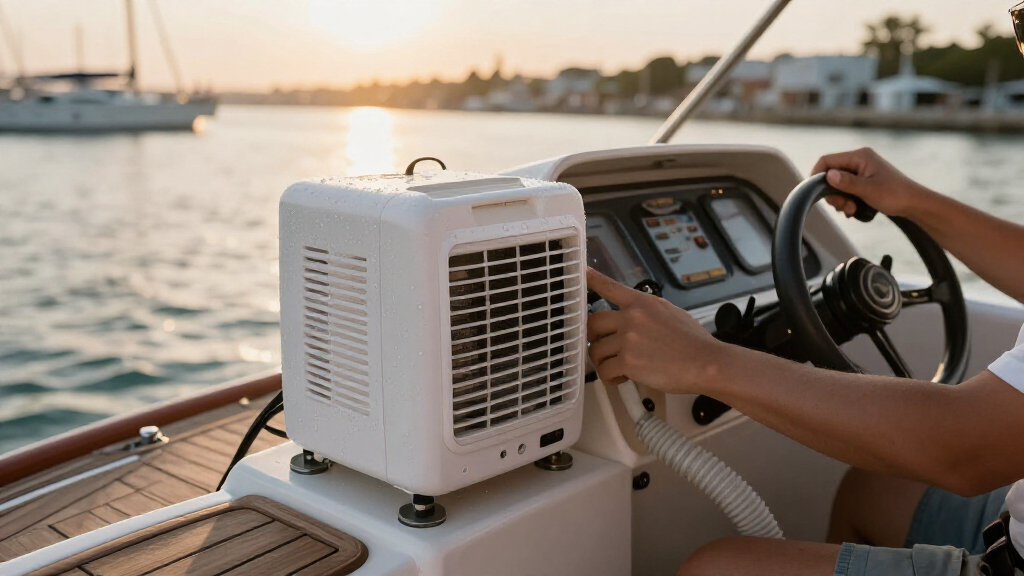
Portable boat air conditioners can make hot days aboard more manageable, but these camping-oriented units vary in cooling capacity, power draw, and how well they suit a boat’s confined spaces. My best overall pick is the OUTOHOME IOG-1 5,200 BTU, with the Cybertake S2 Pro standing out for buyers seeking a portable camp-focused design and the Cybertake model with heating for added seasonal versatility. The main tradeoff is between cooling output and the electrical supply, room, and ventilation a unit requires. I compare all 12 options by their stated specs and likely boat-use fit, while flagging where product names alone do not confirm marine suitability. Read on for the full breakdown, buying advice, and answers to common setup questions.

Get sports gear delivered free with Prime
- Fast, free delivery on millions of items
- Prime Video, Amazon Music and more included
- Member-only deals all year
Complete the kit


Key Takeaways
- Cooling capacity clusters tightly: most listed models are rated around 5,000–5,200 BTU, so small differences in the stated number should not outweigh power, airflow, and cabin layout.
- The OUTOHOME IOG-1 leads the comparison as the best overall pick among the listed 5,200 BTU portable options; its boat fit still depends on verifying power and venting requirements.
- The Cybertake S2 Pro and S1 Pro serve different shortlist roles: compare their exact specifications and included setup details rather than assuming the model names signal a major performance gap.
- Heating is a distinct advantage, not a cooling upgrade: the Cybertake portable model with heating may suit shoulder-season use, but buyers should check how its heating mode affects power needs.
- None of these product names establishes marine certification: confirm safe operation around moisture, electrical compatibility, exhaust routing, and condensate handling before bringing a camping-style unit aboard.
| Cuelep 5,200 BTU Portable Air Conditioner |  | Best for a Compact Cabin | Cooling capacity: 5,200 BTU (1,500 W) | Power: 110 V AC; 450 W | Coverage: Up to 160 sq. ft. | VIEW LATEST PRICE | See Our Full Breakdown |
| GETUHAND Portable Air Conditioner for Camping, RVs, Trucks, and Vans |  | Best for Humidity-Aware Operation | Cooling capacity: 5,200 BTU | Coverage: 108 sq. ft. | Power: 400 W | VIEW LATEST PRICE | See Our Full Breakdown |
| OUTOHOME IOG-1 Portable Air Conditioner, 5,200 BTU |  | Best for Lower Listed Power Draw | Cooling capacity: 5,200 BTU | Power and voltage: 400 W; 120 V | Temperature range: 60°F–88°F (16°C–30°C) | VIEW LATEST PRICE | See Our Full Breakdown |
| Countrymod Portable Camping Air Conditioner, 5,000 BTU |  | Best Split-System Option | Cooling capacity: 5,000 BTU | Power compatibility: DC 48 V / AC 110 V | Wattage: 500 W | VIEW LATEST PRICE | See Our Full Breakdown |
| Cybertake S2 Pro Portable Camping Air Conditioner |  | Best for Multi-Season Boating | Cooling and heating: 5,100 BTU cooling; 6,100 BTU heating | Coverage: Up to 130 sq. ft. | Power options: 100–240 V AC, 12–24 V vehicle, or 48 V DC | VIEW LATEST PRICE | See Our Full Breakdown |
| Countrymod 5000 BTU Portable Air Conditioner for Camping, RVs, and Tents |  | Best Simple 110V Boat-Cabin Pick | Cooling power: 5,000 BTU | Power: 110V AC | Wattage: 450W | VIEW LATEST PRICE | See Our Full Breakdown |
| Cuelep 5200 BTU Portable Air Conditioner for Camping, RVs, and Small Spaces |  | Best for Quiet Cabin Cooling | Cooling capacity: 5,200 BTU | Coverage area: Up to 160 sq ft | Power: 110V AC | VIEW LATEST PRICE | See Our Full Breakdown |
| Cybertake Portable Camping Air Conditioner with Heating |  | Best for Cooling and Shoulder-Season Heat | Cooling capacity: 5,100 BTU | Heating capacity: 6,100 BTU | Coverage area: 130 sq ft | VIEW LATEST PRICE | See Our Full Breakdown |
| Outohome 5100 BTU Portable Camping Air Conditioner |  | Best for Low-Drain Convenience | Cooling power: 5,100 BTU | Power: 110V | Wattage: 650W | VIEW LATEST PRICE | See Our Full Breakdown |
| Cybertake S1 Pro Portable Camping Air Conditioner |  | Best for Battery-Powered Boat Trips | Cooling capacity: 4,100 BTU | Voltage: 48V | Sleep mode power consumption: 100 watts per hour | VIEW LATEST PRICE | See Our Full Breakdown |
| BAYKUL 5000 BTU Portable Camping Air Conditioner |  | Best for Straightforward Controls | Cooling capacity: 5,000 BTU | Power: 400 W | Voltage: 110 V | VIEW LATEST PRICE | See Our Full Breakdown |
| GETUHAND Portable Tent Air Conditioner, 5,200 BTU, 400 W |  | Best for Humid-Climate Convenience | Cooling capacity: 5,200 BTU | Power: 400 W | Voltage: 110 V | VIEW LATEST PRICE | See Our Full Breakdown |
| portable boat air conditioner | Weight | Modes | Cooling capacity | Dimensions |
|---|---|---|---|---|
| Cuelep 5,200 BTU Portable Air | 31 lb | Cool, Dry, Fan, Sleep | 5,200 BTU (1,500 W) | 20 × 10 × 11 in (D × W × H) |
| GETUHAND Portable Air Conditio | 32.6 lb | Cool, Dry, Sleep, Fan | 5,200 BTU | 22.9 × 11.25 × 13.7 in |
| OUTOHOME IOG-1 Portable Air Co | 31.9 lb | Cooling, dehumidifying, sleep, fan | 5,200 BTU | 22.4 × 11.2 × 14.6 in |
| Countrymod Portable Camping Ai | Conflicting listings: 31.9 lb; 38.5 lb | Cooling, sleep, dehumidification, fan | 5,000 BTU | Conflicting listings: 12.6 × 22.8 × 13.6 in; 15.4 × 21.9 × 25.8 in |
| Cybertake S2 Pro Portable Camp | 25.6 lb | Cool, heat, dehumidify, Eco+ | — | 18.62 × 10.23 × 14.02 in |
| Countrymod 5000 BTU Portable A | 30.8 lb | Cooling, sleep, dehumidifier, fan | — | 21.3 × 11.4 × 13 in |
| Cuelep 5200 BTU Portable Air C | 31 lb | Cool, Dry, Sleep, Fan | 5,200 BTU | — |
| Cybertake Portable Camping Air | 21 lb | Cool, Heat, Dehumidify, Eco+ | 5,100 BTU | — |
| Outohome 5100 BTU Portable Cam | 35 lb | Cooling, dehumidifying, fan, sleep | — | 20.31 × 12.01 × 13.23 in |
| Cybertake S1 Pro Portable Camp | 21.6 lb | — | 4,100 BTU | — |
| BAYKUL 5000 BTU Portable Campi | — | Cooling, dehumidification, sleep, fan | 5,000 BTU | 21.1 × 11.2 × 11.8 in |
| GETUHAND Portable Tent Air Con | 35.8 lb | — | 5,200 BTU | 10.2 × 12.8 × 23.4 in (D × W × H) |
More Details on Our Top Picks
Cuelep 5,200 BTU Portable Air Conditioner
The Cuelep 5,200 BTU is a sensible fit for a small boat cabin or sheltered berth where a compact footprint matters more than broad coverage. At 31 lb and 20 × 10 × 11 inches, it is smaller than the GETUHAND unit, while offering the same stated cooling capacity and a slightly larger coverage claim of up to 160 sq. ft. Its Cool, Dry, Fan, and Sleep modes, remote, and 24-hour timer give it flexibility for overnight use. The main boat-specific limitation is power: it requires 110V AC, so it needs compatible shore power or an inverter setup. It also is not a marine-installed system, and frequent mode changes can require a 3–5 minute pause before restarting. I would choose it over the GETUHAND for its compact size, but not for humid, off-grid cruising.
Pros:- Compact dimensions and 31 lb weight make it easier to stow and reposition than the larger GETUHAND.
- Four operating modes cover cooling, airflow, sleep, and dehumidifying needs.
- Remote control and 24-hour timer make cabin operation more convenient.
- Listed coverage of up to 160 sq. ft. exceeds the GETUHAND’s stated 108 sq. ft.
Cons:- Requires 110V AC, limiting use when the boat is away from shore power unless compatible conversion equipment is available.
- Cooling capacity is intended for small spaces, not a large or open boat interior.
- Frequent mode changes may require a 3–5 minute wait before restarting.
Best for: Boat owners with a compact cabin, access to 110V AC power, and a preference for a lighter unit that can also serve other small spaces.
Not ideal for: Off-grid boaters without an inverter or shore power, and anyone expecting reliable cooling throughout a large or open cabin.
- Cooling capacity:5,200 BTU (1,500 W)
- Power:110 V AC; 450 W
- Coverage:Up to 160 sq. ft.
- Dimensions:20 × 10 × 11 in (D × W × H)
- Weight:31 lb
- Modes:Cool, Dry, Fan, Sleep
- Timer and remote:24-hour timer; remote range up to 32 ft
- Refrigerant:R-290
Our verdict“Choose the Cuelep for a compact, 110V-powered cabin setup; skip it if your boat needs off-grid operation or broader cabin coverage.”
GETUHAND Portable Air Conditioner for Camping, RVs, Trucks, and Vans
The GETUHAND earns a distinct place for boaters who want a straightforward 5,200 BTU unit and can manage its humidity-dependent drainage. In cooling mode, it needs no drainage when humidity stays below 70%, which can simplify use in drier conditions; above that threshold, a drain arrangement is needed. That caveat matters aboard boats, where damp air can be common. Compared with the Cuelep, the GETUHAND has a smaller stated coverage area—108 sq. ft. versus 160 sq. ft.—and a larger body, so it is better suited to a tight cabin than a more open interior. It draws 400 watts and includes a hose, but still relies on 110V power. I would favor the Cuelep for extra stated coverage and the GETUHAND only when its drainage condition suits the boat’s typical humidity.
Pros:- Cooling mode does not require drainage below 70% humidity.
- 400-watt power draw is lower than the Cuelep’s listed 450 watts.
- Includes a hose and has a carrying handle for moving and setup.
- Four modes and a 24-hour timer support different cabin conditions and schedules.
Cons:- Drainage is required above 70% humidity, a meaningful concern in damp marine environments.
- Its 108 sq. ft. coverage claim is lower than the Cuelep’s 160 sq. ft.
- Requires 110V power and is not a self-contained off-grid boat solution.
Best for: Owners of small, relatively dry cabins who have 110V AC available and can route a drain when humidity rises.
Not ideal for: Boaters in persistently humid conditions who cannot manage condensate drainage, or those seeking coverage beyond a small enclosed space.
- Cooling capacity:5,200 BTU
- Coverage:108 sq. ft.
- Power:400 W
- Voltage:110 V
- Dimensions:22.9 × 11.25 × 13.7 in
- Weight:32.6 lb
- Modes:Cool, Dry, Sleep, Fan
- Noise and timer:46 dB; 24-hour timer
- Refrigerant:R-290
Our verdict“Pick the GETUHAND for a small cabin in conditions where its no-drain threshold is useful, but choose another option if boat humidity is often high.”
OUTOHOME IOG-1 Portable Air Conditioner, 5,200 BTU
The OUTOHOME IOG-1 is a practical pick for boaters comparing compact AC units by stated electrical demand: its listed 400 W draw is below the Cuelep’s 450 W, while both provide 5,200 BTU of cooling. It brings a remote, four operating modes, and a 24-hour timer, making it easier to adjust a cabin without walking back to the unit. Its 46 dB noise level and 31.9 lb weight put it close to the GETUHAND in the basic portability category, rather than setting it apart as unusually quiet or light. Drainage is not needed below 70% humidity, but a drain pipe is required above that point—a condition worth weighing aboard a boat. The listed 120 V supply also calls for compatible AC power; this is not a direct 48V DC option like the Countrymod.
Pros:- Listed 400 W power draw is lower than the Cuelep’s 450 W specification.
- Remote control and a 24-hour timer add convenient cabin adjustments.
- Four modes include dehumidifying as well as cooling, fan, and sleep operation.
- No draining is needed below 70% humidity.
Cons:- Requires a drain pipe when humidity exceeds 70%, which may complicate boat installation.
- 46 dB noise rating is not the quietest listed option in this group.
- Uses 120 V AC and has no inverter or direct DC power option.
Best for: Boat owners with compatible AC power who prioritize a 400 W listed draw, remote operation, and familiar portable-unit controls.
Not ideal for: Boaters who need direct 48V DC compatibility, or those in humid cabins where arranging a drain pipe is inconvenient.
- Cooling capacity:5,200 BTU
- Power and voltage:400 W; 120 V
- Temperature range:60°F–88°F (16°C–30°C)
- Dimensions:22.4 × 11.2 × 14.6 in
- Weight:31.9 lb
- Modes:Cooling, dehumidifying, sleep, fan
- Noise level:46 dB
- Refrigerant:R-134A
- Timer and warranty:24-hour timer; 1-year warranty
Our verdict“Choose the IOG-1 for its 400 W listed draw and remote-equipped operation, but skip it if you need direct DC power or simple drainage in humid weather.”
Countrymod Portable Camping Air Conditioner, 5,000 BTU
The Countrymod stands out for its split-system design, which expels heat outside the tent or vehicle rather than relying on a single compact cabinet. For a boat with a suitable opening and room to position the components, that arrangement may better match a fixed cabin setup than the Cuelep or GETUHAND, both of which are conventional portable units. Its strongest boat-specific advantage is 48V DC and 110V AC compatibility, giving it more power-source flexibility than those AC-only models. The tradeoff is uncertainty in the product details: listed weight and dimensions conflict between the item information and description, making storage and installation planning harder. At 5,000 BTU and 500 W, it also has slightly less stated cooling capacity and higher listed wattage than the 5,200 BTU, 400 W OUTOHOME IOG-1.
Pros:- Split-system design sends heat outside the tent or vehicle.
- Supports both 48V DC and 110V AC power, unlike the AC-only Cuelep and GETUHAND.
- Includes cooling, sleep, dehumidification, and fan modes.
- Remote, touch controls, and an ergonomic carrying handle offer multiple ways to operate and move it.
Cons:- Product data lists conflicting weights and dimensions, complicating fit and installation planning.
- At 5,000 BTU and 500 W, it has less stated cooling capacity and higher wattage than the OUTOHOME IOG-1.
- Its split layout may require more careful placement than a single-unit portable AC.
Best for: Boat owners who can accommodate a split-system layout and want the option of 48V DC or 110V AC power.
Not ideal for: Buyers who need clear, reliable size and weight information before fitting equipment into a tight locker or cabin.
- Cooling capacity:5,000 BTU
- Power compatibility:DC 48 V / AC 110 V
- Wattage:500 W
- Temperature range:60°F–89°F (16°C–32°C)
- Noise level:45 dB
- Modes:Cooling, sleep, dehumidification, fan
- Dimensions:Conflicting listings: 12.6 × 22.8 × 13.6 in; 15.4 × 21.9 × 25.8 in
- Weight:Conflicting listings: 31.9 lb; 38.5 lb
- Warranty:1 year
Our verdict“Choose the Countrymod if its split design and 48V DC support suit your boat, but verify its actual dimensions and weight before planning installation.”
Cybertake S2 Pro Portable Camping Air Conditioner
The Cybertake S2 Pro is the most versatile choice here for boaters who want more than summer cooling. Its 5,100 BTU cooling and 6,100 BTU heating give it a role the Cuelep and OUTOHOME IOG-1 cannot fill, while its 25.6 lb weight is lighter than every other unit in this batch. It accepts AC, 12–24V vehicle power, or 48V DC, making it the strongest option for varied onboard power setups; actual compatibility still depends on the boat’s electrical system. The 40 dB rating and IPX4 shell are useful on a boat, but water resistance does not make it suitable for submersion or direct exposure to harsh marine conditions. A boost converter and remote are extra purchases, and stable cooling takes 5–10 minutes, so it is not the simplest ready-to-run pick.
Pros:- Provides both 5,100 BTU cooling and 6,100 BTU heating for use beyond hot-weather trips.
- At 25.6 lb, it is lighter than the other four units in this batch.
- Supports 100–240V AC, 12–24V vehicle, and 48V DC power options.
- 40 dB operation and an IPX4 water-resistant shell suit boat use better than a louder, non-specified shell.
Cons:- Boost converter and remote control require separate purchases.
- Stable cooling takes 5–10 minutes, so it is not an instant-cooling option.
- IPX4 protection does not indicate suitability for submersion or harsh direct marine exposure.
Best for: Boaters who use their vessel across warm and cool seasons and need a lighter unit that can work with multiple power sources.
Not ideal for: Buyers seeking a complete out-of-box remote-control setup, or anyone who needs a unit designed for prolonged exposure to seawater or immersion.
- Cooling and heating:5,100 BTU cooling; 6,100 BTU heating
- Coverage:Up to 130 sq. ft.
- Power options:100–240 V AC, 12–24 V vehicle, or 48 V DC
- Modes:Cool, heat, dehumidify, Eco+
- Weight:25.6 lb
- Dimensions:18.62 × 10.23 × 14.02 in
- Noise level:40 dB
- Water resistance:IPX4
- Timer and extras:0–12 hours; boost converter and remote sold separately
Our verdict“Choose the S2 Pro for multi-season trips and flexible power options, provided you are comfortable sourcing its converter and remote separately.”
Countrymod 5000 BTU Portable Air Conditioner for Camping, RVs, and Tents
I’d shortlist this 5,000 BTU Countrymod for boat owners who can plug into shore power and want straightforward cooling with a few useful extras. Its cooling, sleep, dehumidifier, and fan modes cover more cabin conditions than a cooling-only setup, while the remote and timer let you adjust operation without getting up in a cramped berth. At 30.8 pounds, it is a little lighter than the Outohome 5100 BTU, though neither is a featherweight for frequent carrying between dock and boat. The listed 450W draw is useful planning information, but the 110V requirement limits it to compatible AC power; this is not a direct battery-powered choice. I’d favor it over the Outohome when lower weight matters more than auto-evaporation drainage, and skip it if your boat lacks a suitable outlet.
Pros:- Four modes cover cooling, air circulation, sleep, and dehumidifying.
- Remote control and timer allow adjustments from a berth or seating area.
- Carry handle and 30.8-pound weight make it easier to move than the 35-pound Outohome.
- 450W listed wattage helps buyers plan AC power needs.
Cons:- Requires 110V AC power, limiting use away from shore power or a compatible inverter.
- At 5,000 BTU, it is aimed at small spaces rather than larger cabins.
- Its listed dimensions still require a stable storage and operating spot aboard.
Best for: Shore-power boaters cooling a small cabin who want remote operation, multiple modes, and a carry handle.
Not ideal for: Owners relying on DC batteries or a small off-grid power setup, since the unit requires 110V AC power.
- Cooling power:5,000 BTU
- Power:110V AC
- Wattage:450W
- Noise level:46 dB
- Modes:Cooling, sleep, dehumidifier, fan
- Dimensions:21.3 × 11.4 × 13 in
- Weight:30.8 lb
- Controls:Buttons and remote control
Our verdict“Choose the Countrymod for a small, shore-powered boat cabin if you want simple multi-mode operation and a lighter carry than the Outohome.”
Cuelep 5200 BTU Portable Air Conditioner for Camping, RVs, and Small Spaces
The Cuelep’s strongest case for boat use is its 42 dB noise rating, which is lower than the 46 dB listed for the Countrymod and Outohome. That difference may matter in a compact cabin where the unit sits close to the sleeping area. It also lists 5,200 BTU cooling, coverage up to 160 square feet, three fan speeds, and a 24-hour timer, giving it more explicit control and coverage details than the Countrymod. Its 110V-only power still makes it a shore-power or suitable-inverter appliance, not a battery-first marine solution. The 31-pound body is portable by handle, but the compressor’s restart waiting period may frustrate anyone cycling power frequently. I’d choose it over the Countrymod for quieter operation and a longer timer, but not for off-grid flexibility.
Pros:- 42 dB listed noise level is quieter than the Countrymod and Outohome figures.
- Three fan speeds provide more adjustment than a basic fixed-speed setup.
- 24-hour timer supports scheduled operation during longer stays aboard.
- Built-in handle and 31-pound weight suit occasional moves between boat and dock.
Cons:- Runs on 110V AC only, so off-grid use depends on a compatible power system.
- Compressor requires a waiting period before restarting after shutdown.
- At 31 pounds, it is portable but still a substantial item to carry aboard.
Best for: Boat owners with shore power who sleep near the cooling unit and value quieter operation, adjustable fan speeds, and a long timer.
Not ideal for: Boaters seeking direct DC or battery operation, or anyone who needs to restart the compressor rapidly after power interruptions.
- Cooling capacity:5,200 BTU
- Coverage area:Up to 160 sq ft
- Power:110V AC
- Wattage:450W
- Noise level:42 dB
- Weight:31 lb
- Modes:Cool, Dry, Sleep, Fan
- Timer:24 hours
- Temperature range:61°F–90°F
Our verdict“Pick the Cuelep over the Countrymod if quieter cabin operation and a 24-hour timer matter more than direct battery compatibility.”
Cybertake Portable Camping Air Conditioner with Heating
Most options here focus on cooling; this Cybertake adds 6,100 BTU of heating alongside 5,100 BTU cooling, making it the most versatile pick for boats used beyond hot-weather weekends. At 21 pounds, it is notably lighter than the Countrymod and Cuelep, which helps when moving it through a companionway or storing it between trips. Its 40 dB noise rating and IPX4 water-resistant shell are useful aboard, though water resistance does not mean it can be exposed to spray without care. The 48V power system supports AC and DC, but the required boost converter is sold separately, so setup may take extra planning. Compared with the Cybertake S1 Pro, this model adds heating and higher cooling capacity, while the S1 Pro lists more power-source options and a quieter sleep-mode figure.
Pros:- Provides both 5,100 BTU cooling and 6,100 BTU heating.
- At 21 lb, it is much lighter than the Countrymod, Cuelep, and Outohome.
- 40 dB operation is quieter than the listed noise figures for those 110V models.
- IPX4 water-resistant shell offers added protection in damp-use settings.
Cons:- Boost converter is sold separately, adding a required component for the relevant power setup.
- Cooling can take about 5–10 minutes to stabilize after startup.
- Listed coverage is limited to 130 sq ft, so it is not aimed at larger boat interiors.
Best for: Boaters who use their vessel in cool shoulder seasons and want one portable unit for both cabin cooling and supplemental heat.
Not ideal for: Buyers seeking a ready-to-connect battery setup, since the boost converter is separate, or those who need cooling for spaces larger than the listed 130 sq ft.
- Cooling capacity:5,100 BTU
- Heating capacity:6,100 BTU
- Coverage area:130 sq ft
- Power voltage:48V
- Noise level:40 dB
- Weight:21 lb
- Modes:Cool, Heat, Dehumidify, Eco+
- Water resistance:IPX4
- Timer:0–12 hours
Our verdict“Choose this Cybertake if you want lighter-weight cooling plus supplemental heat and can plan around its separate boost converter.”
Outohome 5100 BTU Portable Camping Air Conditioner
The Outohome earns its place for boaters who value auto-evaporation drainage and a 24-hour timer more than carrying weight. Reducing routine water handling can be welcome in a compact cabin, where finding a convenient place for condensate is not always easy. It offers 5,100 BTU cooling, four modes, touch controls, and a temperature range of 60°F–86°F. The tradeoff is a 35-pound body, heavier than the Countrymod and Cuelep, with 650W listed wattage compared with their 450W figures. Its 110V corded power also ties it to shore power or a suitable inverter. I’d choose it over the Countrymod for the drainage feature and longer timer, but the Countrymod is the easier carry and lists lower wattage. Neither is a strong match for battery-only cruising.
Pros:- Auto-evaporation drainage can reduce routine condensate handling.
- 24-hour timer supports scheduled operation.
- Cooling, dehumidifying, fan, and sleep modes suit changing cabin conditions.
- Touch controls and a carry handle provide straightforward operation and repositioning.
Cons:- At 35 lb, it is heavier than the Countrymod and Cuelep.
- 650W listed wattage is higher than the 450W figures for those two alternatives.
- Requires 110V corded power, limiting use away from shore power or a suitable inverter.
Best for: Shore-power boaters who want scheduled cooling and less hands-on condensate handling in a small cabin.
Not ideal for: Anyone who frequently carries equipment aboard or relies on a limited-capacity battery system, given its 35-pound weight and 650W listed wattage.
- Cooling power:5,100 BTU
- Power:110V
- Wattage:650W
- Modes:Cooling, dehumidifying, fan, sleep
- Temperature range:60°F–86°F
- Timer:24 hours
- Weight:35 lb
- Dimensions:20.31 × 12.01 × 13.23 in
- Noise level:46 dB in sleep mode
Our verdict“Choose the Outohome over the Countrymod if auto-evaporation and a 24-hour timer outweigh its extra weight and higher listed wattage.”
Cybertake S1 Pro Portable Camping Air Conditioner
The S1 Pro is the clearest fit here for boaters who cannot count on shore power: its 48V DC inverter system supports DC batteries, portable power stations, car chargers, and AC power. That flexibility sets it apart from the 110V-only Countrymod, Cuelep, and Outohome. At 21.6 pounds, it is also easier to move through a boat than those heavier units, and its 38 dB sleep mode is the quietest stated setting in this group. The 4,100 BTU capacity is lower than the other cooling figures here, so I’d reserve it for a smaller cabin rather than choosing it for maximum output. Battery operation requires a separately purchased boost converter, and the remote is optional; app and push-button controls are included. The Cybertake with heating offers more cooling capacity and heat, but the S1 Pro lists broader power options.
Pros:- Supports AC, DC batteries, portable power stations, and car chargers.
- 38 dB sleep mode is quieter than the listed figures for the other products here.
- At 21.6 lb, it is easier to reposition than the Countrymod, Cuelep, and Outohome.
- Cooling, dehumidifying, fan, and eco sleep modes offer useful operating choices.
Cons:- 4,100 BTU cooling capacity is lower than the other cooling ratings in this batch.
- DC battery use requires a separately purchased boost converter.
- Remote control is sold separately, although app and push-button controls are listed.
Best for: Owners of smaller boats who run a portable power station or compatible DC battery and want quiet overnight cooling without relying only on shore power.
Not ideal for: Boaters prioritizing maximum cooling capacity or a ready-to-use DC setup, since its 4,100 BTU rating is lower and battery use requires a separate boost converter.
- Cooling capacity:4,100 BTU
- Voltage:48V
- Sleep mode power consumption:100 watts per hour
- Sleep mode noise:38 dB
- Weight:21.6 lb
- Power options:AC power, DC battery, portable power station, car charger
- Controls:App, push button, optional remote
- Timer:12 hours
- Air vent adjustment:90 degrees
Our verdict“Pick the S1 Pro for a smaller boat and flexible battery-based power, but choose the higher-capacity Cybertake with heating if you need more output and supplemental warmth.”
BAYKUL 5000 BTU Portable Camping Air Conditioner
The BAYKUL makes the most sense for boaters who want a compact, basic cooling unit with useful controls rather than a higher-capacity feature set. Its 5,000 BTU output and four modes cover cooling, fan use, sleep, and moisture control, while the remote and 24-hour timer let you adjust operation without reaching the unit. Compared with the GETUHAND Portable Tent Air Conditioner, 5,200 BTU, it gives up a little stated capacity and features such as auto swing and low-humidity drainage handling, but its listed dimensions are more compact in height. The tradeoff is a 110 V corded power requirement and no inverter, so it needs a compatible onboard power setup and is not suited to battery-only cooling. I would choose it for a small cabin or dockside use, not as a self-contained solution for an off-grid boat.
Pros:- Four modes include cooling, dehumidification, fan, and sleep
- Remote control and 24-hour timer simplify operation from a berth
- Carry handle supports moving it between cabin and dockside use
- Listed 46 dB noise level provides a concrete reference for cabin planning
Cons:- Requires corded 110 V power, limiting use away from shore power or a generator
- No inverter, so it is not designed for direct battery-powered operation
- Lower stated cooling capacity than the 5,200 BTU GETUHAND option
Best for: Boaters with a small cabin and access to compatible 110 V shore power or a suitable generator who want remote operation and a sleep mode.
Not ideal for: Battery-only cruisers and boaters seeking a drainage-management feature or broader air distribution; this unit is corded, has no inverter, and lacks the GETUHAND’s stated auto swing.
- Cooling capacity:5,000 BTU
- Power:400 W
- Voltage:110 V
- Dimensions:21.1 × 11.2 × 11.8 in
- Noise level:46 dB
- Temperature range:60–86°F (16–30°C)
- Modes:Cooling, dehumidification, sleep, fan
- Controls and timer:Remote control; 24-hour timer
Our verdict“Choose the BAYKUL for a compact, remotely controlled cabin unit when dependable 110 V power is available.”
GETUHAND Portable Tent Air Conditioner, 5,200 BTU, 400 W
For boaters who can supply shore power or a generator, the GETUHAND’s strongest distinction is not its modest capacity bump but its dual-loop water cooling and drainage claim: it requires no manual drainage below 70% humidity. That can reduce routine attention in less humid conditions, though it is not a promise of drain-free operation in every marine climate. Its 5,200 BTU rating, four modes, and 75° auto swing give it a broader feature set than the BAYKUL, which has a smaller stated capacity and no swing feature. The cost of that versatility is a taller, heavier format at 35.8 lb, plus a listed noise level of 60 dB outside sleep mode. I would treat it as a portable cabin appliance, not a compact, quiet system for a tight berth; its 110 V corded supply also rules out casual battery-only use.
Pros:- 5,200 BTU capacity is slightly higher than the BAYKUL’s 5,000 BTU
- 75° auto swing helps spread airflow across a cabin area
- No manual drainage is required below 70% humidity
- Four modes and a 24-hour timer support varied use
Cons:- Listed noise level rises to 60 dB outside sleep mode
- At 35.8 lb and 23.4 in tall, it may be awkward in a small boat cabin
- Corded 110 V power is required, and power adapters are sold separately
Best for: Boaters with a powered cabin who want modestly higher stated capacity, moving airflow, and reduced manual drainage below 70% humidity.
Not ideal for: Owners of narrow cabins, noise-sensitive sleeping spaces, or battery-only boats; it is 35.8 lb, reaches a listed 60 dB outside sleep mode, and requires corded power.
- Cooling capacity:5,200 BTU
- Power:400 W
- Voltage:110 V
- Coverage:Up to 130 sq. ft.
- Dimensions:10.2 × 12.8 × 23.4 in (D × W × H)
- Weight:35.8 lb
- Noise level:45 dB in sleep mode; 60 dB listed outside sleep mode
- Airflow and drainage features:75° auto swing; no manual drainage below 70% humidity
- Modes and timer:Cooling, dry, sleep, fan; 24-hour timer
Our verdict“Pick the GETUHAND over the BAYKUL if auto-swing airflow and lower-humidity drainage convenience matter more than a lighter, quieter-running setup.”

How We Picked
I ranked these 12 products for portable boat use, not for tent or RV use alone. The comparison prioritizes stated cooling capacity, portability, power information where supplied, and practical fit for a small cabin or enclosed cockpit. I also looked at whether a model offers a meaningful point of difference, such as an included heating function, rather than treating similar BTU claims as proof of equal real-world performance.
The OUTOHOME IOG-1 5,200 BTU takes the top spot as the strongest all-around candidate based on its stated capacity and clear model identity. Other placements reflect likely buyer needs and the available product details: the 400 W claim on the GETUHAND tent model is useful for initial power planning, while heating gives the Cybertake option a separate use case. Since the supplied information does not establish marine certification, noise levels, exact power compatibility, or condensate arrangements for every unit, I treat those as verification points rather than assumed strengths.
Factors to Consider When Choosing Portable Boat Air Conditioners
A portable unit that works well in a tent may still be awkward or unsuitable aboard a boat. I would check the vessel’s electrical system and ventilation plan before choosing by BTU rating, then match the unit to the space you actually want to cool.
Match Cooling Capacity to the Space You Can Close Off
A 5,000–5,200 BTU rating gives a useful comparison point, but it does not tell me how quickly a unit will cool every cabin. Sun-exposed windows, poor insulation, open companionways, and hot equipment all add load. Measure the enclosed area and think about whether doors or curtains can separate the sleeping space from the rest of the boat. A small cabin that stays closed may be a better match for a portable unit than a larger open cockpit. Buying more capacity than the space can use may add bulk and power demand without solving heat gain through an open layout. Treat BTU figures as a starting point, not a promise of a particular cabin temperature.
Check the Electrical Supply Before Choosing a Unit
Portable air conditioners need a reliable power source, and a boat’s available supply may differ from a campsite outlet. Compare the unit’s rated input with the inverter, battery bank, shore-power connection, and circuit limits you plan to use. The GETUHAND 5,200 BTU tent model lists 400 W, but that figure alone does not confirm startup demand or runtime from a battery. Ask the manufacturer for running and startup power if those details are missing. Estimate how long you want cooling to run and include other loads such as refrigeration, lighting, or charging. A unit that fits the cabin but exceeds the boat’s practical electrical budget is the wrong fit.
Plan Exhaust Routing and Condensate Management
Many portable cooling systems need a path to move hot exhaust air outside the cooled space. On a boat, that route must avoid blocking a hatch, compromising a screened opening, or creating a path for rain and spray to enter. Check what vent hose, panel, or adapter comes with the unit and whether it can be fitted to your boat without unsafe alterations. Humid marine air can also create condensate, so find out whether the unit drains continuously, stores water, or needs manual emptying. A full reservoir or poorly routed drain can interrupt cooling at the least convenient time. Do not assume a tent or window kit will fit a marine opening as supplied.
Treat Marine Safety and Moisture Protection as Separate Checks
A product described for camping, RVs, trucks, or tents is not automatically designed for the marine environment. Salt air, splashes, vibration, and limited ventilation can affect both the appliance and its electrical connections. Look for manufacturer guidance on moisture exposure, operating clearances, grounding, and use aboard boats rather than relying on a general portable-use label. Keep the unit and its connections away from bilge water and areas exposed to spray. If the maker does not state that the appliance is suitable for marine use, ask before installation or operation. This check may rule out an otherwise attractive option, but it is more important than a small difference in rated cooling capacity.
Balance Portability Against Noise, Space, and Setup
A portable appliance still needs a stable place to sit, room for airflow, and a route for its hose and cord. Measure the intended location, doorways, and storage space before purchase; dimensions and weight matter more aboard than they do in a roomy vehicle. Ask for noise information if you plan to run the unit near a berth, since a loud compressor or fan can disrupt sleep in a compact cabin. Frequent setup and removal may favor a simpler arrangement, while a unit left in place can tolerate a more involved vent installation. Check how the unit handles motion and whether the manufacturer permits operation while underway. Convenience is the whole point of portability, but it should not come at the cost of an unstable or obstructed installation.
Pay Extra for a Feature You Will Actually Use
Heating, a lower stated power draw, or a more useful venting kit can matter more than a small increase in BTU output. The Cybertake model with heating has a clearer shoulder-season role than a cooling-only unit, but the added function is valuable only if you need warmth and can support its electrical load. A model’s label or feature list should not replace checking the exact included accessories and operating requirements. For occasional dockside use, a straightforward cooling unit may be the more sensible choice. For repeated trips across hot and cool weather, added modes may justify choosing a more versatile model. Spend for a feature that fits your boat and routine, not one that merely sounds useful.
Frequently Asked Questions
Can I run a portable boat air conditioner from my battery bank?
Possibly, but the product’s running wattage, startup demand, and your battery system all matter. The listed 400 W figure on the GETUHAND tent model is a useful data point, but it does not state how much power the unit draws at startup or how long a particular battery bank will run it. Check the manufacturer’s electrical specifications and your inverter’s continuous and surge capacity. Then account for battery usable capacity, conversion losses, and other appliances running at the same time. If those figures are unavailable, ask the manufacturer before planning battery-only cooling.
Are camping air conditioners safe to use on a boat?
Do not assume that a camping or RV label confirms suitability for marine conditions. Boats add exposure to salt air, spray, vibration, restricted ventilation, and electrical setups that may differ from a campsite. Check the product documentation for marine-use approval, moisture limits, required clearances, and electrical instructions. Keep the unit and connections out of wet areas, and do not make an improvised installation that blocks ventilation or compromises an opening. If the manufacturer cannot confirm the intended use, consult a qualified marine electrician or choose equipment specifically approved for boats.
Is a 5,000–5,200 BTU portable unit enough for my boat cabin?
It may suit a small enclosed cabin, but the BTU number alone cannot settle the question. Cabin size, insulation, sun exposure, window area, ventilation, and whether doors remain open all affect cooling demand. A unit near 5,000 BTU is less likely to keep up if it is asked to cool a large, open cockpit as well as a cabin. Measure the space you intend to cool and ask the manufacturer for guidance based on that area and conditions. If the space cannot be enclosed, improving shade and reducing hot-air leaks may matter as much as choosing a slightly higher capacity.
How should I vent a portable air conditioner on a boat?
Follow the manufacturer’s instructions for exhausting hot air, and plan the route before buying. The vent needs to discharge outside the cooled space without allowing water, exhaust, or hot air to return through the opening. A tent or window adapter may not match a boat hatch or port, so check dimensions and available accessories. Avoid permanent changes to a hatch or hull without suitable advice, and preserve required ventilation around the appliance. You will also need a plan for condensate, since moisture collection can interrupt operation or create a spill if ignored.
Should I choose a model with heating if I mainly want summer cooling?
Choose heating only if you expect to use the boat in cooler weather and the extra mode fits your electrical plan. The Cybertake portable model with heating has a broader stated use case than cooling-only picks, but that does not make it a better summer cooler by default. Check whether the manufacturer lists separate power figures for heating and cooling, since the load may differ by mode. If you only need relief during hot weather, compare cooling performance, power, installation, and storage first. A feature you rarely use can add complexity without improving your main use case.
Conclusion
For the strongest all-around starting point, I would shortlist the OUTOHOME IOG-1 5,200 BTU, then verify its power, venting, and marine-use guidance against your boat. For value-minded buyers, the Countrymod 5,000 BTU models are reasonable candidates to compare, but I would choose between them only after checking their exact specifications and included setup parts. Beginners should favor the model with the clearest instructions, electrical details, and venting plan rather than the most ambitious feature list. For shoulder-season trips, the Cybertake model with heating is the specific-use pick; for buyers focused on portable camp-style cooling, compare the Cybertake S2 Pro and S1 Pro on verified specs. I would treat any model as a boat option only after confirming safe power, moisture handling, exhaust routing, and a stable place to operate it.