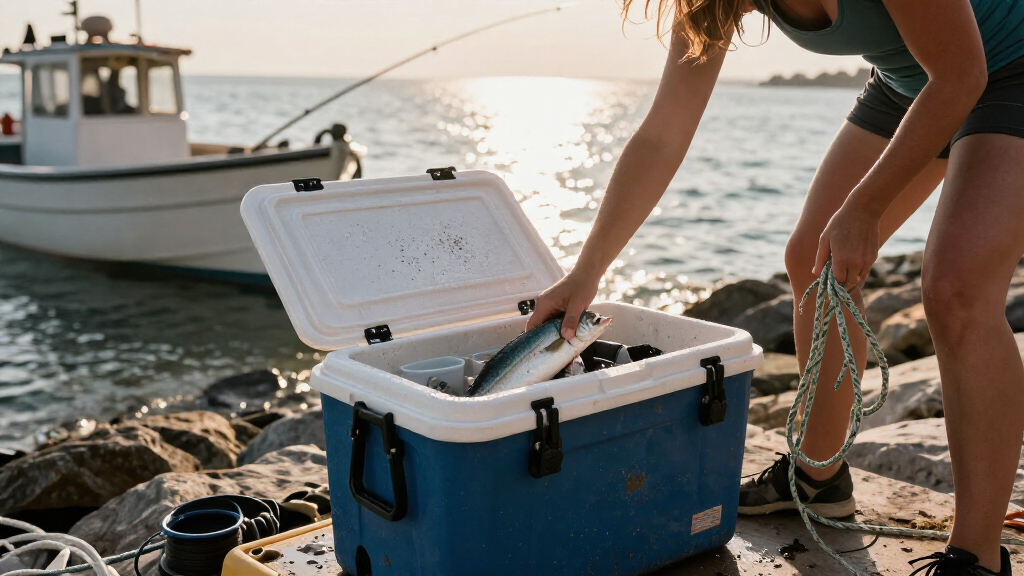

Choosing a marine cooler comes down to how you use the boat: a soft-sided container is easier to carry between shore and deck, while a hard-sided model typically offers better ice retention, stronger protection, and more usable space. Both can keep food and drinks cold, but the difference matters when trips run long, the cooler gets knocked around, or storage is tight. Choose soft-sided for short outings and flexible stowage; choose hard-sided for longer days, rougher handling, or a larger group.

Get sports gear delivered free with Prime
- Fast, free delivery on millions of items
- Prime Video, Amazon Music and more included
- Member-only deals all year

Igloo Marine Ultra 150 Qt Latitude Hard Cooler, White
- ✔ Capacity: 150 quarts; stated capacity up to 250 cans
- ✔ Dimensions: 39.09 × 18.81 × 20.66 inches
- ✔ Weight: 25.4 pounds

Sheffield 12681 Marine Storage Box, Dry Box Made in USA, Waterproof Container for Boat and Dock Gear, Small Parts Organizer with…
- ✔ External dimensions: 11.4 × 5 × 7.25 inches
- ✔ Internal dimensions: 9.38 × 4 × 6 inches
- ✔ Listed capacity: 225 cubic inches; approximately 4.6 gallons as supplied

Sheffield 12680 Marine Storage Box
- ✔ External dimensions: 11.5 × 5 × 7.25 inches
- ✔ Internal dimensions: 9.38 × 4 × 6 inches
- ✔ Capacity: 4.1 liters
At a Glance
| Criteria | Soft-sided marine cooler containers | Hard-sided marine cooler containers | Winner |
|---|---|---|---|
| Ice retention | Usually suited to shorter outings; performance varies by insulation and closure. | Usually stronger insulation and a tighter lid support longer ice retention. | B |
| Portability | Lightweight, with flexible handles or straps; easier to carry ashore. | Heavier and bulkier, especially when loaded; some models have wheels or handles. | A |
| Capacity and shape | Often compact or flexible, but soft walls limit stacking and usable volume. | Rigid shape can provide more predictable capacity and support stacking. | B |
| Impact protection | Fabric can resist scuffs, but offers limited protection from crushing or sharp impacts. | Rigid shell better protects contents from bumps and pressure. | B |
| Stowage when empty | Many models compress or fold, taking less space when empty. | Keeps its full footprint when empty and can be awkward to stow. | A |
| Cleaning and maintenance | Fabric seams and liners may need thorough drying; trapped moisture can cause odor. | Smooth interiors are generally easy to wipe, though drains and corners need attention. | B |
| Typical cost and value | Often lower cost; good value when portability and occasional use matter most. | Often costs more; worthwhile when longer cooling and protection are regularly needed. | Depends |
Igloo Marine Ultra 150 Qt Latitude Hard Cooler, White
When we need one container to carry provisions for a group, the Igloo Marine Ultra 150 Qt is the only option here built for that job. Its 150-quart capacity is vastly larger than either Sheffield box, and the insulated hard shell makes it the lineup’s clear choice for chilled food and drinks. The stated capacity of up to 250 cans helps us picture its scale, though actual packing needs will vary with ice and other contents.Marine use is reflected in the details: UV protection and rust-resistant stainless steel screws address exposure, while non-slip handles give us a more secure grip when loading or unloading. The threaded drain plug can connect to a hose, which is useful when a large cooler needs draining near a dock or boat. Compared with the small Sheffield containers, this is a provision hauler rather than a parts organizer; it will not keep small items separated in a tray or compartment.Size is its main compromise. At 25.4 pounds before contents, the cooler can be cumbersome to move, and it has no built-in wheels or rollers for long distances. Buyers who regularly transport it alone across a marina may find that limitation more important than its capacity. For a fixed boat, group outing, or setup where another person can help with loading, its volume and drain design make it the strongest all-around cooler choice in this comparison.
Pros:
- 150-quart insulated capacity for large loads of food and drinks.
- Threaded drain plug supports hose hookup for draining.
- UV protection and rust-resistant stainless steel screws suit marine exposure.
- Non-slip comfort-grip handles support loading and unloading.
Cons:
- At 25.4 pounds empty, it can be cumbersome to move.
- No built-in wheels or rollers for longer transport.
Best for: Boaters and outdoor groups who need high-volume insulated storage for provisions and can manage a large cooler without built-in wheels.
Not ideal for: Solo buyers who must roll a cooler over long distances, or anyone seeking a compact organizer for small hardware and tackle.
Bottom line: We rank the Igloo first for marine cooler storage because it offers the lineup’s only large insulated capacity, provided its weight and wheel-free design fit the way we transport it.
“We rank the Igloo first for marine cooler storage because it offers the lineup’s only large insulated capacity, provided its weight and wheel-free design fit the way we transport it.”
Sheffield 12681 Marine Storage Box, Dry Box Made in USA, Waterproof Container for Boat and Dock Gear, Small Parts Organizer with…
The Sheffield 12681 is the practical companion to a cooler, not a smaller cooler. Its compact body is intended for boat and dock gear, with a compression-fit lid and rubber gasket to help keep contents protected from moisture and dust. Where the Igloo carries provisions by the load, this box corrals the little items that can otherwise get lost or scattered.Its differentiator against the nearly similar Sheffield 12680 is the built-in top tray, which gives small pieces a more accessible place while leaving the main space available for other items. The interlocking base-to-lid design is useful when several boxes need to be stacked together, and the latch offers three locking options. Polypropylene avoids the rust concern associated with metal box bodies, though we should still match the claimed water protection to the conditions and use described by the manufacturer.The tradeoff is its limited footprint: internal dimensions are just 9.38 by 4 by 6 inches, with one main compartment. It will not hold bulky equipment, and the tray does not turn it into a large multi-compartment organizer. Compared with the orange 12680, this model is the better fit when the tray and white finish suit our setup; if color-coded visibility matters more, the 12680 may be easier to pick out. Neither can replace the insulated capacity of the Igloo.
Pros:
- Compression-fit lid with rubber gasket helps shield contents from moisture and dust.
- Built-in top tray separates frequently used small items from the main space.
- Interlocking design allows stable stacking with matching boxes.
- Lockable latch offers three locking options.
Cons:
- Compact internal dimensions limit the size of gear it can hold.
- One main compartment cannot sort a large assortment into multiple dedicated sections.
- Not an insulated cooler for food or drinks.
Best for: Boaters who want a compact, stackable box for small parts, tackle, or dock accessories, with a top tray for quick access.
Not ideal for: Anyone storing chilled provisions, larger tools, or a broad assortment that needs several dedicated compartments.
Bottom line: We recommend the 12681 as a compact marine gear organizer when its tray and stackable form matter more than cooler capacity or room for bulky equipment.
“We recommend the 12681 as a compact marine gear organizer when its tray and stackable form matter more than cooler capacity or room for bulky equipment.”
Sheffield 12680 Marine Storage Box
For small marine essentials that benefit from being easy to spot, we give the orange Sheffield 12680 a distinct role. Its listed internal dimensions, 9.38 by 4 by 6 inches, are nearly the same as the 12681, so it belongs in the same compact storage category. The bright color offers a simple way to distinguish one box from other equipment; the supplied details do not establish a larger capacity or stronger protection than its white counterpart.A compression-fit lid with a rubber gasket and a stainless steel latch with three locking options make it suitable for keeping small tools, tackle, or hardware together. The interlocking base can help keep matching boxes stable when stacked. Compared with the 12681, the obvious loss is the built-in tray described for the white model. If we need to sort small items for quick access, the 12681 is the more organized choice; if visibility and a simple storage space are the priority, the orange 12680 has a reason to be here.Its limits follow from its size and single compartment. Larger boat tools and bulky dock gear will not fit, while a collection of tiny parts may still need separate bags or dividers. Also, this is a water-resistant storage box according to the supplied specifications, not an insulated cooler. We would pair it with the Igloo for provisions rather than ask it to serve the same role. That narrower purpose makes it a useful compact pick, but not the best choice for buyers who expect cooling or substantial capacity.
Pros:
- Orange color helps distinguish the box among stored gear.
- Gasketed compression-fit lid helps keep moisture and dust out.
- Stainless steel latch offers three locking options.
- Interlocking base-to-lid design supports stable stacking.
Cons:
- Single compartment offers limited organization for many small parts.
- Compact internal dimensions rule out bulky gear.
- No insulation or cooler capacity.
Best for: Boaters who want a small, bright orange container to identify and separate a few essential tools, tackle, or hardware items.
Not ideal for: Buyers who need a built-in tray, multiple compartments, space for bulky tools, or insulated food and drink storage.
Bottom line: We choose the 12680 when a clearly identifiable compact gear box matters more than the 12681’s built-in tray or the Igloo’s insulated capacity.
“We choose the 12680 when a clearly identifiable compact gear box matters more than the 12681’s built-in tray or the Igloo’s insulated capacity.”
As an Amazon Associate we earn from qualifying purchases.
Key Differences
The main practical divide is between carrying convenience and cold-holding performance. Soft-sided coolers are easier to move, tuck into a locker, or take off the boat for a picnic. Their flexibility helps in cramped storage spaces, but their lighter construction usually offers less insulation and less protection for food or drinks when equipment shifts around. For a short trip where the cooler will be opened often and emptied the same day, that tradeoff can make sense.
Hard-sided coolers are the stronger choice when cold retention, capacity, and protection matter more than easy stowage. Their rigid bodies can take more routine knocks and hold their shape when packed alongside other gear. The cost is weight and a fixed footprint: a large hard cooler may be difficult to move when loaded and may occupy valuable deck or cabin space. Paying extra makes sense for frequent, longer outings; occasional day users may get better value from a simpler soft-sided model.
Detailed Comparison
Ice retention (Hard-sided marine cooler containers wins — major)
Hard-sided coolers generally win because their thicker insulation and fitted lids are designed to limit heat entry. The gap is moderate to major on longer trips, though exact performance depends on construction, sun exposure, how often the lid opens, and how the cooler is packed. For an all-day outing or overnight use, a hard-sided model is the safer bet. For a few hours with pre-chilled contents, a soft-sided container may be enough.
Portability (Soft-sided marine cooler containers wins — major)
Soft-sided containers win by a clear margin for carrying from a car or dock to the boat and back. They weigh less before loading and often include shoulder straps. A loaded cooler is still heavy, but the flexible body is easier to manage through tight spaces. Hard-sided models can add wheels or sturdy handles, yet their weight and bulk remain noticeable, especially aboard a small boat.
Capacity and shape (Hard-sided marine cooler containers wins — moderate)
Hard-sided models usually win for dependable usable space. Their walls do not collapse inward, and a flat top can support light items or stacking, subject to the model’s design. Soft-sided bags can fit into awkward gaps, but their capacity may be less predictable once packed, and they are not designed to carry weight on top. The difference is moderate for a couple and more meaningful when provisioning for a group.
Impact protection (Hard-sided marine cooler containers wins — moderate)
Hard shells provide better protection against ordinary bumps, shifting gear, and pressure from nearby items. This is a moderate advantage when the cooler shares space with tackle or tools. A soft-sided bag can handle scuffs and flexible contact, but it gives less protection to fragile food containers and can be punctured or compressed. Neither type should be treated as a secure seat or as protection against severe impact unless the manufacturer specifies that use.
Stowage when empty (Soft-sided marine cooler containers wins — major)
Soft-sided models win because some flatten or fold when not in use, freeing limited cabin or locker space. This is a major practical benefit on boats with little storage. A hard-sided cooler keeps its full dimensions year-round, so its footprint needs a dedicated spot. If it doubles as useful onboard seating or a dry storage box, that fixed footprint may be less of a drawback.
Cleaning and maintenance (Hard-sided marine cooler containers wins — minor)
Hard-sided interiors usually win for quick cleanup: wipe the smooth surface, empty the drain if fitted, and dry the lid and corners. Soft-sided liners can also be easy to wipe, but seams, zippers, and folds may hold moisture or residue. The difference is minor with careful drying and moderate with frequent use in salty, damp conditions. Check whether the liner is removable before buying if thorough cleaning matters.
Typical cost and value (moderate difference)
There is no universal winner. Soft-sided models often cost less and deliver better value for short trips, light loads, and users who prioritize portability. Hard-sided coolers can cost more, but the extra expense is justified when longer ice retention, sturdy construction, or group capacity will be used regularly. Pay more for performance you need on most outings, not for maximum capacity that will sit empty.
Soft-sided marine cooler containers: Pros and Cons
Pros:
- Lightweight and easy to carry between dock and boat.
- Flexible shape fits tight storage spaces.
- Some models fold or compress when empty.
- Often costs less for occasional day use.
Cons:
- Typically less ice retention than a well-insulated hard cooler.
- Offers less protection from impacts and crushing.
- Soft walls can reduce dependable usable capacity.
- Seams and folds need careful drying to prevent lingering moisture or odor.
Hard-sided marine cooler containers: Pros and Cons
Pros:
- Generally better ice retention for longer outings.
- Rigid walls protect contents and keep their shape.
- Often provides predictable capacity and a stable top.
- Smooth interiors are usually straightforward to clean.
Cons:
- Heavier and harder to move when loaded.
- Fixed shape takes storage space even when empty.
- Often costs more than a basic soft-sided container.
- Can be inconvenient aboard a small boat with limited deck or cabin room.
Who Should Choose What
Choose Soft-sided marine cooler containers if:
- You mostly take short day trips and can refill ice or return to shore easily.
- You regularly carry the cooler from the boat to a beach, picnic, or vehicle.
- Your boat has limited locker space and a foldable cooler would be useful.
- Keeping purchase cost and unloaded weight low matters more than maximum ice retention.
Choose Hard-sided marine cooler containers if:
- You spend long days on the water or need cold storage overnight.
- You carry provisions for several people and need the cooler to hold its shape.
- The cooler will sit near gear that could bump or press against it.
- You use the cooler frequently enough that stronger insulation and easier wipe-down justify the higher cost.
Skip both if: If you need secure, temperature-controlled storage for medicines or other temperature-sensitive items, use equipment designed and rated for that purpose; a standard marine cooler is not a substitute.
Value for Money
Paying more for a hard-sided cooler is worthwhile when longer cooling time, protection, and frequent use solve a real problem. A family spending full days aboard will likely get more practical value from that construction than from repeatedly replacing ice or managing delicate contents in a soft bag. For a couple of hours on the water, or for a cooler that must travel ashore and disappear into a small locker afterward, a soft-sided model can be the better buy. Compare usable capacity, insulation details, closure design, and empty dimensions rather than relying on the marine label alone.
Final Verdict
For most boaters who need dependable cold storage through a full day, choose a hard-sided marine cooler: its better ice retention, rigid capacity, and impact protection usually justify the added weight and cost. Choose a soft-sided container if your outings are short, portability is central, or onboard storage is too tight for a rigid box. The deciding factor is whether you need cooling to last longer than the convenience of carrying and stowing the cooler. Buy the hard-sided option only when you will use its extra performance regularly; otherwise, the lighter soft-sided model is the better value.
Frequently Asked Questions
Which type keeps ice longer on a boat?
Hard-sided coolers generally keep ice longer because they tend to have thicker insulation and better-fitting lids. Results still depend on the specific model, how full it is, sun exposure, and how often it is opened.
Are soft-sided coolers suitable for marine use?
Yes, for short outings and lighter loads. Choose one with a durable outer fabric, sealed or well-protected seams, and a liner that can be cleaned and dried. It will not provide the same rigid protection or typical ice retention as a hard-sided cooler.
Is a more expensive hard-sided cooler worth the price?
It is worth paying more if you take frequent long trips, need cold storage for a group, or value a sturdy shell. For occasional trips that last only a few hours, a lower-cost soft-sided container is often the more sensible purchase.
What size should I choose for a boat?
Start with the number of people and trip length, then check the cooler’s external dimensions against the actual locker or deck space. A cooler that holds more is useful only if it can be stored safely and moved when loaded.