
Understanding the difference between magnetic north and true north is vital for navigation. Magnetic north is where your compass points, but it shifts over time and location due to Earth’s magnetic field. True north is fixed at the geographic North Pole. If you ignore magnetic declination, your navigation can go off course. To stay accurate, always adjust your compass readings for local declination and learn how to interpret both. Keep exploring to master precise navigation techniques.
Key Takeaways
- True north refers to Earth’s geographic North Pole; magnetic north is where compass needles point, influenced by Earth’s magnetic field.
- Magnetic declination is the angle between true north and magnetic north, varying by location and time.
- Use true north for precise navigation, especially over long distances, and magnetic north for quick, everyday directions.
- Always adjust compass readings for local magnetic declination to avoid navigation errors.
- Relying on magnetic north without correction can cause deviations; understand and differentiate both for accurate navigation.

Boat Compass, Pivoting Boat Marine Compass Dashboard Suction LED Illuminated Backlight Magnetic Declination Adjustment Digital Navigation for Boat Car Truck Ship Marine
【High-Precision Navigation】This marine compass uses a high-sensitivity magnet and an independent balancing system to provide accurate readings via…
As an affiliate, we earn on qualifying purchases.
As an affiliate, we earn on qualifying purchases.
What Are True North and Magnetic North, and Why Do They Differ?

Have you ever wondered why maps and compasses often don’t agree? It’s because of the difference between true north and magnetic north. True north refers to the geographic North Pole, which is fixed at the top of the Earth’s axis and defined by geographic coordinates. Magnetic north, however, is where the Earth’s magnetic field points, and it shifts over time due to magnetic anomalies—irregularities in Earth’s magnetic field caused by variations in the planet’s core and crust. This means magnetic north isn’t a fixed point like true north. As a result, compasses point toward magnetic north, which can differ markedly from true north depending on your location. Understanding this difference is essential for accurate navigation. Additionally, magnetic declination varies across different regions and must be accounted for to ensure precise directional readings. Recognizing the variations in magnetic field is crucial for navigators to adjust their readings and avoid errors. Moreover, magnetic anomalies can sometimes cause compass deviations that require correction for precise navigation.
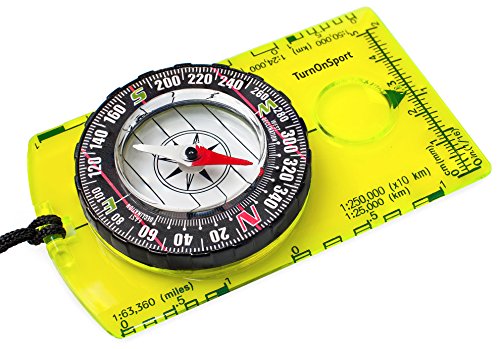
Orienteering Compass – Hiking Backpacking Compass – Advanced Scout Compass for Camping and Navigation – Boy Scout Compass for Kids – Professional Field Compass for Map Reading – Best Survival Gifts
KEY FEATURES: This manual magnet compass consists of Acrylic Baseplate with Azimuth bearing and 360 degree rotating bezel….
As an affiliate, we earn on qualifying purchases.
As an affiliate, we earn on qualifying purchases.
How Magnetic Declination Affects Navigation and How to Adjust for It

Magnetic declination, the angle difference between true north and magnetic north, directly impacts navigation accuracy. When you don’t account for it, your compass readings can lead you off course, especially in areas with magnetic anomalies that distort the magnetic field. These anomalies, caused by local mineral deposits or underground structures, can skew your compass calibration, making it less reliable. To stay on track, you need to adjust your compass reading by the local declination value, which varies by location and changes over time. Many modern compasses and navigation apps provide declination information or allow you to set it manually. Proper adjustment guarantees your navigation remains precise, helping you avoid misdirection caused by magnetic anomalies and declination errors. Additionally, understanding magnetic declination is crucial for accurate navigation and avoiding errors caused by local magnetic influences. Recognizing how magnetic declination interacts with magnetic anomalies can help you develop better navigation strategies in challenging environments, especially when relying on traditional compass methods. Being aware of magnetic field variations can further enhance your ability to adapt to different geographic areas and magnetic conditions.

7'' GPS Navigator for Car Truck RV – 2026 North America Maps Free Lifetime Updates, Touchscreen Navigation System, Speed & Red Light Warning, Turn-by-Turn Voice Guidance, for All Cars (Blue)
【Lifetime Free Map Updates】The GPS navigator comes preloaded with the latest 2026 edition maps of North America (USA,…
As an affiliate, we earn on qualifying purchases.
As an affiliate, we earn on qualifying purchases.
When Should You Use True North Versus Magnetic North for Accurate Navigation?

Knowing when to rely on true north instead of magnetic north can considerably improve navigation accuracy, especially in complex environments. Use true north when precision is critical, such as in wilderness navigation or planning long routes, where magnetic variations can cause errors. Proper compass calibration helps ensure your compass points correctly, reducing inaccuracies. If you’re using GPS, remember that it relies on satellites and provides true north data, so trust it for detailed positioning. Magnetic north is useful for quick, everyday navigation but can be affected by local magnetic interference. Keep these tips in mind: magnetic declination can be adjusted for more precise navigation, especially when relying on compass readings. Additionally, understanding magnetic variation helps you account for differences between true and magnetic north in various locations. Regularly checking magnetic field disturbances can prevent unexpected deviations. Being aware of magnetic anomalies can also help you avoid unexpected compass errors. – Calibrate your compass regularly – Use true north in areas with magnetic interference – Rely on GPS for precise positioning – Adjust for magnetic declination when needed – Switch to true north for advanced navigation tasks. Incorporating magnetic field data from local sources can further enhance your navigation accuracy in challenging environments.
![Wall Art Impact 24"x36" World Magnetic Declination Poster Political Topographical and Physical Maps of USA [Laminated]](https://m.media-amazon.com/images/I/51PQwNUlA5S._SL500_.jpg)
Wall Art Impact 24"x36" World Magnetic Declination Poster Political Topographical and Physical Maps of USA [Laminated]
LAMINATED Heat-sealed Lamination that will stand the test of time. Printed on a sturdy paper at resolution 600…
As an affiliate, we earn on qualifying purchases.
As an affiliate, we earn on qualifying purchases.
How to Find Your Local Magnetic Declination and Correct Your Compass

To accurately navigate using a compass, you need to find your local magnetic declination—the angle between magnetic north and true north. You can do this by consulting online maps, mobile apps, or topographic charts that provide magnetic declination data for your location. Once you know the declination, you can perform compass correction by adjusting your compass reading accordingly. If your magnetic declination is east, add it to your compass heading; if west, subtract it. This adjustment guarantees you’re aligning your compass with true north, preventing navigational errors. Regularly verify the declination, especially if you’re traveling over large distances or in different regions, to maintain accurate readings. Proper compass correction is essential for precise navigation and avoiding mistakes caused by magnetic declination discrepancies. Proper kitchen gear care can also help extend the lifespan of your tools used for navigation or outdoor adventures. Additionally, utilizing reliable technological tools like digital compasses or GPS devices can further enhance your navigation accuracy. Knowing how to determine and adjust for magnetic declination is a crucial navigation skill for outdoor enthusiasts and navigators alike. Keeping your navigation equipment well maintained ensures consistent performance in all environments.
Common Mistakes to Avoid When Navigating With Magnetic and True North

One common mistake when orienting with magnetic and true north is neglecting to account for local magnetic declination, which can lead you considerably off course. Failing to properly calibrate your compass or ignoring updates to navigation tools can cause errors. To avoid this, always verify your compass calibration before setting out. Be aware of how magnetic declination varies by location and adjust your readings accordingly. Additionally, rely on up-to-date navigation tools that factor in declination. It’s also important to understand the magnetic declination and how it influences compass readings in different regions. Remember these pitfalls:
- Forgetting to recalibrate your compass regularly
- Ignoring changes in magnetic declination over time
- Relying solely on outdated maps or navigation tools
- Confusing magnetic north with true north without adjustment
- Neglecting to double-check your headings before proceeding. Using accurate navigation data can help prevent these common mistakes. Additionally, understanding how magnetic anomalies can affect compass readings in certain areas is crucial for precise navigation.
Frequently Asked Questions
How Does Magnetic Declination Vary Over Time and Location?
Magnetic declination varies over time and location because the magnetic pole shifts, affecting your position relative to geographic coordinates. Near the magnetic pole, declination changes more rapidly, while it’s more stable farther away. You should regularly check local magnetic declination charts or use a compass with declination adjustment to account for these changes, ensuring accurate navigation regardless of how the magnetic pole moves over time.
Can Magnetic North Ever Align Exactly With True North?
A wise person once said, “Never say never.” Magnetic north can align with true north temporarily during magnetic pole shifts, but it’s rare and unpredictable. Variations occur due to shifts and Earth’s movement, so compass calibration techniques are essential for accuracy. While perfect alignment is unlikely, understanding magnetic pole shifts helps you adjust your navigation tools, ensuring you stay on course even when the stars seem to align.
What Tools Can Help Measure or Calculate Magnetic Declination Accurately?
You can use a magnetic declination calculator or smartphone compass app to measure declination accurately. These tools rely on Earth’s magnetic field data and declination mapping to provide precise readings. Topographic maps with declination information are also helpful, especially in remote areas. By comparing your compass reading with the map’s declination, you can determine the magnetic declination at your location and adjust your navigation accordingly.
How Do Different Types of Compasses Account for Magnetic Variation?
You can account for magnetic variation with different compass types by performing regular compass calibration, especially in areas with magnetic anomalies. For example, a magnetic compass needs calibration to adjust for local magnetic interference, ensuring accurate readings. Some advanced compasses automatically compensate for magnetic anomalies, while traditional ones require manual adjustment. Always verify your compass’s calibration before navigation to avoid errors caused by local magnetic disturbances.
Why Is Understanding Magnetic Versus True North Important for GPS Devices?
Understanding magnetic versus true north is essential for GPS devices because it affects your navigation accuracy. If you don’t account for magnetic variation, your compass readings could be off, leading you in the wrong direction. Regularly calibrate your compass and adjust for magnetic declination to guarantee your GPS provides precise directions. This knowledge helps you stay on course, especially in unfamiliar areas where navigation accuracy is critical.
Conclusion
Remember, confusing true north with magnetic north is like mixing up the compass needle with the map’s arrow—you’ll end up lost. Think of magnetic declination as the twist in a roller coaster track; without accounting for it, your navigation ride gets bumpy. Always verify your local declination and use the right north for your situation. Mastering this guarantees your path stays clear, so you arrive exactly where you intend—like a boat steady on calm waters.