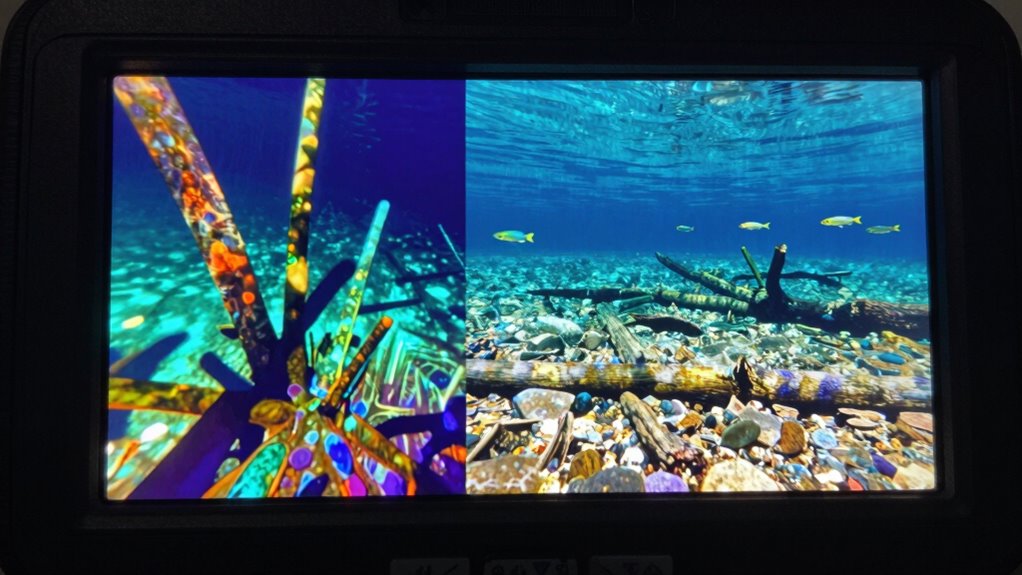

Side imaging shows a wide view of underwater structures and fish on both sides of your boat, helping you spot habitat features and schools over a broad area. Down imaging provides a detailed, vertical picture directly beneath you, revealing specific fish, terrain, and hazards with high clarity. Knowing what each shows can improve your fishing and navigation. Keep exploring further, and you’ll uncover even more tips to interpret these images effectively.
Key Takeaways
- Side imaging provides a wide, lateral view of underwater structures and fish, revealing a broad area on both sides of the boat.
- Down imaging offers a vertical, beneath-the-vessel view, showing detailed images of the bottom, rocks, vegetation, and fish directly below.
- Fish appear as shadowy shapes on side imaging, while down imaging shows precise details and textures of individual fish and structures.
- Side imaging is ideal for locating schools and habitat features over large areas; down imaging excels at detailed identification beneath the boat.
- The choice depends on whether you need a broad survey (side imaging) or detailed, close-up views (down imaging).

Garmin Striker Vivid 7sv, Easy-to-Use 7-inch Color Fishfinder and Sonar Transducer, Vivid Scanning Sonar Color Palettes (010-02553-00)
easy-to-use 7” color fishfinder with new vivid scanning sonar color palettes to easily distinguish fish and structure
As an affiliate, we earn on qualifying purchases.
How Do Side Imaging and Down Imaging Work?
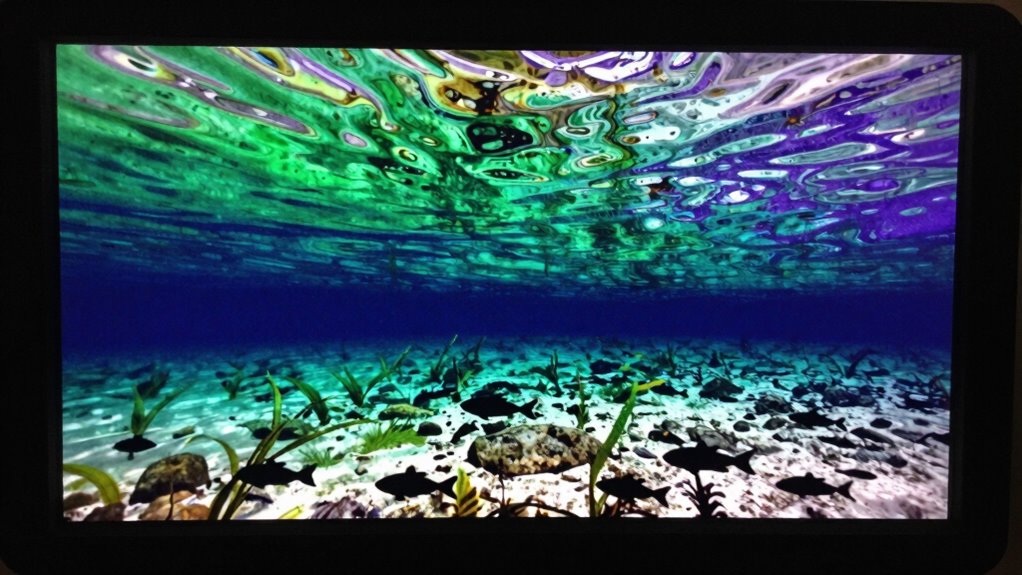
Side imaging and down imaging use high-frequency sonar waves to create detailed pictures of underwater structures. When you activate your fish finder, a sonar signal emits from the transducer, bouncing off objects below and around you. This imaging technology then interprets the returning echoes to generate images. Down imaging directs the sonar signal straight beneath your boat, providing a vertical view of the underwater environment. In contrast, side imaging sends sonar signals out to the sides, covering a wider area. The reflected signals are processed to produce detailed, almost photographic images of the underwater scenery. This combination of sonar signals and advanced imaging technology allows you to see fish, structures, and terrain with remarkable clarity, making your underwater exploration more precise and effective. Additionally, some advanced models incorporate electric power options to enhance performance and efficiency during long trips, and understanding the sonar frequency used can help optimize your imaging results. Modern imaging resolution capabilities further improve the clarity and detail of these underwater images, enabling more accurate identification of features.

Humminbird Helix 7 G4 GPS Fish Finder with Transducer, MEGA Side Imaging
MEGA Side & Down Imaging Technology: View fish, structures, and contours 125 feet on either side of your...
As an affiliate, we earn on qualifying purchases.
What Will You See on a Side Imaging Screen?
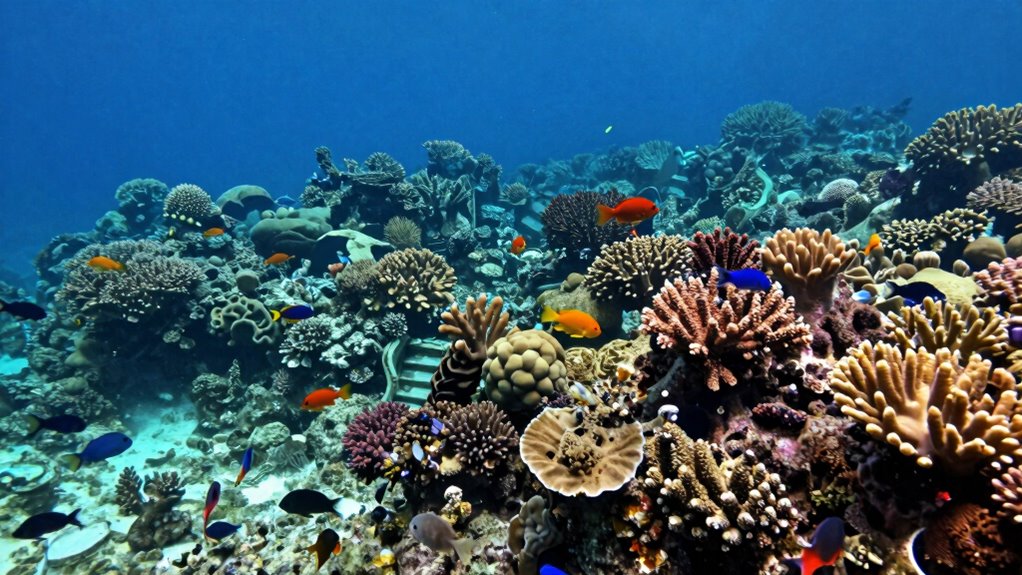
When you look at a side imaging screen, you’ll notice a wide field of view that reveals more of what’s beneath and to the sides of your boat. You can easily spot underwater structures like rocks, logs, and brush, which help identify good fishing spots. Additionally, schools of fish often appear as moving clusters, making it easier to target your catch. Utilizing effective floor scrubber techniques, such as pre-soaking pads and adjusting pressure, can also ensure a clean deck area, reducing slipping hazards while you fish. Being aware of sonar technology advancements can further enhance your ability to interpret the images more accurately. Understanding imaging resolution can significantly improve your detection of subtle details on the screen, leading to better fishing decisions. Moreover, staying updated on transducer technology can provide clearer images and reveal more details beneath the water surface. Keeping an eye on fish behavior patterns can help you interpret the images more effectively and increase your catch rate.
Wide Field of View
Have you ever wondered what a side imaging screen reveals about what’s beneath and around your boat? With its wide field of view, you can see more of the underwater environment, thanks to advanced sonar technology and imaging techniques. This broad perspective helps you spot fish, structures, and contours on both sides of your boat, increasing your chances of a good catch. The expansive display shows details over a large area, making it easier to identify potential hotspots without constantly repositioning. To visualize this, consider the table below:
| Feature | What You’ll See |
|---|---|
| Sonar Coverage | Large, sweeping view of the water column |
| Imaging Techniques | Clear images of fish and structures |
| Field of View | Wide, extending on both sides of the boat |
| Detail Level | High, with clarity over a broad area |
This wide view is essential for effective fishing and navigation. Additionally, understanding the contrast ratio can help you interpret the image quality and contrast between different objects on the screen.
Detecting Underwater Structures
Detecting underwater structures on a side imaging screen provides a detailed view of what’s hidden beneath the water’s surface. You’ll see features like underwater caves with dark, hollow shapes that hint at openings or tunnels. Submerged vegetation appears as dense, bushy patterns along the bottom, often swaying with the current. These structures can serve as landmarks or habitat spots for fish, making them important to identify. The clarity of side imaging helps you distinguish between different types of formations, revealing sharp edges of rocky outcroppings or the soft contours of sunken trees. By paying close attention to these details, you can locate promising fishing spots, navigate safely around underwater hazards, and better understand the underwater landscape. Regularly maintaining your equipment ensures optimal imaging performance and accurate readings. Additionally, understanding how different imaging techniques work can improve your ability to interpret what you see on the screen.
Identifying Fish Schools
Fish schools often appear as tightly packed, shadowy shapes moving across your side imaging screen. Recognizing these formations requires understanding species behavior, as different fish gather in unique patterns. For example, baitfish tend to form dense, compact groups, while predator species may hunt in looser clusters. Water temperature influences their behavior, affecting how and where schools form; warmer water often increases activity and schooling size, while cooler water can cause fish to spread out or stay near structure. By observing the shape, density, and movement of these shadows, you can identify a school of fish and determine if they’re actively feeding or migrating. Additionally, Free Floating techniques can help you interpret how the natural environment impacts fish movements, leading to more accurate readings. Recognizing species behavior patterns enhances your ability to interpret side imaging data and locate fish more effectively. Combining this visual information with your knowledge of species behavior and water temperature helps you make smarter, more targeted fishing decisions.

Humminbird Helix 5 G3 GPS Fish Finder with Transducer, Dual Spectrum Chirp Sonar & Down Imaging
CHIRP Down Imaging: Filters out visual noise and clutter for a clear view beneath your boat; CHIRP Digital...
As an affiliate, we earn on qualifying purchases.
What Does Down Imaging Show Beneath Your Boat?
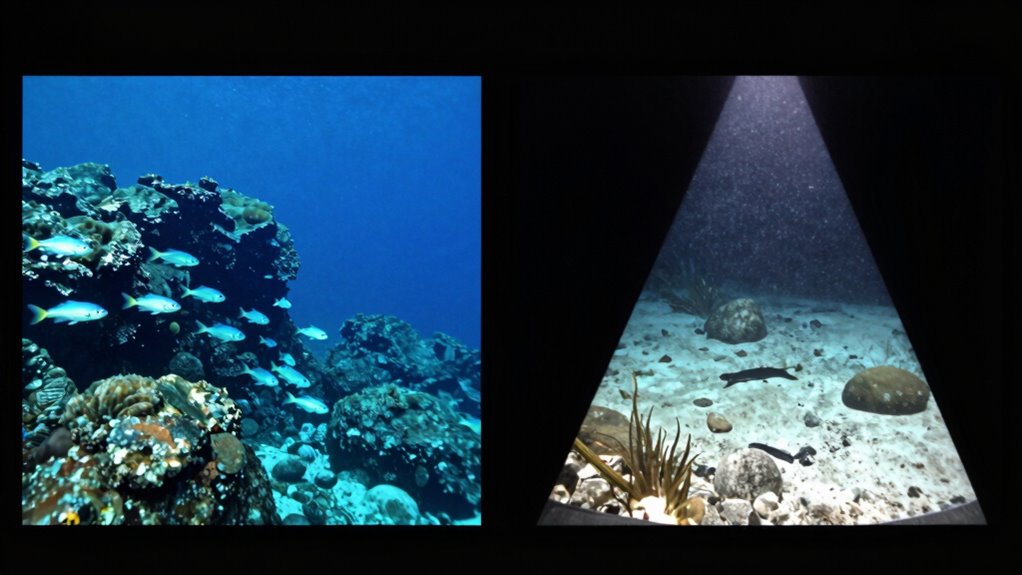
Down imaging provides detailed views of what’s directly beneath your boat, with sharp image clarity and high resolution. It reveals depth and structure details, helping you identify underwater features and potential hazards. Plus, its target identification capabilities allow you to distinguish fish from other objects with confidence. Additionally, understanding seasonal changes can improve your interpretation of underwater structures and fish behavior patterns. Recognizing local underwater conditions further enhances your ability to interpret sonar data accurately throughout different times of the year.
Image Clarity and Resolution
When using down imaging, the clarity and resolution of the images are crucial for accurately interpreting what’s beneath your boat. High-resolution images let you see the underwater terrain clearly, revealing details like rocks, vegetation, or structure. Water clarity plays a significant role; murky or turbid water can reduce visibility, making images less detailed. Good resolution helps distinguish between different objects and terrain features, giving you confidence in your readings. If your equipment offers adjustable settings, optimize them for the current water conditions to enhance image quality. Sharp, detailed images are essential for identifying fish, structures, and obstacles. Understanding Water clarity and its impact on imaging can help you better interpret what you see on your fish finder. Properly calibrated imaging settings also contribute significantly to achieving optimal image clarity. Continuous monitoring of performance metrics can help you fine-tune your system for the best possible images. Additionally, being aware of sensor quality can influence the overall effectiveness of your imaging. Ultimately, better clarity and resolution improve your ability to make quick, informed decisions while navigating or fishing.
Depth and Structure Details
Down imaging provides a detailed view of what’s directly beneath your boat, allowing you to see the underwater landscape in real-time. Using advanced sonar technology, it displays the water column and the structures below with remarkable clarity. You can distinguish features like drop-offs, submerged rocks, and vegetation, helping you understand the terrain’s shape and depth. This level of detail reveals the contours and composition of the bottom, making it easier to identify promising fishing spots. Unlike traditional sonar, down imaging creates a picture-like image, showing both the distance and the structure details beneath you. This insight helps you navigate safely, avoid hazards, and target fish more effectively based on the underwater formation and environmental features directly below your boat.
Target Identification Capabilities
Down imaging excels at revealing detailed images of underwater objects, making it easier for you to identify potential targets. With this technology, you can distinguish different fish species based on their shape, size, and movement, helping you determine which ones are worth targeting. It also clearly displays underwater vegetation, so you can see how fish relate to their habitat. This detailed view helps prevent you from wasting time on false targets or debris. Down imaging provides crisp, high-resolution images directly beneath your boat, giving you confidence in your target identification. Additionally, understanding target identification capabilities can help you develop more effective fishing strategies. Recognizing underwater structures can further enhance your ability to locate fish and optimize your fishing efforts. Utilizing imaging resolution can improve the accuracy of your target recognition and overall success. The clarity provided by high-quality sonar technology can make a significant difference in your fishing results. Moreover, advancements in target separation allow for more precise differentiation between closely located objects, increasing your chances of a successful catch.

Lowrance Eagle 7 FishFinder/Chartplotter with SplitShot HD Transducer and Preloaded C-MAP Inland Charts, 7-inch IPS Screen, Black, 000-16114-001
HIGH-VIS IPS SCREEN: IPS Screen allows for anglers to view crisp images in the daylight, with polarized sunglasses,...
As an affiliate, we earn on qualifying purchases.
Which Fish Finder Is Better for Covering Large Areas?
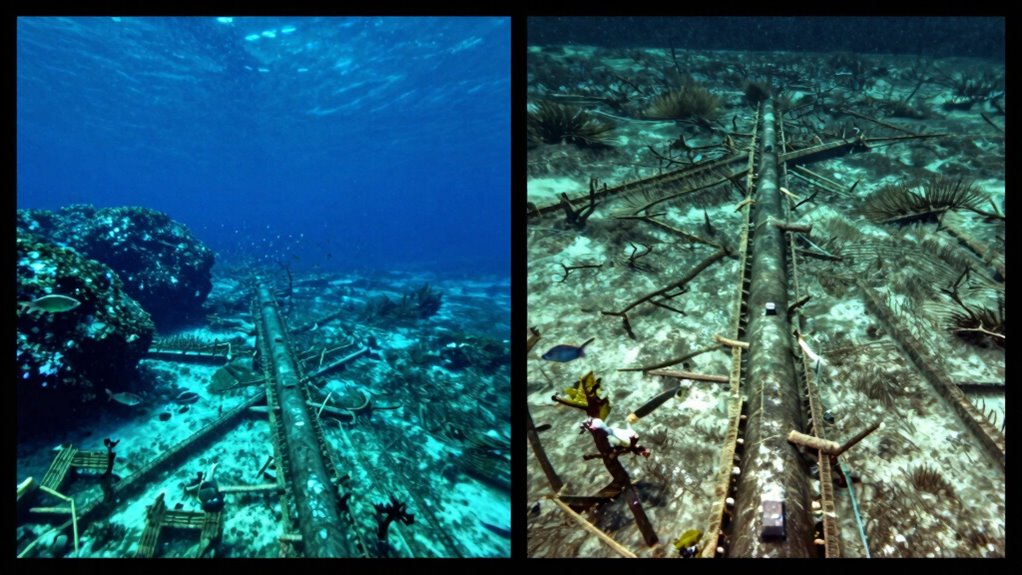
If you’re trying to cover large areas efficiently, choosing the right fish finder can make a big difference. Side imaging fish finders excel at wide coverage, making area surveying quicker and easier. They provide detailed images of the sides of your boat, helping you identify fish hiding in cover or along structures. Down imaging focuses directly beneath your boat, offering high-resolution images of the bottom but with narrower coverage. For large-area surveying, side imaging is generally better because it scans more territory at once. It’s ideal when you need to monitor extensive waters or locate schools quickly. Additionally, understanding the water damage implications of your equipment is essential for maintaining its performance over time. Properly protecting your fish finder from water exposure can extend its lifespan and ensure accurate readings during your fishing trips. Being aware of waterproofing techniques can further help safeguard your device against unforeseen conditions.
How Accurate Are Side and Down Imaging for Identifying Fish?
How Accurate Are Side and Down Imaging for Identifying Fish?
Side and down imaging technologies are highly effective tools for identifying fish, but their accuracy can vary depending on conditions. You’ll find that larger fish are easier to identify clearly, as their size makes them stand out against the environment. However, smaller fish can sometimes be harder to distinguish, especially if they’re close to the bottom or near underwater vegetation. Vegetation can create visual clutter, making it tricky to accurately interpret what you’re seeing. Light penetration, water clarity, and the angle of the sonar also influence accuracy. resolution and the quality of your imaging system play crucial roles in the clarity and detail of the images you receive. While these imaging methods provide detailed images, they aren’t foolproof. You might see fish that aren’t there or miss some altogether, especially in complex habitats with dense underwater plant life. Understanding the capabilities of your imaging system can significantly impact your ability to identify fish accurately.
When Should You Use Side Imaging Instead of Down Imaging?
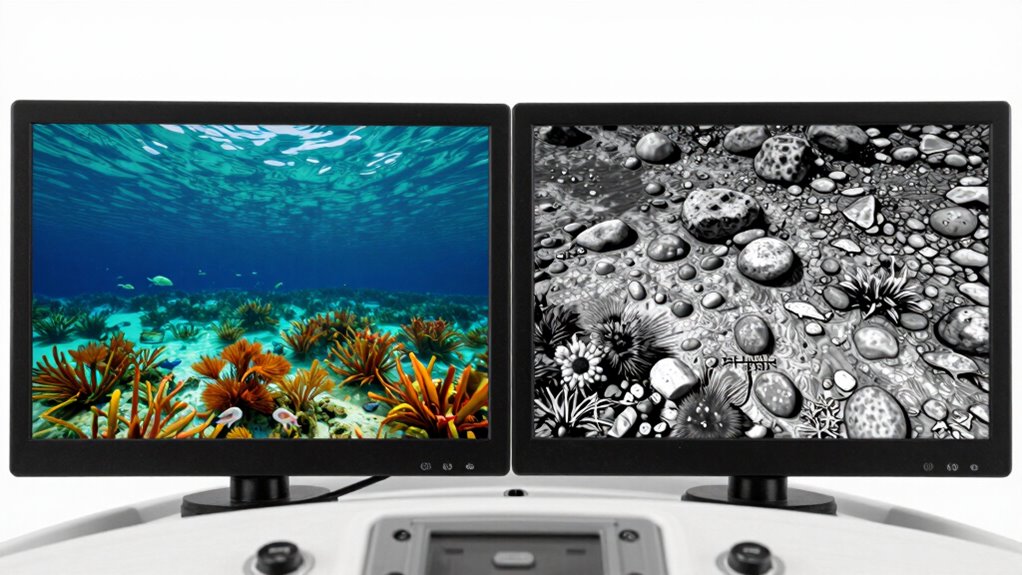
Knowing when to rely on side imaging instead of down imaging can substantially improve your fishing success. Use side imaging when you’re searching for fish around structures, submerged rocks, or weed beds that aren’t directly below your boat. Its wider sonar technology scan covers more water horizontally, making it ideal for locating schools or habitat features at a distance. The user interface of your fish finder also influences this choice; if it’s easier to interpret the side imaging display, you’ll spot fish more quickly.
| Situation | Best Imaging Type | Why |
|---|---|---|
| Searching large structures | Side Imaging | Wide coverage for locating features |
| Covering extensive areas | Side Imaging | Broader view to find fish schools |
| Precise depth or bottom detail | Down Imaging | Clarity for pinpointing fish |
Tips for Interpreting Fish Finder Images and Improving Your Skills
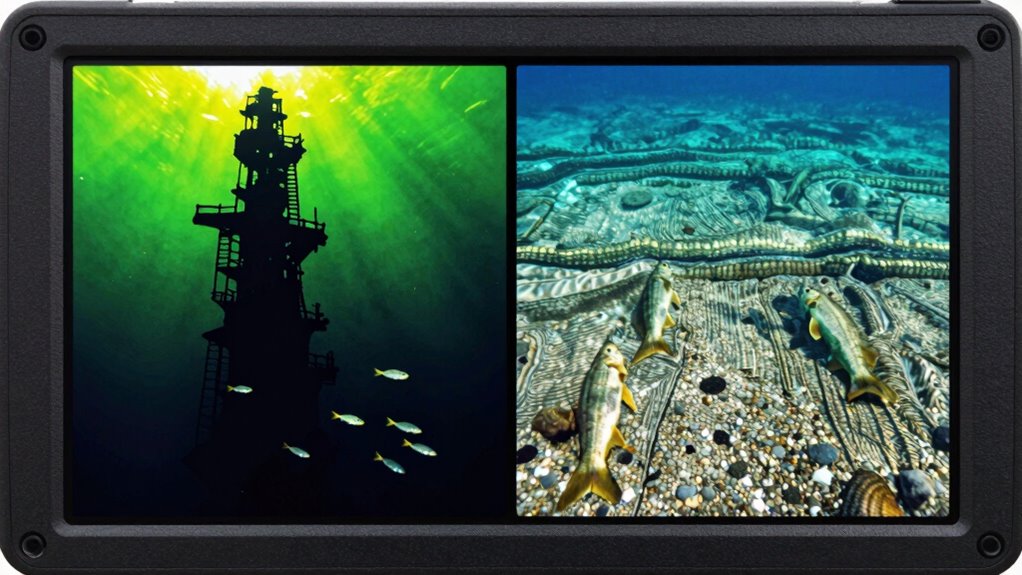
Interpreting fish finder images accurately can considerably boost your chances of a successful catch. To do this, familiarize yourself with sonar technology and how it displays underwater features. Pay attention to details like underwater vegetation, which often shows as dense, bright areas on the screen. Recognizing these patterns helps you differentiate between fish and clutter. Practice scanning at different depths and angles to improve your understanding of how fish and structures appear. Use zoom functions to clarify images and identify smaller targets. Keep your boat steady to avoid blurry images, and compare images over time to spot consistent patterns. Over time, your ability to read fish finder images will sharpen, making your fishing trips more productive and enjoyable.
Frequently Asked Questions
Can Side and Down Imaging Be Used Simultaneously?
Yes, you can use dual imaging with side and down imaging simultaneously. Many fish finders incorporate technology integration that allows you to view both images at once, giving you a complete view of underwater structures and fish. This dual imaging setup enhances your fishing experience by providing more detailed information. Make sure your device supports both imaging modes, so you can switch seamlessly and maximize your fishing success.
What Are the Limitations of Side and Down Imaging Technology?
Technology limitations can leave you lost in the lurch, especially with side and down imaging. Environmental factors like water clarity, depth, and debris distort details, diminishing image accuracy. Shadows and thermoclines can obscure targets, making precise positioning problematic. You’ll find that power constraints and equipment cost can also hamper performance, so understanding these limitations helps you optimize your approach and avoid overestimating what your imaging technology can truly reveal beneath the water’s surface.
How Does Water Clarity Affect Imaging Quality?
Water clarity directly impacts your imaging quality. When the water is clear, you’ll notice sharper, more detailed images, making it easier to identify fish and structures. Conversely, murky or muddy water reduces image clarity, obscuring details and making it harder to interpret what’s beneath the surface. To get the best results, try to fish in areas with good water clarity, which enhances your overall imaging experience.
Are There Specific Brands That Excel in Imaging Accuracy?
When it comes to imaging accuracy, brands like Garmin and Lowrance stand out for their reputation and imaging precision. While some may prioritize affordability, these brands deliver sharp, detailed images that help you spot fish and structures clearly. You’ll find that investing in reputable brands pays off with consistently reliable performance. So, if precision matters, stick with these proven leaders to get the clearest, most accurate imaging on the water.
How Do I Calibrate My Fish Finder for Optimal Images?
You should start by accessing your fish finder’s menu and selecting the calibration or imaging settings. Adjust the sensitivity, contrast, and depth range to match your fishing environment. Make small changes and observe the results on the screen, ensuring clear and detailed images. Regular fish finder calibration helps optimize imaging accuracy, making it easier to identify fish and structures. Don’t forget to save your settings once you’re satisfied.
Conclusion
In the end, choosing between side and down imaging is like picking a trusty compass on a foggy day—each guides you differently. With a little practice, you’ll become as adept as a seasoned sailor spotting treasures beneath the waves. Remember, whether you’re scanning vast waters or peering directly below, understanding what your fish finder shows will turn you into a catch master. So, embrace the tech, and happy fishing—your next big haul could be just a scan away!