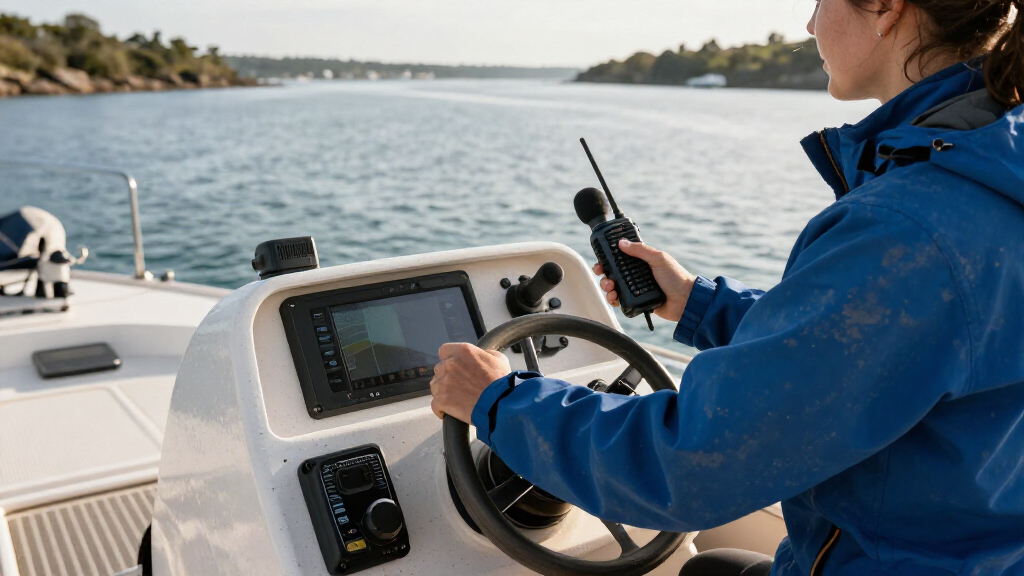
Choosing the right boat navigation radios can mean the difference between a routine trip and a safe return. My top pick for most boaters is the Uniden UM385BK because it balances powerful 25-watt transmission with intuitive controls and reliable DSC features. For those needing portability, the Cobra BlueBound 350 stands out for its rugged build and ease of use, while the Simrad GO9 XSE offers an integrated chartplotting solution for larger vessels. The main tradeoff you will face is between the raw power of fixed-mount units and the flexibility of handhelds. Continue reading to see which of these twelve options fits your specific boating needs.

Get sports gear delivered free with Prime
- Fast, free delivery on millions of items
- Prime Video, Amazon Music and more included
- Member-only deals all year
Complete the kit



Key Takeaways
- Fixed-mount 25-watt radios like the Uniden UM385BK provide significantly greater range and reliability than handheld units, making them the standard for primary vessel communication.
- Handheld radios are not just backups; models like the Icom M25EVO and Standard Horizon HX210 are essential for crew members moving around the deck or using tenders.
- DSC (Digital Selective Calling) capability is no longer a premium feature; even mid-range radios now include it, which is mandatory for sending automated distress signals with GPS location data.
- Waterproof ratings vary widely; while many claim IPX7, only specific models like the Retevis RM01P and Uniden Atlantis 155 are truly rated for submersion and floating, which is critical for rough conditions.
- Integrated GPS in radios is highly valuable for DSC functionality, but it often requires a separate antenna installation for fixed-mount units to work correctly, adding to the total setup complexity.
| Retevis RM01P 3.5W Floating VHF Marine Radio, IP67 Waterproof, USB-C Charging |  | Best for Rugged Portable Use | Transmit power: 3.5W | Channels: 88 | Battery capacity: 1750mAh | VIEW LATEST PRICE | See Our Full Breakdown |
| Cobra BlueBound 350 VHF Handheld Marine Radio |  | Best Handheld for Adjustable Transmit Power | Transmit power: Selectable 1W, 3W, or 6W | Channels: 98 | Maximum talking range: 25 miles (listed) | VIEW LATEST PRICE | See Our Full Breakdown |
| Uniden UM385BK 25-Watt Fixed-Mount Marine VHF Radio |  | Best Fixed-Mount Pick for DSC Safety | Radio type: Fixed-mount marine VHF | Transmit power: 25W | Channels: 40 | VIEW LATEST PRICE | See Our Full Breakdown |
| Uniden Atlantis 155 Floating Handheld VHF Marine Radio |  | Best for Submersion Protection | Transmit power: Selectable 1W or 3W | Channels: 16 | Battery: 4 included 950mAh rechargeable AAA NiMH batteries | VIEW LATEST PRICE | See Our Full Breakdown |
| Uniden UM385 25-Watt Fixed-Mount Marine VHF Radio | 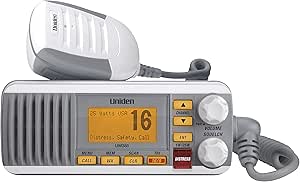 | Best Fixed-Mount Option for Regional Channel Coverage | Radio type: Fixed-mount marine VHF | Transmit power: 25W | Channels: 40 | VIEW LATEST PRICE | See Our Full Breakdown |
| Uniden UM725 Marine VHF Radio |  | Best Fixed-Mount Pick for All-Weather Readiness | Channels: 25 | Transmit power: Selectable 1 W or 25 W | Marine channel coverage: US, Canada, and international | VIEW LATEST PRICE | See Our Full Breakdown |
| Cobra BlueBound 350 Floating VHF Handheld Marine Radio, White |  | Best Handheld for Adjustable Power and Watchkeeping | Channels: 98 | Transmit power: Selectable 1, 3, or 6 W | Display: Day/night LCD | VIEW LATEST PRICE | See Our Full Breakdown |
| Simrad GO9 XSE Chartplotter and Fish Finder with HDI Transducer and C-MAP Discover Card |  | Best Navigation and Sonar Display | Display: 9-inch multi-touch | GPS: Built-in 10 Hz receiver | Sonar: 83/200 kHz CHIRP and DownScan Imaging | VIEW LATEST PRICE | See Our Full Breakdown |
| Standard Horizon HX210 6W Floating Handheld Marine VHF Transceiver |  | Best Handheld for Emergency Visibility | Channels: 200 | Output power: Selectable 6 W, 2.5 W, or 1 W | Battery: 1850 mAh Li-ion | VIEW LATEST PRICE | See Our Full Breakdown |
| Icom M25EVO Floating VHF Marine Radio, Blue |  | Best Lightweight Handheld for Simple Operation | Channels: 15 | Weight: 228 g (7.8 oz) | Maximum talking range: 5 miles | VIEW LATEST PRICE | See Our Full Breakdown |
| Retevis RM15 6W Floating VHF Marine Radio |  | Best for Overboard Visibility | Model: RM15-6W | Channels: 88 | Transmit power: Selectable 1W, 3W, or 6W | VIEW LATEST PRICE | See Our Full Breakdown |
| Retevis RA27 25W Fixed-Mount Marine Radio with GPS and DSC |  | Best Fixed-Mount Safety Features | Model: RA27 | Power: 25W | Channels: 88; USA, Canada, and international | VIEW LATEST PRICE | See Our Full Breakdown |
| boat navigation radio | Channels | Transmit power | Battery life |
|---|---|---|---|
| Retevis RM01P 3.5W Floating VH | 88 | 3.5W | Up to 15 hours |
| Cobra BlueBound 350 VHF Handhe | 98 | Selectable 1W, 3W, or 6W | Up to 12 hours |
| Uniden UM385BK 25-Watt Fixed-M | 40 | 25W | — |
| Uniden Atlantis 155 Floating H | 16 | Selectable 1W or 3W | Up to 10 hours |
| Uniden UM385 25-Watt Fixed-Mou | 40 | 25W | — |
| Uniden UM725 Marine VHF Radio | 25 | Selectable 1 W or 25 W | — |
| Cobra BlueBound 350 Floating V | 98 | Selectable 1, 3, or 6 W | Up to 12 hours |
| Simrad GO9 XSE Chartplotter an | — | — | — |
| Standard Horizon HX210 6W Floa | 200 | — | — |
| Icom M25EVO Floating VHF Marin | 15 | — | Up to approximately 14 hours in Eco Mode |
| Retevis RM15 6W Floating VHF M | 88 | Selectable 1W, 3W, or 6W | Over 10 hours operation; up to 100 hours standby |
| Retevis RA27 25W Fixed-Mount M | 88; USA, Canada, and international | — | — |
More Details on Our Top Picks
Retevis RM01P 3.5W Floating VHF Marine Radio, IP67 Waterproof, USB-C Charging
The Retevis RM01P is a practical pick for boaters who want a handheld that can survive a wet deck and stay easy to recharge. Its IP67 rating and floating design add reassurance if it gets splashed or dropped, while USB-C charging and an on-screen progress indicator make topping it up straightforward. The listed battery life of up to 15 hours exceeds the Cobra BlueBound 350’s 12 hours, which can matter on a long day away from shore. The tradeoff is its 3.5W output: unlike the Cobra’s selectable 6W setting, it offers less transmit-power flexibility. At 500 g, it is also heavier than the Cobra’s listed 9.44 ounces, so it may feel cumbersome when carried all day.
Pros:- IP67 rating protects against dust and water exposure
- Floating design helps keep the radio recoverable if dropped overboard
- USB-C charging includes an on-screen charging progress indicator
- Listed battery life of up to 15 hours is longer than the Cobra BlueBound 350’s 12 hours
Cons:- 3.5W output lacks the Cobra BlueBound 350’s selectable 6W setting
- At 500 g, it is substantially heavier than the listed Cobra BlueBound 350
- Up to 15 hours of battery life may not cover extended trips without recharging
Best for: Boaters who want a floating, dust-tight handheld with USB-C charging for day trips and wet working conditions
Not ideal for: Users who need the strongest selectable handheld output or a light radio to carry all day
- Transmit power:3.5W
- Channels:88
- Battery capacity:1750mAh
- Battery life:Up to 15 hours
- Standby time:Up to 66 hours
- Charging:USB-C, 5V
- Weight:500 g
Our verdict“Choose the RM01P for a tough, easy-to-recharge handheld, but pick the Cobra BlueBound 350 if higher selectable transmit power matters more than battery runtime.”
Cobra BlueBound 350 VHF Handheld Marine Radio
The Cobra BlueBound 350 stands out for boaters who want to choose how much power to use rather than accept one fixed output. Its 1W, 3W, and 6W settings let users favor battery conservation or stronger transmission as conditions call for it, giving it an advantage over the Retevis RM01P’s fixed 3.5W output. The day/night display, Tri-Watch, and NOAA weather alerts also make it a more feature-rich handheld for routine watchkeeping. If it goes overboard, the floating body and Float ’n Flash aid recovery. Its listed battery life is up to 12 hours, shorter than the Retevis’s 15, and the stated 25-mile talking range should not be treated as guaranteed in every boating environment. This pick suits feature-focused users, not those prioritizing longer listed runtime.
Pros:- Selectable 1W, 3W, and 6W output provides power and battery-management options
- Float ’n Flash helps locate the radio if it is dropped in the water
- Tri-Watch and NOAA weather alerts support routine monitoring
- Day/night LCD display is designed for changing light conditions
Cons:- Listed battery life of up to 12 hours is shorter than the Retevis RM01P’s 15 hours
- The stated maximum talking range of 25 miles depends on operating conditions
- IPX7 protection is less dust-specific than the Retevis RM01P’s IP67 rating
Best for: Recreational boaters who want selectable transmit power, weather alerts, and a floating handheld for varied day trips
Not ideal for: Boaters who prioritize the longest listed battery life or prefer a simpler, less feature-heavy radio
- Transmit power:Selectable 1W, 3W, or 6W
- Channels:98
- Maximum talking range:25 miles (listed)
- Battery life:Up to 12 hours
- Features:Tri-Watch, NOAA weather alerts, Float ’n Flash, day/night LCD
- Charging:USB-C
- Weight:9.44 ounces
Our verdict“Pick the BlueBound 350 if adjustable power and watchkeeping features matter more than the Retevis RM01P’s longer listed battery life.”
Uniden UM385BK 25-Watt Fixed-Mount Marine VHF Radio
For a boat with a dedicated helm installation, the Uniden UM385BK offers the greater transmission power and emergency-calling features that handhelds such as the Cobra BlueBound 350 cannot match. Its 25W output and Class D DSC support a more capable fixed-radio setup, including distress calling and position functions. Triple watch and NOAA SAME alerts add useful monitoring for regular trips. GPS-related position functions depend on pairing a compatible Uniden MRN-GPSK receiver, so buyers should account for that extra component rather than assume GPS is built in. This model is also IPX4 rated, protection for rain and splashing rather than submersion; it is not a replacement for a floating handheld such as the Uniden Atlantis 155. Choose it for an installed helm radio, not as a portable backup.
Pros:- 25W transmission suits a fixed-mount radio installation
- Class D DSC includes a distress call and position send and request functions
- Triple watch and NOAA SAME alerts support channel and weather monitoring
- Compatible with the Uniden MRN-GPSK GPS receiver for GPS-linked functions
Cons:- Compatible GPS receiver is a separate component
- IPX4 protection does not cover submersion
- Fixed-mount design is less useful as a portable or overboard-ready backup than the Uniden Atlantis 155
Best for: Boat owners installing a 12V helm radio who want 25W transmission, Class D DSC, and weather alerts
Not ideal for: Small-boat users seeking a portable radio or buyers who need waterproofing beyond rain and splashes
- Radio type:Fixed-mount marine VHF
- Transmit power:25W
- Channels:40
- Water resistance:IPX4
- DSC:Class D; distress, position send and request, and test call
- Weather alerts:NOAA SAME
- Voltage:12V
- GPS compatibility:Uniden MRN-GPSK receiver
Our verdict“Choose the UM385BK for a 12V helm installation with DSC safety features, but add a compatible GPS receiver if you need GPS-linked position functions.”
Uniden Atlantis 155 Floating Handheld VHF Marine Radio
The Uniden Atlantis 155 is the handheld to favor when protection against submersion matters more than high output or a long channel list. Its IPX8/JIS8 rating and floating design make it a stronger choice around water than the IPX7 Cobra BlueBound 350, while its speaker-clearing feature helps restore sound after the radio is submerged. The Atlantis 155 receives USA, Canadian, and international marine channels plus NOAA weather alerts, and its dual-color backlit display supports use in different light. Output tops out at 3W, below the Cobra’s 6W setting, and listed battery life is up to 10 hours. Its rechargeable AAA battery setup may also be less convenient than USB-C charging on the Retevis RM01P. This is a safety-minded handheld, not a long-runtime or high-output choice.
Pros:- IPX8/JIS8 submersion rating and floating design suit wet-deck use
- Speaker-clearing function helps restore audio after submersion
- Receives USA, Canadian, and international marine channels plus NOAA weather alerts
- Dual-color backlit LCD supports daytime and nighttime viewing
Cons:- Selectable output reaches only 3W, below the Cobra BlueBound 350’s 6W maximum
- Listed battery life is up to 10 hours, shorter than the Retevis RM01P’s 15 hours
- Uses included rechargeable AAA batteries rather than the Retevis RM01P’s USB-C charging setup
Best for: Boaters who want a floating handheld with a high submersion rating and access to multiple regional marine channel sets
Not ideal for: Users who need higher transmit power, longer listed battery life, or direct USB-C charging
- Transmit power:Selectable 1W or 3W
- Channels:16
- Battery:4 included 950mAh rechargeable AAA NiMH batteries
- Battery life:Up to 10 hours
- Display:Dual-color backlit LCD
- Maximum talking range:15 km (listed)
- Dimensions:1.5 x 2.5 x 8.9 inches
Our verdict“Choose the Atlantis 155 when submersion protection is your priority, but look to the Cobra BlueBound 350 for more transmit power or the Retevis RM01P for longer listed runtime.”
Uniden UM385 25-Watt Fixed-Mount Marine VHF Radio
The Uniden UM385 is a fixed-mount choice for boaters who want broad regional channel support alongside 25W transmission and DSC safety functions. It covers USA, international, and Canadian marine channels, making it a more flexible match for varied cruising areas than a handheld such as the Uniden Atlantis 155. Class D DSC includes a distress button and position features, while triple watch and NOAA weather alerts help with routine monitoring. Like the UM385BK, though, GPS-related functions rely on a compatible Uniden receiver, and the IPX4 rating only covers rain and splashes. The main distinction from the black UM385BK is the white-and-grey finish and listed weight of 3.6 pounds versus 3.3 pounds; buyers should compare installation fit and finish rather than expect a major feature difference.
Pros:- Supports USA, international, and Canadian marine channels
- 25W fixed-mount transmission with Class D DSC distress and position features
- Triple watch and NOAA weather alerts support regular monitoring
- White-and-grey finish offers an alternative to the UM385BK’s black styling
Cons:- IPX4 protection is for rain and splashes, not submersion
- GPS-related functions require a compatible Uniden GPS receiver
- At 3.6 pounds, it is slightly heavier than the UM385BK’s listed 3.3 pounds
Best for: Boat owners who want a fixed 25W radio with USA, international, and Canadian channel support
Not ideal for: Boaters needing a floating handheld, submersion protection, or GPS position functions without a separate compatible receiver
- Radio type:Fixed-mount marine VHF
- Transmit power:25W
- Channels:40
- Channel coverage:USA, international, and Canadian marine channels
- DSC:Class D; distress button and position features
- Water resistance:IPX4
- Weight:3.6 pounds
- Color:White and grey
Our verdict“Choose the UM385 for broad regional channel support in a fixed installation, while comparing it with the UM385BK if finish and listed weight matter more.”
Uniden UM725 Marine VHF Radio
For a boat with a 12-volt electrical system, the Uniden UM725 pairs fixed-mount output with features that support routine weather checks and emergency calling. Its selectable 1 W or 25 W transmission lets the operator use lower power nearby or higher power when more reach is needed, while DSC distress send and receive adds a dedicated emergency communication function. Compared with the handheld Cobra BlueBound 350, this radio suits a permanent helm installation rather than carrying around the boat, and it offers higher maximum transmit power. Its IPX8 waterproof rating and NOAA alerts are useful safeguards, but it depends on 12-volt power and is not a grab-and-go backup. The included speaker microphone adds radio controls and boat-to-boat text messaging, though that messaging is limited to compatible communication between boats.
Pros:- Selectable 1 W and 25 W transmit power supports nearby and longer-range calls.
- IPX8 waterproof rating suits a permanently installed marine radio.
- NOAA weather channels and alerts provide weather updates at the helm.
- DSC distress send and receive add an emergency-calling feature.
Cons:- Requires a 12-volt power source and is not a portable backup.
- Text messaging is limited to boat-to-boat communication.
- Its fixed-mount format is less practical than the handheld Cobra BlueBound 350 for moving around the boat.
Best for: Boat owners installing a fixed helm radio who want high-power VHF, NOAA alerts, and DSC distress calling.
Not ideal for: Kayakers, small-craft users without a 12-volt system, or anyone who needs a portable radio to carry away from the helm.
- Channels:25
- Transmit power:Selectable 1 W or 25 W
- Marine channel coverage:US, Canada, and international
- Weather features:NOAA weather channels and alerts
- DSC:Distress send and receive
- Power supply:12 V
- Included connections:NMEA0183 data cord and extension speaker cord
Our verdict“Choose the UM725 for a powered helm installation with 25-watt capability, weather alerts, and DSC; skip it if portability is the priority.”
Cobra BlueBound 350 Floating VHF Handheld Marine Radio, White
The Cobra BlueBound 350 is a strong fit for crews who want one handheld radio for regular calls, weather checks, and monitoring more than one channel. Its 1, 3, and 6-watt settings give more flexibility than the 6-watt-only upper setting on the Icom M25EVO, while Tri-Watch helps keep selected channels in view. The floating, IPX7-rated body and Float ’n Flash retrieval aid address a practical risk: a dropped radio can stay visible and recoverable. A day/night LCD and NOAA alerts also suit changing light and weather conditions. The tradeoff is limited endurance—battery life is listed at up to 12 hours—and handheld range varies with conditions, so it cannot replace the stronger fixed-mount reach of the Uniden UM725.
Pros:- Selectable 1, 3, and 6-watt output balances range and power use.
- Floating IPX7-rated design includes Float ’n Flash retrieval assistance.
- Tri-Watch supports monitoring multiple selected channels.
- USB-C charging and NOAA weather alerts suit regular onboard use.
Cons:- Battery life is listed at up to 12 hours, which may not cover extended trips without recharging.
- The stated maximum range can vary with terrain, antenna position, and conditions.
- As a handheld, it does not match the Uniden UM725’s 25-watt fixed-mount output.
Best for: Small-boat operators and crew members who want an adjustable-power handheld with channel monitoring and a visible recovery aid.
Not ideal for: Boaters who need a fixed-mount 25-watt radio for longer-range communication or routinely spend more than a day away from charging.
- Channels:98
- Transmit power:Selectable 1, 3, or 6 W
- Display:Day/night LCD
- Channel monitoring:Tri-Watch
- Weather channels:12
- Battery life:Up to 12 hours
- Charging port:USB-C
Our verdict“Pick the BlueBound 350 for a versatile floating handheld with useful watchkeeping features, not as a substitute for a high-power helm radio.”
Simrad GO9 XSE Chartplotter and Fish Finder with HDI Transducer and C-MAP Discover Card
The Simrad GO9 XSE serves a different job from the VHF radios in this roundup: it combines chartplotter navigation and fish-finding sonar, but it is not a marine radio. Its 9-inch touchscreen, built-in GPS, included C-MAP Discover card, and HDI transducer make it a centralized helm display for boaters who want charts and underwater information together. Compared with the Uniden UM725, it offers chart and sonar functions rather than VHF voice communication or DSC distress calling; buyers may need both devices for those separate tasks. Wi-Fi, NMEA 2000, customizable split screens, and support for select Simrad radar systems allow a more connected setup, though radar needs separate compatible equipment. Automatic routing is unavailable in the USA, which limits one of the chart-planning conveniences some buyers may expect.
Pros:- Combines chartplotter navigation with CHIRP sonar and DownScan Imaging.
- Includes an HDI transducer and a C-MAP Discover card with US and Canada coverage.
- Nine-inch touchscreen supports customizable split-screen views.
- NMEA 2000, Wi-Fi, and compatibility with select Simrad radar systems support system expansion.
Cons:- It is not a VHF radio and does not provide voice or DSC distress communication.
- Automatic routing features are unavailable in the USA.
- Radar functions require a separately compatible Simrad radar system.
Best for: Owners outfitting a helm with chart navigation and sonar who already have, or plan to add, a separate VHF radio.
Not ideal for: Buyers looking for a boat navigation radio, handheld emergency communications, or a chartplotter with automatic routing in the USA.
- Display:9-inch multi-touch
- GPS:Built-in 10 Hz receiver
- Sonar:83/200 kHz CHIRP and DownScan Imaging
- Included transducer:HDI
- Chart card:C-MAP Discover, US and Canada coverage
- Connectivity:Wi-Fi and NMEA 2000
- Radar compatibility:Simrad Broadband 3G, Broadband 4G, and Halo Pulse Compression
Our verdict“Choose the GO9 XSE as a chart-and-sonar helm display alongside a separate VHF radio, not as a radio replacement.”
Standard Horizon HX210 6W Floating Handheld Marine VHF Transceiver
The Standard Horizon HX210 makes emergency signaling its clearest distinction: its water-activated strobe can flash SOS or remain on, and the radio floats face up if dropped. That gives it a different safety emphasis from the Icom M25EVO, whose Float’n Flash feature helps locate a dropped radio but does not list the same SOS strobe function. The HX210 also offers selectable 6 W, 2.5 W, and 1 W output, NOAA weather reception, FM broadcast reception, and USA, international, and Canadian channels. Its rapid charging cradle with AC and DC cables is useful for keeping it ready at home or aboard. The main limitation is the listed five-mile maximum range, so buyers who prioritize greater handheld reach may prefer the Cobra BlueBound 350, while a fixed-mount radio remains a better choice for higher-power communication.
Pros:- Floats face up and carries an IPX7 waterproof rating.
- Water-activated strobe can flash SOS or stay on continuously.
- Selectable 6 W, 2.5 W, and 1 W output suits different communication needs.
- Includes NOAA and FM reception plus AC/DC charging accessories.
Cons:- Listed maximum talking range is five miles.
- Charging relies on the supplied cradle and AC/DC cables rather than USB-C.
- FM reception is limited to the stated 76–108 MHz frequency range.
Best for: Small-boat crews who want a floating handheld with an emergency strobe and flexible charging options.
Not ideal for: Boaters who need a longer stated handheld range, or buyers who want USB-C charging rather than the included cradle and cables.
- Channels:200
- Output power:Selectable 6 W, 2.5 W, or 1 W
- Battery:1850 mAh Li-ion
- FM frequency range:76–108 MHz
- Weather reception:NOAA weather channels
- Included charging accessories:Rapid charger cradle with AC and DC cables
- Warranty:3-year waterproof warranty
Our verdict“Choose the HX210 if an emergency strobe and cradle-based charging matter more than the Cobra BlueBound 350’s longer listed range.”
Icom M25EVO Floating VHF Marine Radio, Blue
At 7.8 ounces, the Icom M25EVO is the easiest option here to carry through a day of line handling or moving between the cockpit and deck. Its textured grip, large buttons, and floating IPX7-rated body favor straightforward operation in wet conditions. USB-C charging and Eco Mode, rated for up to approximately 14 hours, give it an endurance advantage on paper over the Cobra BlueBound 350’s stated 12-hour maximum. The tradeoff is a less detailed feature set in the supplied information: it lists 15 channels and a five-mile maximum range, while the Cobra lists more channels and Tri-Watch. Float’n Flash and AquaQuake add recovery and speaker-clearing help, but this is still a handheld rather than a 25-watt helm radio like the Uniden UM725. Battery duration also varies by mode.
Pros:- Lightweight 7.8-ounce body with a textured grip and large buttons.
- Floating IPX7-rated design includes Float’n Flash and an alarm when dropped in water.
- USB-C charging and Eco Mode support up to approximately 14 hours of battery life.
- AquaQuake helps clear water from the speaker.
Cons:- Listed maximum talking range is five miles.
- The supplied specifications list 15 channels, fewer than the Cobra BlueBound 350’s 98.
- Battery life varies by mode, so the Eco Mode figure may not reflect typical use.
Best for: Boaters seeking a light, easy-grip handheld with USB-C charging for short trips and routine onboard communication.
Not ideal for: Crews who need a high-power fixed radio, broad channel-monitoring features, or a clearly specified long-range communication option.
- Channels:15
- Weight:228 g (7.8 oz)
- Maximum talking range:5 miles
- Battery life:Up to approximately 14 hours in Eco Mode
- Charging:USB Type-C
- Additional water-use features:Float’n Flash and AquaQuake
- Included components:Antenna, battery, and belt clip
Our verdict“Choose the M25EVO for a light, simple-to-handle handheld with USB-C charging, but pick the Cobra BlueBound 350 for more channel-monitoring options.”
Retevis RM15 6W Floating VHF Marine Radio
The RM15’s floating body and water-activated emergency strobe give it a useful safety advantage over the Retevis RM01P: if the radio goes overboard, it is designed to stay afloat and become easier to spot. Its selectable 1W, 3W, and 6W power lets users choose lower output nearby or higher output when they need more reach, while noise reduction can help keep voice communications clearer. USB-C charging on both the radio and charger is practical for boaters who want a familiar charging setup. The tradeoff is that the stated 16 km range depends on conditions, so it should not be treated as guaranteed coverage. At 302.3 g, it is also heavier than some handheld alternatives; buyers seeking a fixed, higher-output setup should look at the Retevis RA27 instead.
Pros:- Floating design and IP68 waterproof rating help protect the radio after an accidental drop.
- Water-activated emergency strobe can make the radio easier to locate in the water.
- Selectable 1W, 3W, and 6W transmit power offers flexibility for different communication needs.
- USB-C charging and stated operation of over 10 hours support practical use on longer outings.
Cons:- The 16 km communication range is a stated maximum, not a dependable range in all marine conditions.
- At 302.3 g, it may feel heavy for users who carry a handheld radio for extended periods.
Best for: Small-boat crews and coastal boaters who want a handheld VHF that is easier to recover and locate if dropped overboard.
Not ideal for: Boaters who want a lightweight radio for all-day carry or a fixed-mount radio with built-in GPS and DSC distress calling.
- Model:RM15-6W
- Channels:88
- Transmit power:Selectable 1W, 3W, or 6W
- Maximum stated communication range:16 km
- Battery capacity:2000mAh
- Battery life:Over 10 hours operation; up to 100 hours standby
- Charging:USB-C; 5V/1A or 5V/2A adapter
- Water protection:IP68; floating design with water-activated emergency strobe
- Dimensions and weight:1.57 × 2.44 × 5.35 in; 302.3 g
Our verdict“Choose the RM15 if flotation and a water-activated locator matter more than a lighter handheld or the GPS and DSC features of the fixed-mount RA27.”
Retevis RA27 25W Fixed-Mount Marine Radio with GPS and DSC
The RA27 pairs built-in GPS with DSC distress calling, making it a stronger choice for a boat’s primary radio than a handheld such as the Retevis RM15. GPS can supply position information for distress calls, while NMEA 0183 connectivity lets the radio work with compatible chartplotters. It also covers USA, Canadian, and international channels and adds NOAA weather alerts and triple watch, giving crews useful communication and monitoring options from the helm. Its 25W fixed-mount design suits a powered vessel better than a grab-and-go setup, but it needs a 13.8-volt supply and an installation location. Chartplotter integration is limited to compatible NMEA 0183 equipment, so owners with other connection standards should check their setup before buying. IP67 protection is useful aboard, but this is not a floating handheld backup.
Pros:- Built-in GPS supports position information for DSC distress calling.
- NMEA 0183 connectivity allows integration with compatible chartplotters.
- USA, Canadian, and international channel support suits boaters operating across channel regions.
- Bracket or flush mounting gives installers flexibility, and IP67 protection adds water resistance.
Cons:- Requires a 13.8-volt power supply and a fixed installation, unlike the portable Retevis RM15.
- Chartplotter compatibility is limited to NMEA 0183.
- The stated maximum talking range of 10 miles should not be treated as guaranteed coverage.
Best for: Owners of powered boats who want a helm-mounted VHF with built-in GPS, DSC distress calling, and compatibility with NMEA 0183 chartplotters.
Not ideal for: Kayak users, small-craft operators without a 13.8-volt supply, or boaters who need a portable radio or chartplotter integration beyond NMEA 0183.
- Model:RA27
- Power:25W
- Channels:88; USA, Canada, and international
- Power supply:13.8 volts
- GPS and distress calling:Built-in GPS and DSC
- Chartplotter connectivity:NMEA 0183
- Additional features:NOAA weather alerts and triple watch
- Water protection and mounting:IP67; bracket or flush mount
- Dimensions:6.1 × 3.38 × 2.68 in
Our verdict“Pick the RA27 for a powered boat’s fixed helm station when built-in GPS and DSC matter more than handheld portability.”
How We Picked
I evaluated these twelve units by prioritizing communication reliability, regulatory compliance, and ease of use under stress. The primary metric was transmission power and clarity, as a radio that cannot be heard in heavy wind or rain fails its core purpose. I also weighed the importance of DSC integration, since automated distress calling is a safety standard that separates modern marine electronics from outdated hobbyist gear. Build quality was assessed based on waterproof ratings and button tactile feedback, ensuring that gloves can be worn without struggling to operate controls.
The ranking logic favors versatility and safety redundancy. Fixed-mount units are ranked higher than handhelds for primary vessel use because of their superior range and antenna potential. However, high-quality handhelds are ranked above low-power fixed units because a portable radio can save lives when a vessel loses main power or crew members are separated. I also considered the ecosystem; radios that pair well with existing chartplotters or have simple antenna requirements were favored over those requiring complex professional installations.
| boat navigation radio | Battery life |
|---|---|
| Retevis RM01P 3.5W Floating VH | Up to 15 hours |
| Cobra BlueBound 350 VHF Handhe | Up to 12 hours |
| Uniden UM385BK 25-Watt Fixed-M | — |
| Uniden Atlantis 155 Floating H | Up to 10 hours |
| Uniden UM385 25-Watt Fixed-Mou | — |
| Uniden UM725 Marine VHF Radio | — |
| Cobra BlueBound 350 Floating V | Up to 12 hours |
| Simrad GO9 XSE Chartplotter an | — |
| Standard Horizon HX210 6W Floa | — |
| Icom M25EVO Floating VHF Marin | Up to approximately 14 hours in Eco Mode |
| Retevis RM15 6W Floating VHF M | Over 10 hours operation; up to 100 hours standby |
| Retevis RA27 25W Fixed-Mount M | — |
Factors to Consider When Choosing Boat Navigation Radios
Selecting marine communication equipment requires balancing technical specifications with practical usability. Here are the key factors that should drive your decision.Fixed-Mount vs. Handheld: Defining Your Primary Role
The first decision is whether you need a primary communication hub or a portable backup. Fixed-mount radios typically offer 25 watts of power, allowing communication over 20-30 nautical miles under ideal conditions. This power level is necessary for contacting Coast Guard stations or other vessels in open water. In contrast, handhelds usually range from 1 to 6 watts, limiting their effective range to 1-5 nautical miles. A common mistake is relying solely on a handheld as the main radio, which can leave you isolated during emergencies. If you have a console, a fixed-mount unit is mandatory for serious boating. If you operate a small dinghy or kayak, a high-quality handheld is your primary and only link to safety services.
The Importance of DSC and GPS Integration
Digital Selective Calling (DSC) transforms a radio from a voice device into a digital safety beacon. When paired with a GPS receiver, a DSC-enabled radio can send an automated distress signal containing your precise location, vessel name, and MMSI number. This feature dramatically reduces response times because rescuers know exactly where to look. Many modern radios, like the Uniden UM725, include internal GPS, but others require an external antenna connection. Failing to connect the GPS antenna is a frequent installation error that renders DSC location features useless. Always verify if your chosen radio needs a separate GPS module or if it has one built-in, and factor that into your installation plan.
Waterproofing and Durability Standards
Marine environments are hostile to electronics due to salt spray, humidity, and accidental submersion. Look for an IPX7 rating, which means the device can withstand immersion in up to one meter of water for 30 minutes. However, not all waterproof claims are equal; some units are splash-proof but will fail if dropped overboard. Floating radios, such as the Retevis RM01P and Uniden Atlantis 155, offer a distinct advantage by staying on the surface if dropped. For fixed-mount units, durability refers to resistance to UV degradation and corrosion on connectors. A radio that fails due to moisture ingress is worse than no radio at all, so prioritize units with sealed keypads and robust housing materials.
Antenna Requirements and Installation Complexity
A 25-watt radio is only as good as its antenna system. Most fixed-mount radios do not include an antenna, and using a generic or improperly mounted one will cripple performance. A 1.5-meter fiberglass antenna is standard for pleasure craft, but its height and location on the vessel affect range significantly. Handhelds have fixed antennas that cannot be upgraded, which is a physical limitation you cannot engineer around. When buying a fixed-mount unit, budget for a quality marine antenna and coaxial cable. Incorrect installation, such as using non-marine-grade connectors, can lead to signal loss and water damage. If you are not comfortable with radio frequency basics, professional installation is a worthwhile investment to ensure your system works when needed.
Ease of Use Under Stress
Marine radios must be operable with wet hands, heavy gloves, and in low-light conditions. Small, flat touchscreens or tiny buttons are difficult to manipulate in rough seas. Look for units with tactile, backlit buttons and large, high-contrast displays. The Cobra BlueBound 350 is praised for its simple interface, which reduces cognitive load during emergencies. Complex menus that require multiple keystrokes to change channels are a liability when seconds count. Test the ergonomics if possible, or read reviews specifically mentioning glove operation. A radio that is intuitive to use will be used correctly; a confusing one will lead to errors when you are panicked or exhausted.
Frequently Asked Questions
Do I really need a fixed-mount radio if I have a handheld?
Yes, if you operate a vessel larger than a small tender or kayak. Handheld radios typically operate at 1-6 watts, which limits their range to a few nautical miles and makes them susceptible to interference from the boat’s own electronics and structure. A fixed-mount 25-watt radio connects to a dedicated antenna on the highest point of the vessel, providing a clear line of sight and much greater range. This is critical for contacting Coast Guard stations or distant vessels during an emergency. Relying solely on a handheld is a significant safety risk because its lower power output may not reach rescue services in bad weather or heavy traffic.
What is the difference between IPX7 and IP67 ratings on marine radios?
IPX7 indicates that the device is protected against temporary immersion in water up to one meter for 30 minutes, but it does not specify protection against dust. IP67, however, offers both complete dust protection and the same water immersion standard. In a marine environment, dust and sand can infiltrate keypads and charging ports, causing long-term failure. A radio with an IP67 rating, like the Retevis RM01P, is generally more durable for rough coastal use or boats that are stored on trailers where dust is prevalent. If you only see IPX7, assume the unit is splash-proof but vulnerable to particulate ingress over time.
Can I use a marine radio without an MMSI number?
You can use it for voice communication, but you cannot use the Digital Selective Calling (DSC) distress feature effectively. The MMSI number is your unique digital identifier that allows the Coast Guard and other vessels to identify you and locate you via DSC. Without it, pressing the distress button will send a signal but will not include your identity or precise location, forcing rescuers to search a wider area. Obtaining an MMSI number is free for most recreational boaters through national regulatory bodies. It is a simple process that takes minutes and is required to fully utilize the safety capabilities of modern marine radios.
Why do some handheld radios float while others sink?
Floating radios are designed with buoyant materials and sealed casings that displace enough water to stay on the surface. This is a critical safety feature because dropping a radio overboard is common, and a sinking unit is lost instantly. Models like the Uniden Atlantis 155 and Standard Horizon HX210 are engineered to float, often with bright colors for visibility. Non-floating radios are typically denser and will sink rapidly, especially in saltwater. If you are purchasing a handheld for active deck use, fishing, or tenders, a floating model is highly recommended to prevent accidental loss during rough handling or wet conditions.
Is it better to buy a radio with built-in GPS or connect to an external one?
Built-in GPS is convenient for handhelds and smaller fixed-mount units because it requires no extra wiring. However, for fixed-mount installations, an external GPS antenna often provides a stronger signal and more accurate location data. Internal GPS antennas can suffer from interference from the radio’s own circuitry or the vessel’s metal structure. If you already have a chartplotter or GPS system on your boat, connecting the radio to that network via NMEA 2000 or NMEA 0183 protocols is often the most robust solution. This ensures your distress signal uses the same high-quality location data as your navigation system, reducing the chance of discrepancies during a rescue.
Conclusion
Choosing the right boat navigation radios depends entirely on your vessel size and operating environment. For most recreational boaters with a console, the Uniden UM385BK is the best overall choice due to its reliable 25-watt power and user-friendly DSC features. If you are on a tight budget but need essential safety features, the Retevis RA27 offers impressive value with GPS and DSC included. For those who prioritize portability and ruggedness, the Icom M25EVO stands out as the best premium handheld, offering exceptional clarity and durability. Beginners should start with the Cobra BlueBound 350 for its straightforward interface and forgiving learning curve. Finally, if you need an all-in-one navigation and communication hub, the Simrad GO9 XSE is the best integrated solution, though it requires a higher initial investment and installation effort. Match the radio’s capabilities to your actual usage patterns to ensure you have reliable communication when it matters most.