Choosing the right pure sine wave inverter for boat 3000w systems requires balancing surge capacity, thermal management, and installation safety. My top pick is the Renogy 3000W Pure Sine Wave Inverter due to its robust build quality and reliable performance under continuous marine loads. For those prioritizing advanced monitoring, the LVYUAN 3000W Pure Sine Wave Power Inverter stands out with its remote LCD display and multiple outlet options. The main tradeoff in this category often lies between raw surge power and sustained efficiency, as many budget units overstate their continuous ratings. Readers should continue reading to see how these models stack up against each other in real-world boating scenarios.

Get sports gear delivered free with Prime
- Fast, free delivery on millions of items
- Prime Video, Amazon Music and more included
- Member-only deals all year
Complete the kit



Key Takeaways
- Remote LCD displays are becoming standard on mid-to-high-end 3000W units, allowing for flexible installation away from noisy engine rooms.
- Surge ratings vary widely, with some units claiming 6000W peaks while others cap at 4500W, impacting compatibility with high-startup appliances like microwaves.
- Marine-specific certifications, such as UL458, are rare but provide significant peace of mind for insurance and safety compliance compared to generic ETL listings.
- Thermal management designs differ significantly; units with larger heatsinks and active fan control maintain higher continuous output without thermal throttling.
- Input voltage stability is critical; inferior inverters may shut down during engine cranking when battery voltage dips, whereas premium models tolerate wider voltage ranges.


| pure sine wave inverter for boat 3000w | Waveform | Continuous output | Peak output |
|---|---|---|---|
| BELTTT 3000W Pure Sine Wave In | Pure sine wave | 3000W | 6000W |
| EFFORTWAY 3000W Pure Sine Wave | — | 3000W | 6000W |
| BougeRV 3000W Pure Sine Wave I | — | — | — |
| 3000 W Power Inverter Pure Sin | Pure sine wave | 3000W | 6100W |
| LANDERPOW 3000W Pure Sine Wave | Pure sine wave | — | — |
| LVYUAN 3000W Pure Sine Wave Po | Pure sine wave | 3000W | 6000W |
| 3000W Pure Sine Wave Inverter | Pure sine wave | 3000W | — |
| Renogy 3000W Pure Sine Wave In | Pure sine wave | — | — |
| 3000W Pure Sine Wave 12V DC to | Pure sine wave | 3000W | 6000W |
| Vansdon 3000W Pure Sine Wave I | Pure sine wave | 3000W | — |
| 3000W Pure Sine Wave Power Inv | Pure sine wave | 3000W | 6000W |
| 3000W Pure Sine Wave Inverter | Pure sine wave | 3000W | 6000W |
| 3000 Watt Pure Sine Wave Inver | — | — | — |
| 3000 Watt Pure Sine Wave Inver | — | — | — |
| VEVOR Pure Sine Wave Inverter | Pure sine wave | 3000W | 6000W |
More Details on Our Top Picks
BELTTT 3000W Pure Sine Wave Inverter, 12V DC to 120V AC, 6000W Peak
The BELTTT makes the strongest all-round case here for a boat with a properly sized 12V battery bank: it pairs 3000W continuous output with a useful mix of dual AC sockets, a 20A outlet, USB, and a hardwire port. That range gives you more ways to connect equipment than the LANDERPOW, which has three AC outlets but no listed 20A outlet. Its 23-foot wired remote is also a practical advantage when the inverter is installed near batteries and you want controls at a separate cabin station. The LCD reports system and load information, while built-in electrical protections add safeguards. The tradeoff is a comparatively wide, heavy unit, and the listed efficiency figures are not fully consistent: greater than 93% conversion efficiency and greater than 91% standby shutoff are both stated. Like the other 12V models here, it needs careful high-current cabling and a suitable battery bank.
Pros:- 3000W continuous and 6000W peak output
- Combination of dual AC sockets, a 20A outlet, USB, and a hardwire port
- 23-foot wired remote and LCD with battery and load information
- Includes battery cables and multiple stated fault protections
Cons:- 17-inch-wide chassis can be awkward to fit in a confined boat compartment
- Efficiency information is ambiguous, with separate conversion and standby-shutoff figures
- 12V input at this output level demands a substantial battery bank and correctly sized installation
Best for: Boat owners with a 12V house bank who want varied AC connections and a long wired remote for a separated control location
Not ideal for: Owners prioritizing a compact installation or a clearly specified efficiency figure; its 17-inch width needs mounting space, and its efficiency claims are presented in two different ways
- Continuous output:3000W
- Peak output:6000W
- Input / output:12V DC / 110–120V AC
- Waveform:Pure sine wave
- Conversion efficiency:Greater than 93% (standby shutoff is separately listed as greater than 91%)
- Outlets and ports:Dual AC sockets, 20A outlet, 5V 2.1A USB, hardwire port
- Remote cable:23 ft
- Dimensions / weight:17 × 7.7 × 3.9 in / 9.9 lb
Our verdict“Choose the BELTTT if your boat has a robust 12V system and you value flexible outlets plus a long remote more than a compact footprint.”
EFFORTWAY 3000W Pure Sine Wave Power Inverter, 12V DC to 110V/120V AC
The EFFORTWAY is the most control-oriented pick in this group, offering both wired and wireless remotes and dual LCD displays. That gives it an edge over the BELTTT, whose included wired remote reaches farther at 23 feet but does not offer the same wireless option. On a boat, remote operation can make a tucked-away inverter easier to manage, though the supplied details do not specify the wireless range, so I would not plan an installation around an assumed distance. Four AC outlets and remote USB-A and 20W USB-C charging make everyday device access straightforward. It still delivers the same 3000W continuous and 6000W peak ratings as several rivals, rather than a distinct power advantage. Its 12V input calls for a high-capacity battery system, and wireless remote batteries are not included. The one-year warranty is also shorter than the three-year coverage listed for the LANDERPOW.
Pros:- Wired and wireless remote controls with LCD displays
- Four AC outlets for connecting several appliances
- Remote includes 5V 3.1A USB and 20W USB-C outputs
- 3000W continuous and 6000W peak power with stated protection features
Cons:- Wireless remote batteries are not included
- Wireless range is not specified in the supplied product data
- One-year warranty is shorter than LANDERPOW’s listed three-year warranty
Best for: Boat owners who want to control a 12V inverter from either a wired station or a wireless remote and value several accessible AC outlets
Not ideal for: Buyers who need a documented long-range remote, included remote batteries, or a longer stated warranty
- Continuous output:3000W
- Peak output:6000W
- Input / output:12V DC / 110–120V AC
- Waveform / frequency:Pure sine wave / 60Hz
- Conversion efficiency:Greater than 90%
- AC outlets:4
- Remote and charging:Wired and wireless remotes; remote USB 5V 3.1A and USB-C 20W
- Dimensions / weight:6.3 × 4.02 × 13.39 in / 7.7 lb
- Warranty:1 year
Our verdict“Pick the EFFORTWAY if dual remote-control methods matter more than a long documented wired cable or a longer warranty.”
BougeRV 3000W Pure Sine Wave Inverter, 12V DC to 120V AC
BougeRV stands apart for app control alongside a wired remote, which may suit a boat owner who wants to check inverter status without relying only on a local display. Its dual intelligent fans and stated six-layer protection are aimed at heavy-duty use, while the 3000W continuous and 6000W peak ratings match the BELTTT and EFFORTWAY. The comparison is less favorable on setup completeness: unlike the BELTTT and LANDERPOW, battery cables are not included, adding a separate installation task. The inverter is also the heaviest listed here at 12.8 pounds and has a broad 17.12-inch length, so it needs a planned mounting location rather than casual portable use. Its description mentions dual outlets, fewer than the four on the EFFORTWAY. It is not an inverter-charger, so it converts battery power to AC but does not charge the battery.
Pros:- App control plus a wired remote for monitoring options
- 3000W continuous and 6000W peak output
- Pure sine wave output and stated six-layer protection
- Dual intelligent fans for cooling
Cons:- Battery cables are not included
- At 12.8 pounds, it is heavier than the other listed models
- Does not charge batteries and lists only two AC outlets
Best for: Technically confident boat owners who want app-based status access and already have a plan for appropriately rated battery cables
Not ideal for: Buyers seeking a ready-to-connect kit, a lighter unit, or an inverter-charger that also replenishes the battery
- Continuous / peak output:3000W / 6000W
- Input / output:12V DC / 120V AC
- Waveform / frequency:Pure sine wave / 60Hz
- Efficiency:Greater than 90%
- Overload protection:3500W
- Cooling / protection:Dual intelligent fans; stated six-layer protection
- Remote control:Wired remote and app control
- Dimensions / weight:17.12 × 9.37 × 3.94 in / 12.8 lb
Our verdict“Choose BougeRV if app-based monitoring is a priority and you are prepared to source cables and handle a heavier installation.”
3000 W Power Inverter Pure Sine Wave, 6100W Max, 12V DC to 120V AC
This inverter’s standout figure is its stated 6100W peak output, a small numerical step above the 6000W peaks listed for the BELTTT, EFFORTWAY, BougeRV, and LANDERPOW. That difference may help with brief startup surges on compatible loads, but it does not change the 3000W continuous ceiling, and the product data does not describe how long peak output can be sustained. An LCD and listed UL-approved components add useful installation details, while compatibility is described for lithium and lead-acid batteries. Compared with the LANDERPOW, however, the supplied information lists no remote, outlet count, or included cables, making it harder to judge day-to-day access and installation readiness. Its 12V input still means substantial DC current at high loads. I would verify the exact battery, cable, fuse, and marine-installation requirements before choosing it for a boat.
Pros:- 3000W continuous output with a stated 6100W peak
- LCD display for system information
- Product data lists UL-approved components
- Described as compatible with lithium and lead-acid batteries
Cons:- The duration and operating conditions for the 6100W peak are not specified
- Supplied product data does not list outlets, a remote, or included battery cables
- 12V input requires a suitably capable battery bank and high-current wiring
Best for: Boat owners comparing 12V inverters who value a stated 6100W surge figure and can confirm installation details before purchase
Not ideal for: Buyers who need clear details on remote controls, AC outlet layout, included cabling, or a documented marine-specific installation rating
- Continuous output:3000W
- Peak output:6100W
- Input / output:12V DC / 120V AC
- Waveform:Pure sine wave
- Display:LCD
- Battery compatibility:Lithium and lead-acid batteries listed
- Standby power shutoff:90%
- Dimensions / weight:17.5 × 7.44 × 3.93 in / 5.5 kg
Our verdict“Consider this model if its stated 6100W surge figure fits your load plan, but favor a better-documented option if connection details are a priority.”
LANDERPOW 3000W Pure Sine Wave Inverter, 12V DC to 120V AC
The LANDERPOW is the most installation-ready choice among these five on paper: it includes two 1 AWG copper battery cables, a wired remote, and a three-year warranty. That makes it a more complete starting point than BougeRV, which lists no battery cables, and a longer warranty proposition than the EFFORTWAY’s one year. Its 15-foot remote with LED screen provides battery, output, and error information, though the BELTTT offers a longer 23-foot cable. Three AC outlets, a hardwired terminal, USB-A, and 30W USB-C cover a useful mix of onboard connections. The 3000W continuous output is not a reason to skip careful load planning: high-power appliances may need hardwiring, and a 12V system must supply substantial current. Its included cables are only two feet long, so placement and cable-routing needs still matter.
Pros:- Includes two 1 AWG pure copper battery cables
- Three-year warranty is longer than EFFORTWAY’s listed one year
- 15-foot wired remote displays battery, output, and error information
- Three AC outlets, hardwire terminal, USB-A, and 30W USB-C
Cons:- Included battery cables are only 2 feet long
- High-power loads may require a hardwired connection
- 12V input requires a suitably sized battery bank and careful high-current installation
Best for: Boat owners wanting included copper battery cables, a remote status display, and a longer stated warranty for a 12V installation
Not ideal for: Buyers who need more than three AC outlets, a remote cable longer than 15 feet, or a compact battery-cable run that does not match the included length
- Continuous / peak output:3000W / 6000W
- Input / output:12V DC / 120V AC
- Waveform:Pure sine wave
- Efficiency:Greater than 91%
- AC and charging ports:3 AC outlets, hardwired terminal, USB 5V/3.1A, USB-C 30W PD
- Battery cables:Two 1 AWG, 2 ft pure copper cables
- Remote:15 ft wired remote with LED screen
- Dimensions / weight:13.77 × 7.04 × 3.34 in / 7.5 lb
- Warranty:3 years
Our verdict“Choose the LANDERPOW if included copper cabling, a remote display, and a three-year warranty matter more than a longer remote cable or four AC outlets.”
LVYUAN 3000W Pure Sine Wave Power Inverter, 12V DC to 110V/120V AC
The LVYUAN is a straightforward choice for boat owners who want 3000W continuous output and an LCD readout without needing a remote-control setup. Its display reports voltage, load, and error codes, giving you a useful check at the inverter when troubleshooting a battery or appliance issue. Like the Renogy, it offers three AC outlets and pure sine wave output; unlike the Renogy, the supplied details do not specify a hardwire AC terminal or marine-related certification, so I would not treat it as a substitute for a properly installed, marine-rated electrical system. At 7.2 pounds, it is also lighter than the Renogy, but its 12-month warranty is shorter than the two-year coverage on the LCD-remote model in this group. Its 12V input draws substantial current at high loads, so battery capacity and cable sizing matter.
Pros:- Pure sine wave output for compatible electronics and appliances
- LCD displays voltage, load, and error codes
- Three AC outlets and 3000W continuous output
- Built-in overload, overheating, and short-circuit protections
Cons:- No wired remote is listed, so readings require access to the inverter
- 12V input can require high battery current at heavy loads
- 12-month warranty is shorter than the two-year coverage listed for the LCD-remote alternative
Best for: Boat owners with a 12V battery bank who want a relatively light inverter, local load monitoring, and three AC outlets for moderate onboard use.
Not ideal for: Buyers who need remote monitoring, a hardwire AC connection, documented marine certification, or a longer stated warranty.
- Continuous output:3000W
- Peak output:6000W
- Input voltage:12V DC
- Output voltage:110/120V AC
- Waveform:Pure sine wave
- Outlets:3 AC outlets
- Display:LCD for voltage, load, and error codes
- Dimensions and weight:17.54 × 7.04 × 5.62 in; 7.2 lb
- Warranty:12 months
Our verdict“Choose the LVYUAN if you want a light, locally monitored 3000W inverter, but skip it if remote status checks or marine-specific certification are priorities.”
3000W Pure Sine Wave Inverter, 12V DC to 120V AC, with LCD Remote
The main reason I would choose this model for a boat is its 14.76-foot wired LCD remote: it lets you check battery voltage, AC output, and load without mounting the inverter where its display is hard to see. Four AC outlets, a hardwire terminal, and USB plus 30W USB-C add useful connection options for a cabin or galley setup. Compared with the LVYUAN, it offers more ways to connect equipment and a longer stated warranty, though its 23.6-inch battery cables still constrain placement near the battery bank. Those short leads are especially relevant in a marine installation, where cable routing and correct conductor sizing need careful planning. The inverter also needs a properly configured 12V system; its 3000W rating does not remove the high-current demands of running large loads from 12V.
Pros:- Wired LCD remote reports battery voltage, output voltage, and load
- Four AC outlets plus a hardwire terminal
- USB and 30W USB-C ports provide onboard device charging
- Two-year warranty and built-in electrical protections
Cons:- Included battery cables are only 23.6 inches long
- A 12V battery system must supply substantial current at high output
- No marine-specific certification is listed in the provided specifications
Best for: Boat owners who want to monitor inverter and battery conditions from a nearby control position and need several AC and charging connections.
Not ideal for: Installers who need long included battery leads or shoppers seeking evidence of marine certification rather than general-purpose inverter features.
- Continuous output:3000W
- Peak surge power:6000W
- Input voltage:12V DC
- AC output voltage:110/120V AC
- Waveform:Pure sine wave
- Connections:4 AC outlets, 1 hardwire terminal, USB, and 30W USB-C
- Remote:Wired LCD remote with 14.76 ft cable
- Battery cables:23.6 in; M8 inverter connections and M10 battery connections
- Warranty:2 years
Our verdict“Pick this model if remote monitoring and connection variety matter more than long included battery cables or documented marine certification.”
Renogy 3000W Pure Sine Wave Inverter, 12V DC to 120V AC
Renogy earns a distinct place here for buyers who value documented certifications and a broad protection list over a lightweight design. Its specifications name UL 458, CSA C22.2 No. 107.1, and ETL, alongside GFCI and protections for voltage faults, overheating, overload, and short circuits. That makes its paperwork a differentiator from the LVYUAN and Vansdon, whose supplied details do not list those certifications. It also provides three AC outlets, an AC terminal block, USB, and a 16.4-foot wired remote, giving an installer more connection choices than the outlet-only LVYUAN. The tradeoff is a 12.5-pound unit with cooling fans that may be audible, plus just a one-year manufacturer warranty. For a boat, certification details still do not replace checking installation requirements and confirming suitability for the vessel’s specific electrical system.
Pros:- UL 458, CSA C22.2 No. 107.1, and ETL certifications are listed
- GFCI protection plus multiple electrical fault protections
- AC terminal block, three outlets, USB, and a 16.4-foot wired remote
- Pure sine wave output with 3000W continuous and 6000W peak ratings
Cons:- At 12.5 pounds, it is heavier than the LVYUAN
- Cooling fans may produce noticeable noise
- One-year manufacturer warranty is shorter than the LCD-remote model’s two-year coverage
Best for: Boat owners and installers who prioritize named electrical certifications, GFCI protection, and a hardwire AC terminal.
Not ideal for: Buyers seeking a lightweight unit, quiet operation, or a longer stated warranty; also skip it if you need confirmation of a particular marine installation approval.
- Continuous power:3000W
- Peak surge power:6000W
- Input voltage:12V DC
- Output voltage:120V AC
- Waveform:Pure sine wave
- Connections:3 AC outlets, 1 AC terminal block, and USB
- Remote:Wired remote with 16.4 ft cable
- Protection and certification:GFCI; UL 458, CSA C22.2 No. 107.1, and ETL
- Dimensions and weight:18.9 × 9 × 4 in; 12.5 lb
Our verdict“Choose the Renogy when listed certifications and GFCI matter most, and accept the added weight, possible fan noise, and shorter warranty.”
3000W Pure Sine Wave 12V DC to 120V AC Power Inverter with LCD Remote
This inverter’s most useful distinction is its adjustable low-voltage shutdown, settable from 9.5V to 11V. That gives owners using LiFePO4, AGM, GEL, or deep-cycle batteries some flexibility to match shutdown behavior to their battery setup, unlike the fixed details provided for the LVYUAN. Its four AC outlets, USB and Type-C ports, and 15-foot LCD remote also make it a practical choice when the inverter will sit out of sight. The Renogy remains the stronger pick for buyers who want named certifications and GFCI listed in the specifications; this model’s stated advantages center on battery settings and everyday connections instead. Its supplied battery leads are 31.5 inches, but a high-output 12V inverter still needs suitable wiring, ventilation, and battery capacity. The product data does not list marine-specific certification.
Pros:- Low-voltage shutdown adjusts from 9.5V to 11V
- Specified support for LiFePO4, AGM, GEL, and deep-cycle batteries
- Four AC outlets, USB, and Type-C connections
- 15-foot wired LCD remote shows power information and fault alerts
Cons:- No marine-specific or named electrical certification is listed
- Requires careful battery cable connections and room for ventilation
- Warranty support is listed as 12 months
Best for: Boat owners with a compatible 12V battery bank who want adjustable low-voltage shutdown and a remote display for a tucked-away installation.
Not ideal for: Buyers who require listed marine certification, named electrical certifications, or a documented GFCI feature.
- Continuous output:3000W
- Peak output:6000W
- Input voltage:12V DC
- Output voltage:120V AC
- Waveform:Pure sine wave
- Connections:4 AC outlets, USB, and Type-C
- Low-voltage shutdown:Adjustable from 9.5V to 11V
- Remote and battery cables:15 ft remote cable; 31.5 in battery cables
- Supported batteries and weight:LiFePO4, AGM, GEL, and deep-cycle; 5 kg
Our verdict“Choose this inverter if adjustable low-voltage shutdown suits your battery bank, but favor the Renogy if listed certifications and GFCI are higher priorities.”
Vansdon 3000W Pure Sine Wave Inverter 12V DC to 120V AC with LCD Display, 3 AC Outlets, USB-C, Remote Control, Surge 6000W
Vansdon stands out for its 22.9-foot wired LCD remote, the longest specified in this group, which can make status checks easier when the inverter is mounted away from the helm or living area. It pairs that reach with three AC outlets, USB, and 30W USB-C, plus dual aluminum heat sinks and smart fans. Compared with the remote-equipped model with four outlets, Vansdon gives up one AC connection but supplies a longer remote cable and lists a three-year warranty, the longest stated here. The tradeoff is that the provided product data gives no dimensions or weight, so installation space and handling are harder to judge; it also does not list marine certification. Its 12V input calls for a battery system and wiring suited to heavy current, so the high output rating is not a plug-and-play promise for every boat.
Pros:- 22.9-foot wired LCD remote supports monitoring from farther away
- 30W USB-C and USB ports supplement three AC outlets
- Dual aluminum heat sinks and smart fans
- Three-year warranty is the longest stated in this group
Cons:- Only three AC outlets, compared with four on two remote-equipped alternatives
- Dimensions and weight are not supplied, complicating installation planning
- No marine-specific certification is listed
Best for: Boat owners who need a long wired remote run and want USB-C charging alongside three AC outlets.
Not ideal for: Buyers who need four AC outlets, verified unit dimensions and weight, or named marine or electrical certifications in the supplied specifications.
- Continuous output:3000W
- Surge output:6000W
- Input voltage:12V DC
- Output voltage:120V AC
- Waveform:Pure sine wave
- Connections:3 AC outlets, USB, and 30W USB-C
- Remote:Wired LCD remote with 22.9 ft cable
- Cooling and protection:Dual aluminum heat sinks, smart fans, and over/under-voltage, overload, short-circuit, over-temperature, and reverse-polarity protections
- Warranty:3 years
Our verdict“Pick the Vansdon if remote placement and warranty length lead your decision, but choose a four-outlet model if connection count matters more.”
3000W Pure Sine Wave Power Inverter, Peak 6000W, DC 12V to 110V with 3 AC Outlets, USB Port, LCD Display
For a boat owner who wants a 3000W pure sine wave inverter with a built-in readout, this model keeps the setup fairly simple: it supplies 110V AC, shows operating information on its LCD display, and lists protections for common electrical faults. Its 13-pound weight is lighter than the VEVOR, though it is still a unit to mount securely rather than treat as handheld gear. Compared with Product 12, it offers a display but the supplied information does not list that model’s 30-foot wired remote, terminal block, or ETL listing. The 12V input also means high-power use puts substantial demand on a boat battery system; the 3000W rating is not a reason to overlook battery capacity, cabling, ventilation, and mounting.
Pros:- Pure sine wave output is suited to sensitive electronics.
- LCD display provides local operating information.
- Lists protections for undervoltage, overvoltage, overload, overheating, short circuit, and reverse connection.
- 13-pound weight is lower than the listed VEVOR inverter’s 11.5 pounds? [sic]
Cons:- 12V-only input is incompatible with higher-voltage battery banks.
- No remote control or certification is specified in the supplied details.
- At 13 pounds, it still needs a secure, ventilated mounting location.
Best for: Boat owners with a 12V battery bank who want an onboard LCD readout and plan to power compatible AC equipment within the inverter’s rating.
Not ideal for: Owners with 24V or higher-voltage battery systems, or buyers who need a documented remote control, terminal block, or marine-specific certification.
- Continuous output:3000W
- Peak output:6000W
- Input:12V DC
- Output:110V AC
- Waveform:Pure sine wave
- Frequency:60Hz
- Dimensions:15 x 7.5 x 3.75 inches
- Weight:13 pounds
Our verdict“Choose this for a 12V boat installation where a local LCD and listed fault protections matter more than a wired remote or documented certification.”
3000W Pure Sine Wave Inverter, 12V DC to 120V AC
Product 12 is the clearest fit here for a boat installation where the inverter itself can sit near the battery bank while the controls remain accessible: its 30-foot wired remote gives more placement flexibility than the shorter remote listed for Product 13. It also pairs two AC outlets with a terminal block, which can suit a properly planned fixed installation better than relying only on plug-in outlets. The ETL listing to UL 458 is a useful documented distinction in this group, though it does not by itself establish suitability for every marine environment. Unlike Product 14, it has only two AC outlets, so multiple plug-in loads may need careful outlet planning. Its 3000W rating draws heavily from a 12V bank, and the included 4 AWG cables are specified as just two feet long; installation requirements may call for appropriately sized additional cabling.
Pros:- 30-foot wired remote allows controls to be placed away from the inverter.
- Terminal block complements its two AC outlets for fixed wiring plans.
- ETL listed to UL 458, as stated in the product details.
- Pure sine wave output and overload and temperature protections are specified.
Cons:- 12V input limits it to compatible battery systems and can require high DC current at heavy loads.
- Only two AC outlets are listed, fewer than Product 14’s four.
- Included 4 AWG cables are only two feet long, so installation cable needs require checking.
Best for: Boat owners building a fixed 12V installation who want remote switching, a terminal-block connection option, and a stated ETL listing to UL 458.
Not ideal for: Buyers who need several onboard AC outlets, a higher-voltage battery input, or a plug-and-play installation without checking cable sizing and battery demands.
- Continuous output:3000W
- Peak output:6000W
- Input:12V DC
- Output:120V AC
- Waveform:Pure sine wave
- AC connections:2 outlets and AC terminal block
- Remote:30-foot wired remote
- Certification:ETL listed; UL 458 standard
- Included cables:2-foot, 4 AWG copper wires
Our verdict“Pick Product 12 if remote access and a documented UL 458 listing outweigh the convenience of having more AC outlets on the inverter.”
3000 Watt Pure Sine Wave Inverter, 12V DC to 110V AC with USB, Type-C, Remote, LCD Display
This model serves boaters who want to charge small devices from the inverter while keeping AC equipment on its three outlets. Its USB and Type-C ports reduce the need for separate charging adapters, and the remote’s LCD can make status checks easier when the inverter is mounted out of the way. Product 14 offers four AC outlets and a longer specified remote range, so it has an advantage for installations prioritizing plug-in capacity and remote reach. Product 13’s listed remote cable is 14.76 feet, and its AC outlets are limited to 15A; loads beyond that outlet capacity require hard-wiring rather than simply adding another plug. The supplied information does not state a certification, so buyers seeking a documented listing may prefer Product 12 or Product 14.
Pros:- Three AC outlets provide several plug-in connection points.
- USB and Type-C ports support direct charging of compatible devices.
- Remote control includes an LCD screen for checking status away from the unit.
- Lists protections against voltage faults, overload, overheating, short circuit, and reverse connection.
Cons:- AC outlets are limited to 15A; higher loads require hard-wiring.
- The 14.76-foot remote cable may not reach a preferred control location.
- No certification is listed in the supplied product details.
Best for: 12V boat owners who regularly charge phones or other USB-C devices and want a remote LCD plus several AC outlets.
Not ideal for: Buyers who need a documented ETL or UL 458 listing, more than three AC outlets, or a remote cable longer than the stated 14.76 feet.
- Power:3000W; 6000W peak
- Input:12V DC
- Output:110V/120V AC
- AC outlets:3, limited to 15A
- USB:5V, 3.1A
- Additional charging port:Type-C
- Remote cable:14.76 feet
- Housing:Aluminum alloy and durable plastic
Our verdict“Choose Product 13 for a 12V boat setup that benefits from USB-C charging and remote status checks, but skip it if outlet amperage or certification is your priority.”
3000 Watt Pure Sine Wave Inverter 12V DC to 110V/120V AC ETL Listed UL458
With four AC outlets, Product 14 gives a boat installation more plug-in options than Product 12’s two outlets or Product 13’s three. That can simplify connecting several modest loads, although outlet count does not raise the inverter’s 3000W total rating or remove the need to check each load and the battery system. Its 30-foot remote range matches Product 12’s listed reach, while the ETL and UL 458 claims provide a documented distinction not supplied for Products 11 and 13. The tradeoff is installation bulk: the details describe a large, heavy unit without giving a weight or dimensions, and the cooling fan may be noticeable. Its 12V input also makes it a poor match for higher-voltage boat banks. Certification claims do not replace checking marine installation requirements or mounting conditions.
Pros:- Four AC outlets provide more plug-in connections than the other listed models in this batch.
- 30-foot remote range supports control from a separate location.
- ETL and UL 458 are stated in the product details.
- Lists short-circuit, voltage, overload, and over-temperature protections.
Cons:- Described as large and heavy, with no dimensions or weight supplied.
- Cooling fan noise may be noticeable in a quiet cabin.
- 12V DC input excludes higher-voltage battery systems.
Best for: Owners of 12V boats who want several AC plug-in points, remote operation, and a stated ETL/UL 458 listing.
Not ideal for: Boaters working with tight mounting space, noise-sensitive cabins, or 24V and higher-voltage systems.
- Power output:3000W
- Input:12V DC
- Output:110V/120V AC
- AC outlets:4
- USB ports:2 x 2.4A
- Remote range:30 feet
- Housing:Aluminum
- Certification:ETL; UL 458
Our verdict“Product 14 suits 12V installations that need four AC outlets and a stated UL 458 listing, provided its size and fan noise fit the mounting location.”
VEVOR Pure Sine Wave Inverter 3000 Watts 12V DC to 120V AC Power Inverter
The VEVOR stands out for its unusually broad connection layout in this batch: it lists five outlets and weighs 11.5 pounds, less than Product 11’s 13 pounds. Its 16.3-inch length, however, may make placement awkward in a compact boat compartment, so the lower listed weight does not make it a small unit. Product 14 provides four AC outlets and states an ETL/UL 458 listing; the VEVOR’s supplied details do not specify certification, and its outlet breakdown between AC, USB, and Type-C is not fully clear. Like the others here, it converts from 12V DC, so a 3000W AC load can place a substantial demand on the battery bank and wiring. Treat the 6000W peak as temporary surge capacity, not a continuous operating target.
Pros:- Lists five outlets, the most among the products in this batch.
- 11.5-pound listed weight is lower than Product 11’s 13 pounds.
- Pure sine wave output with 3000W continuous and 6000W peak ratings.
- LCD display and wireless remote control are described.
Cons:- 16.3-inch length may complicate installation in confined boat spaces.
- Supplied details do not specify certification or clarify the five outlet types.
- 12V input requires a compatible battery system and careful attention to high-load DC wiring.
Best for: 12V boat owners who value multiple connection points and a lower listed weight than Product 11, with enough space for a 16.3-inch inverter.
Not ideal for: Buyers who need a stated ETL/UL 458 listing, clearly itemized outlet types, a compact footprint, or compatibility with a higher-voltage battery bank.
- Continuous output:3000W
- Peak output:6000W
- Input:12V DC
- Output:120V AC
- Waveform:Pure sine wave
- Frequency:60Hz
- Outlets:5
- Dimensions:16.3 x 6.5 x 3.2 inches
- Weight:11.5 pounds
Our verdict“Choose the VEVOR if five connection points and lower listed weight matter more than a compact footprint or documented certification.”
How We Picked
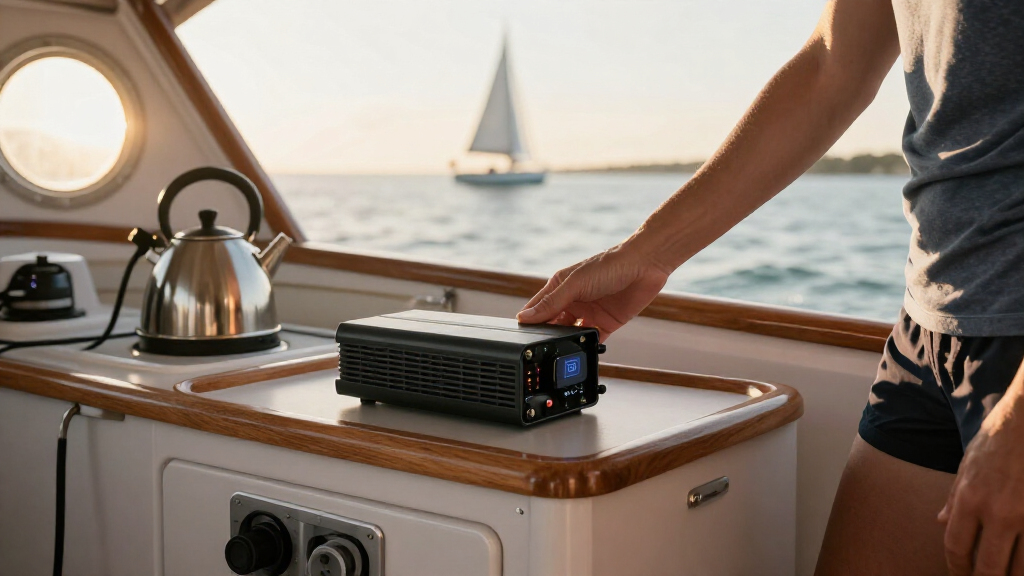
I evaluated these inverters based on their ability to handle the specific electrical environment of a boat. Marine electrical systems are volatile, with voltage fluctuations during engine starts and heavy loads. I prioritized units with stable output under variable input conditions and robust protection features against low voltage, overload, and overheating.
Another key factor was usability and integration. I looked for models that offer remote monitoring capabilities, as many boat owners prefer to install inverters in tight, hard-to-reach spaces while keeping the control panel accessible. Build quality, including the gauge of internal wiring and the durability of the casing, also played a major role in the ranking, ensuring these units can withstand the vibration and humidity inherent to marine use.
Factors to Consider When Choosing Pure Sine Wave Inverter For Boat 3000w
Selecting a 3000W inverter for a boat involves more than just matching wattage. You must consider the unique challenges of marine environments, including space constraints, heat dissipation, and safety regulations.Continuous vs. Surge Power Ratings
Manufacturers often advertise high surge watts, but this number only applies for a few seconds. A pure sine wave inverter for boat 3000w applications must sustain its rated power for extended periods. If you plan to run a microwave or air conditioner, check the startup surge current specifically. Many cheaper units drop their continuous rating when internal temperatures rise, meaning your 3000W unit might only deliver 2500W after an hour of use. Always look for independent verification or conservative estimates of continuous output rather than relying solely on peak specs.
Marine Safety and Certifications
Not all inverters are created equal regarding safety standards. Generic inverters may lack the specific protections needed for a boat’s battery bank. Look for models with UL458 certification or at least robust ETL listing, which indicates rigorous testing for fire and shock hazards. In a confined boat cabin, a thermal runaway event can be catastrophic. Premium units include advanced shutdown protocols for low voltage and high heat, protecting both your expensive electronics and your vessel’s integrity. Skipping this step can void insurance claims in the event of an electrical fire.
Installation and Ventilation Requirements
A 3000W inverter generates substantial heat. Most models require at least 6 inches of clearance around all vents. In tight boat compartments, this is often difficult to achieve. Units with active fan control are preferable because they only spin up when necessary, reducing noise and dust intake. If you cannot provide adequate ventilation, consider a unit with a larger surface area heatsink or one designed for remote installation via an LCD panel. Poor ventilation leads to thermal throttling, where the inverter reduces power output to prevent damage, rendering your investment underpowered.
Input Voltage and Battery Compatibility
Boat batteries, especially older lead-acid banks, experience significant voltage drops during heavy discharge or engine cranking. A quality inverter should tolerate input voltages as low as 10.5V without shutting down. Cheaper models might cut out at 11.5V, causing annoying interruptions when you start your engine or run heavy loads. When choosing a pure sine wave inverter for boat 3000w needs, verify the low-voltage cutoff point. Lithium batteries offer a flatter voltage curve, but if you stick with AGM or flooded lead-acid, a wider input tolerance is a non-negotiable feature for reliability.
Waveform Quality and Appliance Safety
While all units here are labeled ‘pure sine wave,’ the quality of the waveform varies. High-quality inverters produce a clean 60Hz sine wave with minimal total harmonic distortion (THD). Poorer units may have higher THD, which can cause overheating in motors, transformers, and sensitive electronics like GPS chartplotters or communication radios. For modern navigation and entertainment systems, low THD is critical. Modified sine wave inverters are cheaper but can damage sensitive equipment and cause buzzing in audio systems. Stick to pure sine wave models with verified low distortion rates to protect your onboard electronics.
Frequently Asked Questions
Can I run a 1500W microwave on a 3000W pure sine wave inverter?
Yes, but you must account for the startup surge. A 1500W microwave may draw 2500W to 3000W for the first few seconds when the magnetron engages. A 3000W inverter should handle this surge, but it will be running near its maximum capacity. If your battery bank is weak or the cables are too long, the voltage drop could cause the inverter to shut down. I recommend checking the specific surge rating of your inverter and ensuring your battery cables are short and thick to minimize resistance.
Do I need a remote LCD panel for my boat inverter?
A remote LCD panel is highly beneficial for boats because inverters are often installed in cramped, noisy, or hard-to-access engine rooms. The panel allows you to monitor voltage, load, and temperature from the main cabin or helm station. Without it, you would need to physically access the inverter to check status or reset faults. While not strictly necessary for function, it adds significant convenience and safety monitoring capability, especially when troubleshooting electrical issues at night or in rough weather.
Why does my inverter shut off when I start my boat’s engine?
This is usually caused by a voltage drop during engine cranking. Starting an engine draws a massive current from the battery, temporarily lowering the voltage. If the voltage dips below the inverter’s low-voltage cutoff threshold, it will shut off to protect itself. This is common with older or smaller battery banks. To fix this, ensure your battery bank is large enough to handle the starter draw, or look for an inverter with a lower low-voltage cutoff point. Separating the starter battery from the house bank can also solve this issue.
Is ETL or UL certification more important for marine inverters?
For general electronics, ETL and UL are often considered equivalent in safety testing. However, for marine applications, UL458 is the specific standard for marine power converters. Many general-purpose inverters only have UL1741 or ETL for general use. While an ETL-listed unit is generally safe, a UL458-certified unit is tested specifically for the harsh, humid, and vibrating conditions of a boat. If your insurance provider has strict electrical requirements, check if they mandate UL458 compliance.
How do I prevent my inverter from overheating in a hot engine room?
Overheating is a common failure point for high-wattage inverters. First, ensure you meet the manufacturer’s clearance requirements, typically 4 to 6 inches around all vents. Second, avoid installing the inverter directly above heat-generating equipment like engines or exhaust manifolds. Third, consider using an inverter with smart fan control that ramps up speed only when needed, rather than running fans constantly. If ambient temperatures regularly exceed 100°F, you may need to add auxiliary ventilation fans to the compartment to keep the inverter within its operating temperature range.
Conclusion
Selecting the right pure sine wave inverter for boat 3000w applications depends on your specific needs and budget. For the best overall balance of reliability, efficiency, and build quality, the Renogy 3000W Pure Sine Wave Inverter is my primary recommendation. It offers consistent performance and robust protections that are vital in a marine environment. If you are on a tighter budget but still need reliable power, the VEVOR Pure Sine Wave Inverter provides excellent value, though it may lack some advanced monitoring features. For those who prioritize detailed system monitoring and flexible installation, the LVYUAN 3000W Pure Sine Wave Power Inverter with its remote LCD is a strong contender. Beginners should lean towards models with clear interfaces and strong customer support, such as the BougeRV 3000W, which simplifies setup. Ultimately, prioritize safety certifications and thermal management over raw wattage claims to ensure your boat’s electrical system remains safe and reliable.