The Victron Energy Orion-Tr Smart 12/12V 30A Non-Isolated is my best overall marine DC-to-DC charger pick for boaters who want smart charging control and useful output without stepping up to a 50A unit. The Renogy 12V 20A is a simpler lower-output choice, while the Victron Orion XS Smart 12/12V 50A suits larger charging demands and higher-output installations. The main tradeoffs are charging current, isolated versus non-isolated wiring, battery compatibility, and the space and electrical capacity needed for installation. A charger designed for RVs or vans may still need careful review before marine use, especially around its environmental protection and installation requirements. Continue reading for the full breakdown of all 11 options and how to match one to your boat.

Get sports gear delivered free with Prime
- Fast, free delivery on millions of items
- Prime Video, Amazon Music and more included
- Member-only deals all year
Complete the kit



Key Takeaways
- The lineup’s clearest all-around balance is a 30A smart charger: it offers more charging output than the 9A, 18A, and 20A options without the installation demands of a 50A model.
- Isolation is a system-design choice, not a quality ranking: isolated Orion-Tr models can suit systems that need electrical separation, while non-isolated units may be a simpler fit when the battery banks share a suitable ground.
- The two 50A Victron options serve different system needs: the Orion XS Smart 12/12V is aimed at a 12V-to-12V installation, while the Orion XS 1400 supports a 12/24V configuration.
- Dual-input charging is a distinct feature, not a substitute for choosing the right DC charger: Renogy’s 30A dual-input model adds solar input, which may appeal to boats combining alternator and solar charging.
- Higher current is only useful when the whole installation supports it: cable sizing, alternator capacity, battery limits, ventilation, and mounting location can make a 50A charger less suitable than a lower-output pick.
| Renogy 12V 20A DC-to-DC Battery Charger |  | Best for Mixed Battery Chemistries | Model: RBC20D1U | Input voltage: 12 V DC | Output voltage: 12 V DC | VIEW ON AMAZON | See Our Full Breakdown |
| Victron Energy Orion-Tr Smart 12/12V 30A 360W Non-Isolated DC-DC Charger |  | Best App-Controlled 30A Charger | Model: ORI121236140 | Input voltage: 12 V DC | Output voltage: 12 V DC | VIEW ON AMAZON | See Our Full Breakdown |
| Renogy REGO 12V 20A DC-DC Battery Charger | | Best for Dry, Humid Installations | Input voltage: 16 V | Output voltage: 12 V DC | Supported batteries: 12V flooded, gel, AGM, and LiFePO4 | VIEW ON AMAZON | See Our Full Breakdown |
| Victron Energy Orion-Tr 12/12V 30A 360W Isolated DC-DC Converter, IP43 |  | Best Isolated Marine Converter | Model: ORI121240110 | Input voltage: 12 V DC | Output voltage: 12 V DC | VIEW ON AMAZON | See Our Full Breakdown |
| Victron Energy Orion XS Smart 12/12V 50A DC-DC Battery Charger | 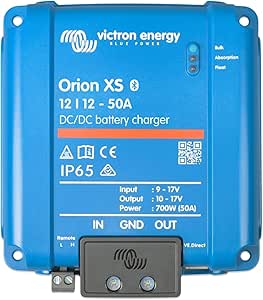 | Best High-Output Smart Charger | Model: ORI121217040 | Input voltage: 11.98 V DC | Output voltage: 12 V DC | VIEW ON AMAZON | See Our Full Breakdown |
| Renogy Smart 30A DC-DC MPPT Battery Charger 12V Dual Input for RVs and Vans |  | Best for Solar-and-Alternator Charging | Input voltage: 12V/24V | Maximum current: 30A | Battery compatibility: Lead-acid, lithium, AGM, gel, and flooded | VIEW ON AMAZON | See Our Full Breakdown |
| Victron Energy Orion-Tr 12/12V 9A 110W Isolated DC-DC Converter | 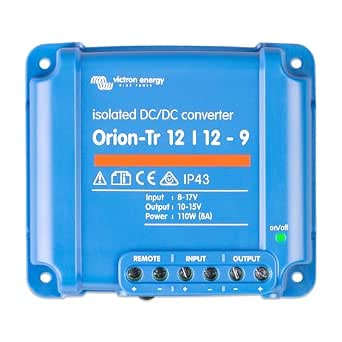 | Best for Low-Draw Isolated Systems | Input voltage: 12V DC | Output voltage: 12V DC | Output current: 9A | VIEW ON AMAZON | See Our Full Breakdown |
| Victron Energy Orion-Tr Smart Isolated DC-DC Charger, 12V/12V, 18A, 220W |  | Best for Moderate-Output Smart Charging | Input voltage: 12V DC | Output voltage: 12V DC | Output current: 18A | VIEW ON AMAZON | See Our Full Breakdown |
| Victron Energy Orion-Tr Smart Isolated DC-DC Charger, 12V/12V, 30A, 360W |  | Best All-Round Isolated Alternator Charger | Input voltage: 12V DC | Output voltage: 12V DC | Power: 360W | VIEW ON AMAZON | See Our Full Breakdown |
| Victron Energy Orion XS 1400 12/24V 50A DC-DC Charger |  | Best for High-Output and Mixed-Voltage Systems | Input voltage: 24V | Output voltage: 24V DC | Output power: 1400W | VIEW ON AMAZON | See Our Full Breakdown |
| Renogy 40A 12V DC-to-DC Battery Charger |  | Best for Higher-Current, Multi-Chemistry Charging | Input voltage: 12V DC | Output voltage: 12V | Stated charging current: 40A | VIEW ON AMAZON | See Our Full Breakdown |
| marine dc to dc charger | Input voltage | Output voltage | Dimensions | Power |
|---|---|---|---|---|
| Renogy 12V 20A DC-to-DC Batter | 12 V DC | 12 V DC | 2.3 × 9.31 × 5.17 in | — |
| Victron Energy Orion-Tr Smart | 12 V DC | 12 V DC | 3.2 × 7.3 × 5.1 in (D × W × H) | 360 W |
| Renogy REGO 12V 20A DC-DC Batt | 16 V | 12 V DC | 2.3 × 9.31 × 5.17 in | — |
| Victron Energy Orion-Tr 12/12V | 12 V DC | 12 V DC | 6.3 × 3.46 × 2.56 in | 360 W |
| Victron Energy Orion XS Smart | 11.98 V DC | 12 V DC | — | Up to 700 W |
| Renogy Smart 30A DC-DC MPPT Ba | 12V/24V | — | 9.6 × 5.7 × 3.13 in | — |
| Victron Energy Orion-Tr 12/12V | 12V DC | 12V DC | 4.92 × 3.54 × 1.77 in | 110W |
| Victron Energy Orion-Tr Smart | 12V DC | 12V DC | 2.8 × 7.3 × 5.1 in | 220W |
| Victron Energy Orion-Tr Smart | 12V DC | 12V DC | 3.2 × 5.1 × 5.1 in | 360W |
| Victron Energy Orion XS 1400 1 | 24V | 24V DC | 2.09 × 5.43 × 4.88 in | — |
| Renogy 40A 12V DC-to-DC Batter | 12V DC | 12V | 6 × 9.31 × 2.36 in (D × W × H) | — |
More Details on Our Top Picks
Renogy 12V 20A DC-to-DC Battery Charger
I’d choose the Renogy 12V 20A DC-to-DC Battery Charger when a boat’s house bank may change chemistry, or when different battery types need support: it handles flooded, gel, AGM, and lithium batteries and includes LiFePO4 activation. Alternator detection helps limit charging to engine-running periods, while multi-stage charging and electronic protections add safeguards for a dual-battery setup. Compared with the Victron Orion-Tr Smart 12/12V 30A, this Renogy supplies less current, so it is a better fit for modest charging needs than a bank that needs faster replenishment. Its compact wall-mount design is useful where space is tight, but app monitoring and control require a separately sold BT-2 module. I’d skip it if built-in Bluetooth or a 30A output matters more than broad chemistry support.
Pros:- Supports flooded, gel, AGM, and lithium batteries, including LiFePO4 activation.
- Alternator detection charges only when the engine is running.
- Electronic protection covers overload, short circuits, overheating, and overvoltage.
- Compact wall-mount form suits installations with limited space.
Cons:- Bluetooth monitoring and control require a separately sold BT-2 module.
- Its 20A output is lower than the 30A Victron Orion-Tr Smart and 50A Orion XS.
- The 12V input and output limit it to 12V dual-battery systems.
Best for: Boat owners with a 12V house battery who want one charger to support lead-acid and lithium chemistries at a moderate 20A rate.
Not ideal for: Boaters who want app monitoring out of the box or need more than 20A of alternator charging; Bluetooth requires a separate BT-2 module.
- Model:RBC20D1U
- Input voltage:12 V DC
- Output voltage:12 V DC
- Supported batteries:Flooded, gel, AGM, lithium
- Dimensions:2.3 × 9.31 × 5.17 in
- Weight:3.3 lbs
- Bluetooth:Renogy BT-2 required; sold separately
- Warranty:2-year material and workmanship warranty
Our verdict“Choose this Renogy for a compact 12V system that needs broad battery-chemistry support, but pick a higher-output Victron if charging speed is the priority.”
Victron Energy Orion-Tr Smart 12/12V 30A 360W Non-Isolated DC-DC Charger
The Victron Orion-Tr Smart 12/12V 30A is the stronger pick for a boat owner who wants app-based setup and monitoring without adding a separate Bluetooth module. Its VictronConnect app provides adjustments and status checks, while three-stage charging supports lead-acid and lithium service batteries. At 30A, it also charges at a higher rate than either 20A Renogy model in this group. The tradeoff is its non-isolated design, which may not suit installations that need electrical isolation between input and output. Compared with the isolated Victron Orion-Tr 30A converter, this Smart model adds charger-focused control and Bluetooth, but gives up isolation. Multiple units can be connected in parallel for more output, though that means a larger, more involved installation.
Pros:- 30A output is higher than the 20A Renogy chargers in this roundup.
- Bluetooth app supports monitoring and charging adjustments.
- Three-stage charging supports lead-acid and lithium batteries.
- Multiple units can be connected in parallel to increase output.
Cons:- Non-isolated construction is unsuitable for systems that require input-output isolation.
- App monitoring and adjustments require a smartphone or tablet.
- Parallel expansion adds wiring and installation complexity.
Best for: Owners of 12V boats with lead-acid or lithium service batteries who want 30A charging and Bluetooth setup through a phone or tablet.
Not ideal for: Installers whose system requires electrical isolation, or buyers who do not want to rely on a smartphone or tablet for app-based adjustments.
- Model:ORI121236140
- Input voltage:12 V DC
- Output voltage:12 V DC
- Power:360 W
- Supported batteries:Lead-acid and lithium
- Isolation:Non-isolated
- Connector type:Screw terminals
- Dimensions:3.2 × 7.3 × 5.1 in (D × W × H)
Our verdict“Pick this Victron when app control and 30A charging matter more than electrical isolation.”
Renogy REGO 12V 20A DC-DC Battery Charger
I’d shortlist the Renogy REGO 12V 20A for a dry, shaded boat installation where corrosion-resistant construction and multiple battery profiles matter more than built-in app access. It supports flooded, gel, AGM, and LiFePO4 batteries, with alternator detection and protection against reverse polarity, overload, short circuits, high temperature, and overvoltage. Compared with the Renogy 12V 20A charger in this roundup, its stated charging stages include bulk, boost, float, and equalization, but both share a 20A output and require the separately sold BT-2 for Bluetooth. That module is also needed to reduce output to 10A. The major marine limitation is placement: this unit is not waterproof, so it needs a protected, dry location. It also does not accept solar input.
Pros:- Supports flooded, gel, AGM, and LiFePO4 12V batteries.
- Alternator detection helps avoid drawing from the starter battery when the engine is off.
- Protection includes reverse polarity, overload, short circuits, high temperature, and overvoltage.
- Corrosion-resistant construction is suited to humid environments when installed in a dry, shaded location.
Cons:- Not waterproof and requires a dry, shaded mounting location.
- Does not accept solar input.
- BT-2 is sold separately and is required for Bluetooth monitoring and reducing output to 10A.
Best for: Boat owners installing a 20A alternator charger in a dry, shaded area who want selectable profiles for several 12V battery chemistries.
Not ideal for: Boaters who need a charger exposed to spray or weather, want solar charging, or expect Bluetooth controls without buying the BT-2 module.
- Input voltage:16 V
- Output voltage:12 V DC
- Supported batteries:12V flooded, gel, AGM, and LiFePO4
- Charging stages:Bulk, Boost, Float, Equalization
- Dimensions:2.3 × 9.31 × 5.17 in
- Connector type:SAE
- Cable requirement:10 AWG up to 3 m for 20A output
- Bluetooth module:BT-2 sold separately
Our verdict“Choose the REGO for protected marine installations needing flexible 12V charging profiles, not for exposed mounting or solar input.”
Victron Energy Orion-Tr 12/12V 30A 360W Isolated DC-DC Converter, IP43
The Victron Energy Orion-Tr 12/12V 30A Isolated is the lineup’s choice for a 12V dual-battery installation where electrical separation is a priority. Its isolated conversion distinguishes it from the Orion-Tr Smart 30A, which is non-isolated and adds Bluetooth charging controls instead. This model provides up to 30A and 360W, with screw terminals for straightforward wiring and IP43 splash protection when installed correctly. That rating offers more protection than an unprotected unit, but it is not permission to mount the converter where water can reach it directly. Unlike the Smart charger, the supplied details do not list Bluetooth or battery-chemistry charging profiles, so I’d favor it as a conversion component for a system designed around isolation rather than for buyers seeking app-guided charger setup.
Pros:- Isolated input and output suit systems that require electrical separation.
- Delivers up to 30A and 360W for 12V applications.
- IP43 splash protection is available when the unit is installed correctly.
- Screw terminals support a direct wired installation.
Cons:- IP43 protection depends on correct installation and does not make the unit waterproof.
- The supplied product details do not list Bluetooth monitoring or app-based setup.
- Limited to 12V DC input and output systems.
Best for: Marine electricians and boat owners building a 12V dual-battery system that specifically needs an isolated 30A DC-to-DC conversion stage.
Not ideal for: Buyers who want Bluetooth monitoring, detailed charging-profile controls, or a device suitable for exposed locations subject to direct water contact.
- Model:ORI121240110
- Input voltage:12 V DC
- Output voltage:12 V DC
- Output current:30 A
- Power:360 W
- Isolation:Isolated
- Dimensions:6.3 × 3.46 × 2.56 in
Our verdict“Choose this Orion-Tr when isolation is the deciding requirement; choose the Smart 30A model instead for Bluetooth charger controls.”
Victron Energy Orion XS Smart 12/12V 50A DC-DC Battery Charger
For a 12V boat with a larger service bank or an intelligent alternator, I’d put the Victron Orion XS Smart 12/12V 50A ahead of the 20A Renogy models when faster alternator charging is the goal. Its output reaches 50A and up to 700W, and Victron lists 98.5% efficiency; that combination supports substantial charging while limiting conversion losses. Configurable input and output currents, engine-running detection, and the VictronConnect app offer more control than the simpler Renogy chargers, which need a separate BT-2 for Bluetooth. The XS also has an IP65-rated, water-resistant design, a stronger fit for marine conditions than the REGO’s dry-location requirement, though it is not described as fully waterproof. It remains a 12V-only option, and its higher output may be unnecessary for smaller house banks.
Pros:- Up to 50A output is higher than the 20A Renogy and 30A Orion-Tr options in this group.
- Compatible with intelligent 12V alternators and includes engine-running detection.
- Bluetooth app provides setup controls, real-time data, and performance history.
- IP65-rated water-resistant design and stated 98.5% efficiency.
Cons:- Designed for 12V systems, not 24V systems.
- Water-resistant rather than described as fully waterproof.
- Higher output may be unnecessary for smaller service banks.
Best for: Owners of 12V boats with larger service batteries or intelligent alternators who want high charging current, configurable limits, and app monitoring.
Not ideal for: Boaters with modest charging needs, 24V systems, or installations requiring a unit explicitly described as fully waterproof.
- Model:ORI121217040
- Input voltage:11.98 V DC
- Output voltage:12 V DC
- Maximum output current:50 A
- Power:Up to 700 W
- Efficiency:98.5%
- Warranty:2 years
Our verdict“Choose the Orion XS for a high-demand 12V bank and intelligent alternator, but avoid it if you need a 24V or fully waterproof charger.”
Renogy Smart 30A DC-DC MPPT Battery Charger 12V Dual Input for RVs and Vans
I’d choose the Renogy Smart 30A when a boat’s house bank needs charging from both its alternator and solar array. Its built-in MPPT makes it more useful for mixed-source installations than the Victron Orion-Tr Smart 30A, which is described here as an alternator-fed charger rather than a solar-and-alternator unit. Support for lithium and several lead-acid chemistries also gives owners room to match the charger to different house batteries.
The tradeoff is setup: fuses and the optional Bluetooth module may require separate purchases, and monitoring also depends on compatible Renogy equipment or an app. Its 30A output is less suited to a large bank needing faster charging than the 50A Victron Orion XS. I’d shortlist it for compact marine installs where solar integration matters more than maximum output, but check the wiring and monitoring requirements before choosing it.
Pros:- Accepts solar and alternator charging with MPPT solar control
- Supports lithium, AGM, gel, flooded, and other lead-acid batteries
- Compact 9.6 × 5.7 × 3.13-inch form fits tighter installation spaces
- Includes protection against over-voltage, over-current, overheating, reverse polarity, and reverse current
Cons:- Fuses and the optional Bluetooth module may add parts and setup work
- Its 30A maximum output is below the 50A Victron Orion XS
- Monitoring depends on compatible Renogy equipment or app setup
Best for: Boat owners with a 12V house bank who want one compact charger to combine alternator and solar charging across supported battery chemistries.
Not ideal for: Owners seeking a high-output alternator-only charger, or buyers who want Bluetooth monitoring without purchasing or configuring additional components.
- Input voltage:12V/24V
- Maximum current:30A
- Battery compatibility:Lead-acid, lithium, AGM, gel, and flooded
- Dimensions:9.6 × 5.7 × 3.13 in
- Weight:3.13 lb
- Connectivity:Bluetooth module sold separately; RS485
- Protection:Isolation, over-voltage, over-current, overheat, reverse polarity, and reverse current
Our verdict“Choose the Renogy Smart 30A if your marine charging plan combines solar and alternator input in a compact installation.”
Victron Energy Orion-Tr 12/12V 9A 110W Isolated DC-DC Converter
The Orion-Tr 12/12V 9A is the low-output choice in this group, suited to a modest 12V load or a small auxiliary battery where galvanic isolation is the priority. Isolation separates input and output electrically, a useful design distinction for some dual-battery installations. Compared with the Victron Orion-Tr Smart 18A, this model supplies only 9A and has no listed Bluetooth monitoring or multi-stage battery-charging features; it is a simpler converter rather than a feature-rich charger.
That simplicity can suit a narrowly defined marine job, but it limits its usefulness for replenishing a substantial house bank. The IP43 splash protection applies only when installation is correct, so this is not a license to mount it where it will take direct spray. I’d pick it over the larger smart models only when its modest output and straightforward conversion match the system’s actual demand.
Pros:- Galvanic isolation suits separated input and output circuits
- Compact footprint for installations with limited space
- Screw terminals support direct wired installation
- IP43 splash protection when installed correctly
Cons:- 9A output is substantially lower than the 18A and 30A Victron Smart models
- No Bluetooth monitoring or battery-chemistry details are specified
- Splash protection depends on correct installation and placement
Best for: Boat owners who need isolated 12V-to-12V conversion for a small auxiliary system with modest current demand.
Not ideal for: Owners charging a larger house bank, needing Bluetooth monitoring, or looking for a higher-output smart charger with specified battery-chemistry support.
- Input voltage:12V DC
- Output voltage:12V DC
- Output current:9A
- Power:110W
- Isolation:Galvanically isolated
- Terminals:Screw terminals
- Dimensions:4.92 × 3.54 × 1.77 in
- Splash protection:IP43 when installed correctly
Our verdict“Choose this Orion-Tr when an isolated 12V supply with modest output matters more than smart charging features or faster bank charging.”
Victron Energy Orion-Tr Smart Isolated DC-DC Charger, 12V/12V, 18A, 220W
For a 12V boat system that needs more than a small converter but not the full output of a 30A unit, I’d look at the Victron Orion-Tr Smart 18A. It combines galvanic isolation, a three-stage charging process, and Bluetooth control in one charger. The Victron Orion-Tr 9A is simpler and lower-output; this model offers twice that current plus app-based adjustment, while the Victron Orion-Tr Smart 30A is the better fit when the bank needs more charging capacity.
The 18A ceiling is the main compromise: it may be slow for a large house bank or heavy onboard use. Its screw-terminal wiring also calls for a proper wired installation rather than plug-and-play setup. I’d favor this model for owners who value app access and battery-chemistry support but don’t need the 30A version. Multiple units can be connected in parallel for greater output, though that adds hardware and installation complexity.
Pros:- Three-stage charging supports a managed charging cycle
- Bluetooth allows monitoring and adjustments through VictronConnect
- Supports lead-acid and lithium batteries
- Parallel connection can expand output with additional units
Cons:- 18A output is lower than the 30A Victron Smart model
- Screw terminals require wired installation
- Increasing output through parallel units adds equipment and system complexity
Best for: Boat owners with a modest 12V house bank who want isolated, app-adjustable charging for lead-acid or lithium batteries.
Not ideal for: Owners with a large bank or high daily energy demand who need more than 18A from a single charger.
- Input voltage:12V DC
- Output voltage:12V DC
- Output current:18A
- Power:220W
- Battery compatibility:Lead-acid and lithium
- Connectivity:Bluetooth via VictronConnect
- Isolation:Isolated
- Dimensions:2.8 × 7.3 × 5.1 in
Our verdict“Choose the Orion-Tr Smart 18A for isolated, Bluetooth-managed charging when a 30A unit would be more capacity than your system needs.”
Victron Energy Orion-Tr Smart Isolated DC-DC Charger, 12V/12V, 30A, 360W
The Victron Orion-Tr Smart 30A earns its place as the balanced pick for a 12V marine house bank: it pairs 30A output with galvanic isolation, three-stage charging, and built-in Bluetooth. Compared with the Orion-Tr Smart 18A, it offers more current from a single unit, which can shorten charging time when the alternator and system are suited to that load. The Renogy Smart 30A adds solar-and-alternator input, so it has an advantage when solar integration is a central requirement.
This Victron is a better match for owners focused on alternator-fed charging who want to monitor or adjust operation in VictronConnect. Its limits are just as clear: output remains 30A, screw terminals need deliberate wiring, and Bluetooth monitoring depends on a phone or tablet. Parallel operation can add capacity, but it means additional units and installation work. I’d choose it for a capable single 12V bank, not as a substitute for a solar-input charger.
Pros:- 30A output offers more charging capacity than the 18A Orion-Tr Smart
- Built-in Bluetooth supports monitoring and adjustment through VictronConnect
- Three-stage charging supports lead-acid and lithium batteries
- Additional units can be connected in parallel
Cons:- Does not list solar input, unlike the Renogy Smart 30A
- Screw terminals require careful wired installation
- Bluetooth functions require a smartphone or tablet
Best for: Boat owners with a 12V house bank who want a 30A isolated alternator charger with Bluetooth adjustment and lead-acid or lithium support.
Not ideal for: Owners who need solar input in the same charger, require more than 30A from one unit, or prefer a display that does not rely on a mobile device.
- Input voltage:12V DC
- Output voltage:12V DC
- Power:360W
- Battery compatibility:Lead-acid and lithium
- Bluetooth:Built-in; VictronConnect monitoring and adjustment
- Connector type:Screw terminals
- Isolation:Isolated
- Dimensions:3.2 × 5.1 × 5.1 in
Our verdict“Choose this 30A Orion-Tr Smart for isolated alternator charging with app control, but select the Renogy if combined solar input is a priority.”
Victron Energy Orion XS 1400 12/24V 50A DC-DC Charger
For a boat with high charging demand or a mixed-voltage setup, the Victron Orion XS 1400 is the most capable option in this batch. Its listed 50A output and support for 12V, 24V, and mixed-voltage systems separate it from the 12V-only Victron Orion-Tr Smart 30A. It also supports a wider stated range of battery types, including LiFePO₄, AGM, and gel, and uses adaptive four-stage charging with engine-running detection to help protect the starter battery.
The tradeoff is that this capacity may be unnecessary for a modest 12V bank, where the 18A or 30A Orion-Tr Smart may be a simpler fit. Bluetooth monitoring uses VictronConnect, while remote management requires an additional Victron communication center. The listed full-output temperature limit is up to 40°C, a point to account for in a hot, enclosed installation. I’d reserve this charger for systems that can make practical use of its higher output or voltage flexibility.
Pros:- 50A output exceeds the 30A Orion-Tr Smart models in this batch
- Supports 12V, 24V, and mixed-voltage systems
- Adaptive four-stage charging and engine-running detection help manage charging and starter-battery drain
- Supports lithium, LiFePO₄, lead-acid, AGM, and gel batteries
Cons:- Remote management requires an additional Victron communication center
- Full rated output is specified only up to 40°C
- Its higher capacity may be unnecessary for smaller house banks
Best for: Boat owners with substantial charging demand or 12V/24V mixed-voltage systems who need support for lithium and several lead-acid battery types.
Not ideal for: Owners with a modest 12V bank who do not need 50A output or mixed-voltage support, especially if remote management is required without added equipment.
- Input voltage:24V
- Output voltage:24V DC
- Output power:1400W
- Efficiency:Up to 98.5%
- Voltage systems:12V, 24V, and mixed-voltage
- Compatible batteries:Lithium, LiFePO₄, lead-acid, AGM, and gel
- Charging algorithm:Adaptive four-stage
- Dimensions:2.09 × 5.43 × 4.88 in
Our verdict“Choose the Orion XS 1400 when your boat needs higher output or mixed-voltage flexibility, and skip it if a 12V 30A charger already fits your demands.”
Renogy 40A 12V DC-to-DC Battery Charger
I’d shortlist this Renogy for a marine setup that needs more charging current than the Renogy 12V 20A DC-to-DC Battery Charger provides, while keeping support for LiFePO4 and common lead-acid batteries. Its 40A output can replenish a house bank faster when the engine is running, and alternator detection helps avoid drawing from the starting system when the engine is off. The three-stage charging and built-in electrical protections add useful safeguards for a boat’s charging system. Its compact wall-mount format also suits installations where space is limited, though the listed dimensions should be checked against the intended mounting area. The tradeoffs are meaningful: Bluetooth monitoring requires a separate BT-2 module, and the product data also lists a conflicting 2A current rating despite specifying 40A charging. I’d verify the rating and installation requirements with the seller before choosing it.
Pros:- 40A stated charging current exceeds the 20A Renogy model’s output
- Supports LiFePO4, AGM, gel, and flooded batteries
- Alternator detection is designed to charge only while the engine is running
- Compact wall-mount design with listed protection against overload, short circuit, high temperature, and overvoltage
Cons:- Product data conflicts between a 40A charging current and a listed 2A current rating
- Bluetooth monitoring requires a separately sold BT-2 module
- No isolation specification is provided, which may rule it out for installations requiring an isolated charger
Best for: Boat owners with a 12V house bank who want up to 40A of alternator-based charging and need compatibility with LiFePO4 or lead-acid batteries.
Not ideal for: Buyers who need built-in Bluetooth monitoring, a clearly verified current specification, or an isolated charger; this model’s Bluetooth needs an extra module and isolation is not specified.
- Input voltage:12V DC
- Output voltage:12V
- Stated charging current:40A
- Battery types:LiFePO4, AGM, gel, flooded
- Charging stages:3-stage
- Efficiency:94%
- Dimensions:6 × 9.31 × 2.36 in (D × W × H)
- Bluetooth monitoring:Requires separately sold BT-2 module
Our verdict“Choose this Renogy when you want a higher-current, multi-chemistry 12V charger, but verify its conflicting current rating before purchase.”
How We Picked
I ranked these chargers by how well their stated output, system configuration, and charging features fit common marine auxiliary-battery needs. I gave extra weight to useful output for typical onboard loads, smart configuration where listed, and clear distinctions such as isolation, dual input, and 12V-to-24V capability. A higher amp rating did not automatically earn a higher place: it can add charging speed, but it can also call for heavier wiring and more alternator capacity.
I also considered practical fit and the limits visible from the product names and specifications provided. The lineup includes models described for RVs and vans, so I treated marine suitability as something buyers must verify rather than assume; enclosure protection, corrosion exposure, ventilation, mounting, and manufacturer guidance matter aboard a boat. The resulting order favors flexible, well-defined options first, then models that make more sense for specific output, isolation, or input needs. These rankings compare stated configurations, not hands-on test results.
Factors to Consider When Choosing Marine Dc To Dc Charger
Choosing a marine DC-to-DC charger starts with the boat’s electrical system, not the largest amp rating on the label. I would first map the alternator, starter battery, house battery chemistry, and any solar or shore charging already installed. Then match the charger to the system’s voltage, grounding arrangement, available space, and installation conditions.
Match Output to Battery Capacity and Alternator Limits
A charger’s amp rating sets a ceiling on how quickly it can transfer power, but it does not guarantee that the alternator can supply that current continuously. Check the alternator’s usable output after engine loads, and account for the house battery’s accepted charge rate. A 50A unit can shorten engine charging time on a suitable system, yet may add heat or strain if the alternator has little spare capacity. A lower-output model can be a better fit for modest banks or short daily runs. Avoid choosing solely by battery amp-hours; charging profile, engine runtime, and other onboard loads matter too.
Choose Isolation Based on the Wiring Plan
Isolated chargers electrically separate input and output circuits, which can help when battery banks or grounds must remain apart. Non-isolated designs connect the input and output grounds, which can simplify some installations but requires a compatible grounding plan. Neither option is automatically safer or better for every boat. Before buying, trace how the starter bank, house bank, engine block, and any shore-power grounding are connected. If the system’s grounding arrangement is unclear, get a marine electrician to review it rather than treating isolation as a plug-in preference. This decision can prevent unwanted current paths and troubleshooting later.
Verify Battery Chemistry and Charging Settings
Confirm that the charger supports the exact house-battery chemistry and the charging voltages required by its manufacturer. Lithium batteries, flooded lead-acid, AGM, and gel batteries can call for different charge limits and control behavior. A “smart” label does not by itself confirm compatibility with every battery or battery-management system. Check whether settings are adjustable, how they are configured, and whether the charger can respond appropriately to a BMS disconnect. Also coordinate settings with other chargers aboard so they do not apply conflicting voltage targets. These checks matter more than a small difference in rated output.
Decide Whether Solar Integration Adds Useful Value
A dual-input charger can make sense when the boat has both alternator charging and a solar array, but confirm the unit’s solar input limits and how it prioritizes or combines sources. A DC-to-DC charger and a solar controller do different jobs, even when one product includes both functions. If a boat already has a well-matched solar controller, a dedicated DC-to-DC model may offer a simpler system and easier fault isolation. If space and wiring simplicity are priorities, combining functions may be appealing. Do not assume an RV- or van-oriented dual-input unit is suited to a marine mounting location without checking its environmental specifications and installation guidance.
Plan for Marine Mounting, Heat, and Exposure
Boats expose electrical equipment to vibration, humidity, salt, and limited airflow, so a charger’s mounting location can matter as much as its feature list. Check the stated ingress protection and any limits on temperature, ventilation, and orientation; an IP rating does not mean the unit is safe for every exposed location. Keep it away from direct spray unless the manufacturer permits that installation, and allow room for heat to escape. Use marine-grade cable, terminals, overcurrent protection, and mounting hardware suited to the environment. Skipping these details can shorten equipment life or create a fire hazard even when the charger itself is correctly sized.
Budget for the Full Installation, Not Just the Charger
The charger is one part of a circuit that also needs correctly sized conductors, fuses or breakers, secure connections, and a sound mounting location. Longer cable runs can require larger wire to limit voltage drop, especially with higher-current models. Confirm the manufacturer’s wiring and protection requirements on both input and output sides before planning the installation. A compact low-output unit may be easier to fit, while a powerful model can call for more room and heavier wiring. If you are replacing an existing charger, check that the old circuit’s cable and protection are suitable for the new unit rather than assuming they can be reused.
Frequently Asked Questions
Can I install an RV- or van-marketed DC-to-DC charger on my boat?
Possibly, but the product’s intended market is not proof of marine suitability. Check its ingress protection, corrosion guidance, operating temperature range, vibration tolerance, and permitted mounting location. A charger installed in a dry, ventilated cabin has different exposure than one near an engine compartment or open cockpit. Review the manufacturer’s installation instructions and warranty terms for marine use before purchasing. If the documentation does not address the conditions aboard your boat, ask the manufacturer or a marine electrician rather than guessing.
Should I choose an isolated or non-isolated charger for two 12V battery banks?
Choose based on how the banks and grounds are arranged, not just because one type sounds more advanced. An isolated charger keeps its input and output circuits electrically separate, while a non-isolated unit shares a ground connection. That distinction can affect grounding paths and compatibility with the rest of the boat’s electrical system. Trace the existing connections and check the charger’s wiring diagram before deciding. If the boat has complex grounding, multiple charging sources, or shore-power equipment, a marine electrician can help confirm the right topology.
Is a 50A charger always a better choice than a 20A or 30A model?
No. A higher-output charger can replenish a suitable house bank faster, but only if the alternator, wiring, fusing, ventilation, and battery charging limits can support it. The 50A models in this roundup target higher-demand installations than the 20A and 30A options, but their extra output may bring added installation requirements. Short engine runs and substantial house loads can favor more charging capacity, while a modest bank or limited alternator may be better served by a lower rating. Compare the complete system’s limits before treating maximum amperage as a benefit.
Do I need a dual-input DC-to-DC charger if my boat already has solar?
Not necessarily. A dual-input model may combine alternator and solar charging in one device, but a separate solar controller can already handle the array while a dedicated DC-to-DC charger manages alternator charging. Compare the solar array’s voltage and current with the charger’s input limits, and check how the product coordinates its two sources. A combined unit can reduce equipment count, while separate devices may be easier to configure or troubleshoot independently. Choose based on the current system layout and installation guidance, not on the assumption that combining inputs always improves charging.
How can I tell whether a 12V-to-24V model fits my boat?
First confirm the nominal voltage of the battery bank the charger will feed and the voltage supplied by the source bank. A 12V-to-24V charger is intended for a different arrangement from the 12V-to-12V models in this roundup, so it is not a direct upgrade for a conventional 12V house bank. Check the exact model’s input and output ranges, charging settings, and wiring diagrams; product names alone may not show every installation limit. Also verify that the 24V battery bank and its loads are designed to work together. If the boat uses mixed-voltage systems, map each circuit before selecting a charger.
Conclusion
For most buyers seeking a flexible 12V-to-12V setup, I would start with the Victron Orion-Tr Smart 30A Non-Isolated as the best overall pick. The Renogy 12V 20A is my best value-style choice for a simpler, lower-output installation, while the Victron Orion XS Smart 50A is the best premium fit when the alternator, battery, and wiring can support higher current. Beginners should favor a clearly compatible smart model with installation instructions that match their battery chemistry and grounding plan, then have the circuit checked if those details are unfamiliar. For specific needs, choose an isolated Orion-Tr when circuit separation is required, Renogy’s dual-input 30A model when its solar integration fits the system, or the Orion XS 1400 for a suitable 12/24V arrangement. The right choice is the one your batteries, alternator, wiring, and marine mounting location can all support.