This checklist is for paddlers putting together a kayaking gear setup for 2026, whether they are choosing a boat or filling in practical accessories. Use it to review each item before buying and to spot where fit, compatibility, or intended use needs closer attention.

Get sports gear delivered free with Prime
- Fast, free delivery on millions of items
- Prime Video, Amazon Music and more included
- Member-only deals all year
The sections follow the gear list: recreational kayak, paddle grips, dry bag, seat cushion, bilge pump, and roof rack. Each section gives a shopping focus and calls out the supplied pick where one is listed; the seat cushion and pump sections offer advice without a product recommendation.
Start with the equipment that must fit your paddling plans and vehicle, then compare the listed details with your own measurements and gear. Treat product names as a starting point, and check compatibility with your kayak, paddle, storage needs, and transport setup before making a choice.
Recreational Kayak
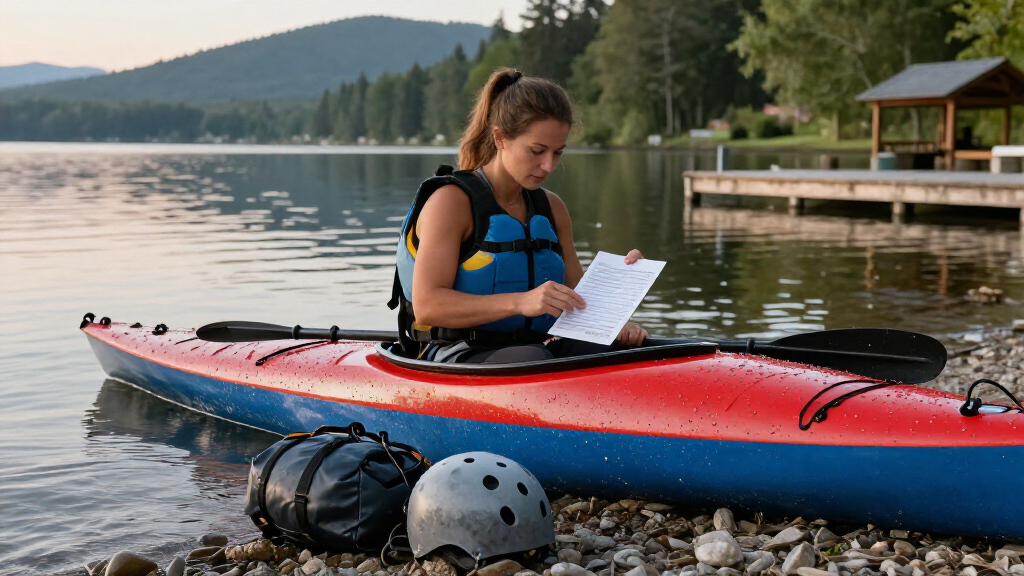
A recreational kayak is the foundation of the checklist, so consider how its stated style and length match the paddling you expect to do. The listed pick is the Wilderness Systems Pungo 120 Sit-Inside Recreational Kayak, 12.2 ft. Its name identifies it as a sit-inside recreational kayak and gives a length to compare with your storage and transport arrangements. Those details help narrow the choice, but they do not establish whether the boat suits your body, the water you use, or the gear you intend to carry.
A common buying mistake is choosing from a product title alone. Before deciding, look for the manufacturer’s specifications on cockpit dimensions, capacity, included components, and any fit guidance. Compare those details with your own needs and the equipment you plan to bring. Check that you can store and move a kayak of the stated length, and confirm that your roof rack is approved for the boat’s dimensions and loading method. If possible, review the cockpit fit in person or consult the maker’s sizing information. Confirm fit and capacity from the product documentation rather than assuming that a recreational label guarantees a particular feel or use. Choose only after the boat and your transport plan make sense together.
What to look for:
- Compare the stated 12.2 ft length with your storage and transport space.
- Check manufacturer guidance for cockpit dimensions and paddler fit.
- Review the documented capacity against the paddler and planned gear.
- Confirm what components are included with the kayak.
- Verify roof-rack compatibility with the kayak’s dimensions and loading instructions.
Wilderness Systems Pungo 120 Sit-Inside Recreational Kayak, 12.2 ft

The Pungo 120 is a sit-inside recreational kayak designed for small to medium-sized paddlers, combining speed and efficiency with a stable hull. Its adjustable Phase 3 Air Pro seat provides ergonomic support and ventilation, while adjustable footrests and thigh pads help accommodate different paddlers.
Pros:
- Stable hull designed to retain performance
- Adjustable seat offers ergonomic support and ventilation
- Adjustable footrests and thigh pads support a more comfortable fit
- Maximum capacity of 325 lb
Cons:
- Designed for small to medium-sized paddlers
- Single-person seating capacity
Best for: Paddlers considering a sit-inside recreational kayak listed at 12.2 ft.
Not ideal for: Shoppers who cannot confirm cockpit fit, capacity, or transport compatibility from the product details.
Bottom line: Compare the Pungo 120’s documented fit, capacity, included components, and transport requirements with your needs before choosing.
Paddle Leash
A paddle leash or grip accessory belongs on the checklist because paddle control and compatibility are worth considering before a trip. The supplied pick is the Kayak Paddle Grips 2-Pack – No-Slip Oar Grips for Take-Apart Paddles. Its name describes a two-pack of grips and identifies take-apart paddles as the intended compatibility context. It does not establish that the grips fit every paddle, so check the product details against your paddle’s design before buying.
A frequent mistake is treating “no-slip” in a product title as proof of performance in every hand, condition, or paddle configuration. Read the maker’s fit information and confirm the grips’ dimensions, installation method, and intended paddle type. Compare those with the shaft and joint area of your paddle, especially if it separates into sections. Check whether the package contains the number of pieces you need and whether the accessory changes how the paddle sections connect or pack away. Verify paddle fit using the actual specifications, not just the title. If details are missing, ask the seller or manufacturer before relying on this item as part of your setup.
What to look for:
- Confirm the grips are intended for your paddle’s style and shaft dimensions.
- Check installation instructions and whether the grips affect a take-apart joint.
- Verify the package contents and number of grips supplied.
- Review product specifications rather than relying on the “no-slip” wording alone.
- Consider how the grips fit your hand and paddle storage routine.
Kayak Paddle Grips 2-Pack – No-Slip Oar Grips for Take-Apart Paddles, Blister Pr

These silicone kayak paddle grips enhance comfort and reduce blisters during paddling. Designed for multi-piece paddles with a 30mm diameter, they provide a non-slip, insulated grip to minimize fatigue on long trips.
Pros:
- Provides a comfortable, non-slip grip for paddles
- Reduces hand fatigue and blisters on long paddling trips
- Insulates hands from hot and cold temperatures
- Easy to slide onto multi-piece paddles
Cons:
- Not compatible with one-piece paddles
- Requires measuring paddle diameter before purchase
- Limited color options (only black listed)
Best for: Paddlers whose take-apart paddle matches the product’s stated compatibility.
Not ideal for: Anyone unable to verify the grip dimensions or installation fit for their paddle.
Bottom line: Check shaft fit and joint clearance before choosing these paddle grips.
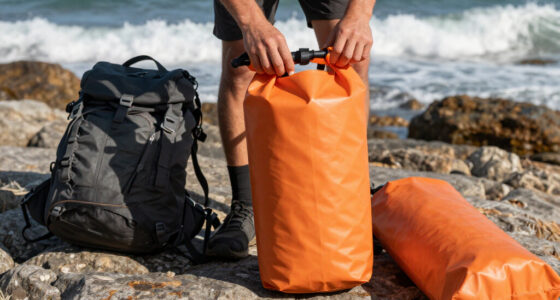
Dry Bag
A dry bag can help organize items you want to keep protected while kayaking, but the right choice depends on what you plan to carry and how the bag is designed to close and attach. The listed product is the Waterproof Bike Rear Rack Bag – 10L Pannier Carrier. Its name presents it as a bike rear-rack bag with a 10L capacity, so do not assume it is designed for kayak use just because it appears in a kayaking checklist.
Before buying, review the manufacturer’s information on materials, closure, waterproofing conditions, dimensions, and attachment points. Compare those details with your kayak’s storage arrangement and the items you want to bring. A capacity figure alone does not tell you whether the shape fits a hatch, deck, or cockpit, or whether the bag can be secured safely to your boat. Common mistakes include assuming “waterproof” means suitable for submersion and overlooking how a bag will be retained while paddling. Check kayak compatibility and the stated protection conditions carefully. If the product documentation only describes bike rack mounting, look for an appropriate way to use it on your kayak before selecting it for this role.
What to look for:
- Confirm the stated 10L capacity suits the items you plan to carry.
- Read the closure and waterproofing details, including stated conditions.
- Compare dimensions with your kayak’s available storage space.
- Verify there is a secure, suitable way to attach or retain the bag on your kayak.
- Check whether the maker describes kayak use or only bike rack mounting.
Waterproof Bike Rear Rack Bag – 10L Pannier Carrier
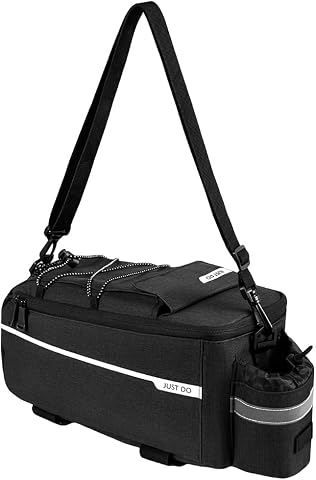
This rear rack bag features a waterproof, insulated lining that keeps food and drinks cold or warm for hours. With a 10‑liter capacity, multiple pockets, and reflective safety details, it offers organized storage and night‑riding visibility.
Pros:
- Waterproof and insulated lining keeps items dry and temperature‑controlled.
- Spacious 10 L capacity with multiple pockets for organized storage.
- Reflective safety features improve visibility during night rides.
- Tool‑free, quick installation with adjustable straps.
Cons:
- Taillight is not included; only a loop is provided.
- Only one main compartment may limit organization for some users.
Best for: Shoppers who can verify that its dimensions and mounting suit their kayak setup.
Not ideal for: Paddlers needing a kayak-specific bag without confirmed kayak attachment or protection details.
Bottom line: Treat the bike rack description as a compatibility question and confirm kayak use before choosing.
Kayak Seat Cushion
A seat cushion is a comfort and fit decision that depends on the kayak seat and the paddler, so this checklist offers advice rather than a product pick. Start by checking the seat’s shape, dimensions, and attachment arrangement, then compare those with any cushion you are considering. A cushion that shifts, bunches, or changes your position can be distracting; secure fit matters alongside comfort.
A common mistake is choosing a cushion based on appearance or thickness without checking whether it fits the seat and stays in place. Look for clear measurements and attachment details, and consider how the added height or bulk may affect your sitting position and available space. Review care and drying guidance for the materials, especially if the cushion may get wet. If you can, test the cushion with the kayak seat before relying on it for a longer outing. Make sure it does not interfere with any seat adjustments or the way you enter and exit the kayak. Match the seat first, then assess comfort and handling together rather than treating them as separate choices.
What to look for:
- Measure the seat and compare it with the cushion dimensions.
- Check how the cushion attaches and whether it is likely to shift.
- Consider added height and bulk in relation to your sitting position.
- Review material care and drying guidance.
- Check that the cushion does not obstruct seat adjustments or entry and exit.
Bilge Pump
A bilge pump is an item to evaluate for your particular kayak and paddling setup; no product pick is supplied here. Check your kayak’s documentation to understand its design and any relevant guidance for managing water. A pump’s size and operation should suit the boat and be practical for you to handle. Check the kayak first so the equipment choice follows the boat’s features and instructions.
A common mistake is buying a pump without confirming that it can be stored accessibly and operated from the kayak. Look for the manufacturer’s dimensions, operation method, and any stated compatibility guidance, then compare them with your available storage and your ability to reach and use the pump. Consider how you will secure it so it remains available while paddling. Do not infer a specific capacity or performance from the general product category; rely on documented specifications and the kayak maker’s guidance. If your kayak’s design or intended use is unclear, consult its documentation or a qualified retailer. Prioritize access and fit alongside the product’s stated operation, and make sure you understand how it is meant to be carried and used before adding it to your kit.
What to look for:
- Review the kayak maker’s guidance on water management and suitable equipment.
- Check pump dimensions against accessible storage space.
- Understand the documented operation method before choosing.
- Consider whether you can reach and operate it from your kayak.
- Confirm how it can be secured and kept accessible while paddling.
Kayak Roof Rack
A roof rack connects the kayak choice to your vehicle, so check fit across the boat, rack, and car before purchasing. The supplied pick is the Thule Compass Kayak and SUP Roof Rack. Its name identifies it as a kayak and SUP roof rack, but does not by itself confirm fit for your vehicle or for a particular kayak. Review the rack maker’s compatibility information and compare it with your vehicle’s roof system and the kayak’s dimensions.
A common buying mistake is assuming that a rack marketed for kayaks fits every roof configuration or boat shape. Check the manufacturer’s vehicle fit guidance, the roof system requirements, loading instructions, and any stated limits. Confirm that the rack can carry the kayak in the intended arrangement and that you have the necessary components to attach it. Consider whether you can load and secure the boat safely with your available space and help. Confirm vehicle compatibility before buying, and verify the rack instructions for securing and transporting your specific boat. If vehicle or kayak details are missing, resolve those questions with the manufacturer or retailer rather than guessing from the product name.
What to look for:
- Check the rack maker’s compatibility guidance for your vehicle and roof system.
- Compare the rack’s stated requirements with your kayak’s dimensions and shape.
- Review loading, attachment, and transport instructions.
- Confirm any stated limits and required components in the product documentation.
- Consider whether you can load and secure the kayak with your available space and help.
Thule Compass Kayak and SUP Roof Rack

This roof rack carries one kayak in J-style or saddle mode, two kayaks in stacker mode, or up to two stand-up paddleboards in saddle mode. Padded rubber supports help protect gear, while the rack folds flat and installs without tools on compatible roof rack systems.
Pros:
- Supports multiple kayak and SUP carrying configurations
- Padded rubber supports help protect watercraft
- Folds flat when not in use
- Installs without tools
Cons:
- Maximum kayak width is 36 inches
- Compatible roof rack system is required
Best for: Shoppers whose vehicle and kayak match the rack’s documented fit guidance.
Not ideal for: Anyone who has not confirmed vehicle roof-system and kayak compatibility.
Bottom line: Verify vehicle fit, kayak fit, and the rack’s loading instructions before choosing the Thule Compass.
Build your kit in a fit-first order: confirm the kayak and how it will be transported, then check the paddle accessory and storage choices against your actual gear. Add a seat cushion or bilge pump only after reviewing your kayak’s dimensions, design, and guidance. This order helps direct attention to the connections that determine whether each item works with the rest of your setup.
Use the checklist as a starting point, and take time to verify product specifications when the names leave questions open. A few careful comparisons can make your gear choices feel more straightforward. Choose with confidence by matching each item to your paddling needs, kayak, and vehicle.