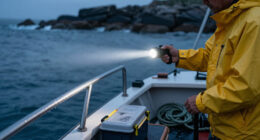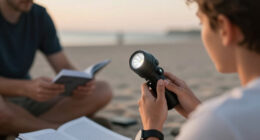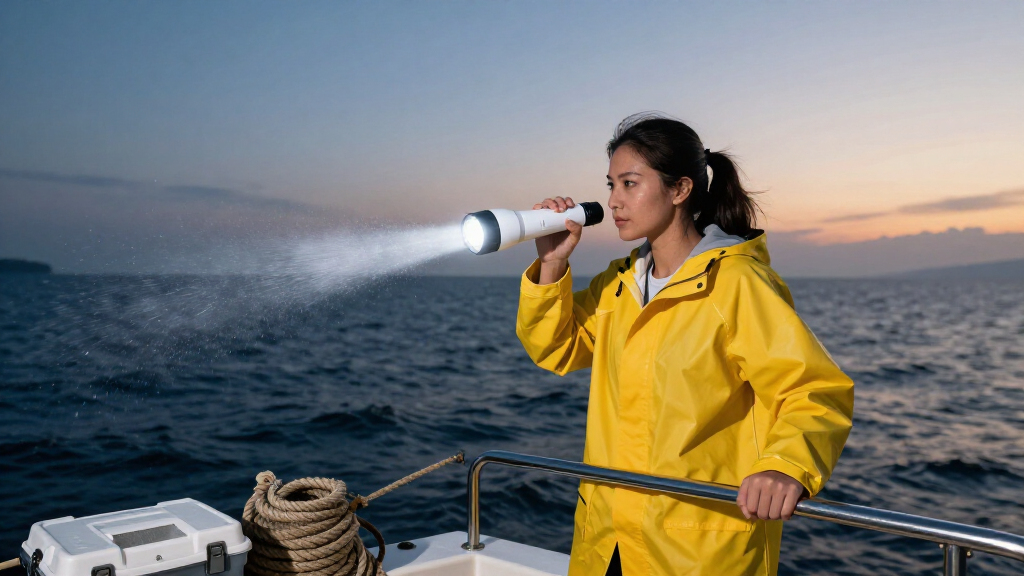
Anyone who has shopped for a marine flashlight hits the same fork in the road: hardware-store LED lights advertise “waterproof” for $35, while purpose-built dive and offshore lights cost $150 to $250 and look, at a glance, almost identical. Both are LED. Both are metal tubes with rubber seals. Both claim waterproofing. So what are you actually buying with the extra $150, and when is the cheap light genuinely enough?

Get sports gear delivered free — and shop member deals
- Fast, free delivery on millions of items
- Access to Prime Big Deal Days deals on October 6–7
- Prime Video, Amazon Music and more included

Durapower Rechargeable IP68 Waterproof Spotlight
- ✔ Waterproof Rating: IP68, submersible to 6ft
- ✔ Beam Throw: Up to 1,400 ft
- ✔ Peak Intensity: 42,000 candelas

YIERBLUE Rechargeable Spotlight Flashlight
- ✔ Waterproof Rating: IP67, submersible to 3ft, floats
- ✔ Beam Throw: Up to 1,000 ft
- ✔ Light Output: 800 lumens listed, 3 modes

Coast G60R 1000 Lumen Waterproof Rechargeable Flashlight, 2-Pack
- ✔ Waterproof Rating: IP67, submersible to 1m, dust-resistant
- ✔ Light Output: 1,000 lumens max
- ✔ Light Modes: Medium, high, low
The answer comes down to what “waterproof” means at the extremes. A budget light is typically rated IPX8, which sounds impressive until you read the fine print: IPX8 usually means it survived a controlled submersion of one to two meters for thirty minutes, once, in fresh water. A premium dive-rated light is built to survive repeated submersion to 20, 50, or 100 meters, with heavier O-ring systems, pressure-rated switches, and materials chosen specifically to resist saltwater corrosion over years of exposure.
This comparison pits a typical budget marine LED flashlight in the $30-60 range against a premium dive-rated light in the $150-250 range. The short version: if your light lives in a dry bag, comes out for occasional dock work or an emergency, and rarely gets more than splashed, the budget light is the smarter buy and the premium one is wasted money. If you dive, work over the side, or keep a light mounted on a boat where it will be soaked in saltwater constantly, the premium light earns its price the first time a budget light floods and dies at the worst possible moment.
At a Glance
| Criteria | Budget Marine Waterproof LED Flashlight (~$30-60, e.g., basic IPX8 aluminum compact lights) | Premium Dive-Rated Marine LED Flashlight (~$150-250, e.g., purpose-built diving and offshore work lights) | Winner |
|---|---|---|---|
| Waterproofing depth and sealing design | IPX8, ~1-2 m for 30 min; single O-ring, minimal pressure testing | Pressure-rated 20-100 m; dual O-rings, greased threads, pressure-tested housings | B |
| Saltwater corrosion resistance | Anodized aluminum, decent at first; corrodes at threads and switch after repeated salt exposure | Marine-grade alloys, hard-anodized or polymer bodies, sealed switches; built for constant salt exposure | B |
| Brightness and beam quality | 300-800 lumens; usable beam, often with hot spot and dim spill | 800-1500+ lumens; wide, even beam tuned for murky water and backscatter | B |
| Runtime and battery system | 1-3 hours on high with AA/18650 cells; steep output drop-off | 2-10 hours depending on mode; often rechargeable packs or high-capacity cells with regulated output | B |
| Drop and impact durability | 1 m rating, usually fine for boat use | Drop-rated and designed for deck abuse; heavier construction throughout | B |
| Switch and one-hand operation (with gloves) | Electronic side switch; can be fiddly with cold, wet gloves | Large twist or magnetic switches sized for gloved hands | B |
| Long-term serviceability | Effectively disposable; seals not sold as spare parts | User-replaceable O-rings and parts; multi-year warranties common | B |
| Price and value | $30-60; often excellent value for splash-level use | $150-250; expensive unless you actually submerge or work offshore | A |
Durapower Rechargeable IP68 Waterproof Spotlight
When a light goes overboard, most ratings evaporate quickly — but the Durapower’s certified IP68 housing keeps working at depths up to six feet, with rubber armor covering most of the body to keep seals intact against salt spray and knocks. That is double the submersion depth of the YIERBLUE and roughly three times the margin of the Coast G60R, which matters if your light lives near an open transom or gets used during recovery work.The beam is the other headline. With up to 42,000 candelas and a 1,400-foot throw, this is the pick for identifying aids to navigation, scanning a dark shoreline, or signaling across open water. Compared with the YIERBLUE’s 1,000-foot reach, the Durapower is clearly the better long-distance tool, while the Coast G60R simply is not in the same class for distance work.Runtime is a genuine strength: a 3,600mAh lithium-ion cell delivers up to 24 hours on lower settings, and the package includes a 12V vehicle charger — handy for topping up from a boat’s auxiliary power. A built-in folding stand with four angle positions covers hands-free deck tasks. The tradeoff is size and precision: this is a spotlight, not an everyday pocket light, and it has no focus adjustment like the Coast’s twist bezel, so close-range flood work is not its strength. Its 1,000-lumen output also sounds modest next to the YIERBLUE’s marketing numbers, though its tighter optics deliver more usable distance per lumen.
Pros:
- IP68 rated for submersion up to 6ft — the deepest rating in this lineup
- 1,400ft tight beam throw with 42,000 candelas for navigation and signaling
- Up to 24 hours runtime with power indicator and included 12V charger
- Rubber-armored body survives 3m drops and rough deck handling
Cons:
- Large spotlight form factor — not pocketable or suitable for EDC
- No adjustable focus, so it is less versatile for close-range flood lighting
- Lower raw lumen figure than competing spotlights may give pause despite better optics
Best for: Boaters, anglers and coastal hunters who need maximum water survival and long-distance beam reach from a single dedicated spotlight.
Not ideal for: Anyone wanting a pocketable everyday-carry light or an adjustable flood beam for close-up cabin or engine-room work.
Bottom line: The most water-capable and farthest-reaching light here, and the one we would trust most when the light itself might end up in the water.
“The most water-capable and farthest-reaching light here, and the one we would trust most when the light itself might end up in the water.”
YIERBLUE Rechargeable Spotlight Flashlight
The YIERBLUE makes its case on buoyancy and bundle value. It is IP67 rated to three feet of submersion, but the smarter design move is that it floats back to the surface if dropped overboard — a recovery feature neither the Durapower nor the Coast can claim. On a small boat where every dropped tool seems destined for the depths, that single trait may matter more than the Durapower’s extra depth rating, since a floating light is one you actually get back.Performance sits comfortably in the middle of this group. The focused spot reaches objects out to 1,000 feet — short of the Durapower’s 1,400-foot throw but far beyond anything the Coast G60R can manage. Runtime is where it pulls ahead of both rivals in practical terms: up to 12 hours on low and 6 on high, with a USB-C fast charge in four hours. An intelligent illumination driver keeps output consistent rather than fading as the battery drains, a small detail that becomes important during an all-night anchorage.The included foldable stand and removable red filter add genuine versatility — hands-free deck repairs and night-vision-friendly hunting or navigation use — and the impact-resistant ABS body with silicone sleeve survives 10-foot drops, a taller fall rating than the Durapower’s. The compromises are real, though: at under a pound it is still a two-handed spotlight, the fixed beam offers no flood-to-spot adjustability like the Coast’s twist bezel, and the much-advertised six-figure lumen claim should be read skeptically next to its listed 800-lumen output.
Pros:
- Floats if dropped overboard — unique recoverability in this lineup
- Up to 12 hours runtime with non-fading brightness driver
- Includes foldable stand for hands-free use and a removable red filter
- 10ft impact resistance with protective silicone housing
Cons:
- IP67 limited to 3ft submersion — half the Durapower’s depth rating
- Fixed spot beam with no focus adjustment
- Marketing lumen claims far exceed the listed 800-lumen output
Best for: Budget-conscious boaters, campers and hunters who want a floating, long-running spotlight with hands-free and red-filter accessories included.
Not ideal for: Buyers who need maximum submersion depth or the longest possible beam throw, or who prefer a compact pocket light.
Bottom line: The smart value play: nearly the capability of our top pick, plus buoyancy and accessories, in exchange for a shorter throw and shallower rating.
“The smart value play: nearly the capability of our top pick, plus buoyancy and accessories, in exchange for a shorter throw and shallower rating.”
Coast G60R 1000 Lumen Waterproof Rechargeable Flashlight, 2-Pack
Not every marine lighting job needs a searchlight. The Coast G60R takes the opposite approach from the Durapower and YIERBLUE: instead of one big spotlight, you get two compact 1,000-lumen flashlights, so one can live at the helm, one in the ditch bag, and nobody argues over who took the light. For redundancy alone — a principle every skipper respects — the two-pack format is a genuine advantage.The standout feature is the twist focus bezel, the only adjustable optic in this lineup. Twisting the head moves the beam from a wide flood for chart-table and engine-bay work to a focused spot for scanning a dock line — flexibility the fixed-beam spotlights simply cannot offer. Its ZITHION rechargeable battery eliminates disposable-cell waste, and a thoughtful lock-out mode prevents the classic dead-battery surprise when a light has been rattling in a locker all season.The honest limitation is water protection: IP67 to just one meter, the shallowest rating here, and no buoyancy — drop it overboard and it is gone. Its throw also falls well short of both spotlights, making it a poor choice for marking distant buoys or signaling across open water. But for onboard tasks — cabin, cockpit, below-decks — its pocketability and beam versatility win. If your boating is inland or coastal day-tripping rather than offshore passage-making, this trade is easy to accept.
Pros:
- Two lights included — true redundancy across helm, cabin and ditch bag
- Twist focus optic shifts from flood to spot, unique in this lineup
- Lock-out mode prevents accidental battery drain in storage
- Rechargeable ZITHION battery saves on disposables over time
Cons:
- IP67 limited to 1m submersion — the shallowest rating of the three
- Does not float and cannot match the spotlights’ long-distance throw
- Bulkier per-light runtime than the 12–24 hour spotlights
Best for: Day boaters and coastal cruisers who want multiple compact, focusable lights stationed around the boat and in emergency kits.
Not ideal for: Offshore or rough-water use where long-throw signaling is needed or where a light is likely to end up submerged beyond a meter.
Bottom line: The right choice when coverage and convenience beat raw beam power — two versatile everyday lights rather than one dedicated searchlight.
“The right choice when coverage and convenience beat raw beam power — two versatile everyday lights rather than one dedicated searchlight.”
As an Amazon Associate we earn from qualifying purchases.
Key Differences
The single most consequential difference is the sealing system. Budget IPX8 lights pass a factory submersion test at shallow depth for a short time; that tells you almost nothing about how the light behaves after the O-ring picks up sand, after the threads are greased incorrectly (or not at all), or after the light is taken to five meters of actual seawater where pressure compresses the housing and tests every seal at once. Premium dive lights use two redundant O-rings on every opening, factory grease on every thread, and switches that are sealed rather than merely gasketed. In practice, budget lights that get repeatedly submerged tend to flood unpredictably — sometimes on the tenth dunk, sometimes the fiftieth — and a flooded light is not just dead, it is dead instantly and without warning.
The second big gap is corrosion. Anodized aluminum handles a few dunkings, but salt is persistent: it creeps into threads, switch boots, and charging ports, and within a season or two a budget light left on a boat often shows white corrosion crusts and a switch that sticks. Premium marine lights either use materials salt cannot easily attack (hard-anodized alloys, impact polymers, titanium in some models) or they isolate the vulnerable points with sealed designs and sacrificial-friendly maintenance parts. This is why a premium light can live on a bracket in the salt air for five years while a budget light in the same spot often needs replacement within two.
Where budget lights are not embarrassed is in the scenario most buyers actually have: a light kept in a dry bag or glove compartment, taken out at night to check lines, find a dropped shackle, or signal someone. At that level of exposure, the brightness gap is modest for the task, the runtime is adequate, and the corrosion problem barely materializes because the light stays dry. The premium advantages are real, but they only pay for themselves when the light is genuinely exposed to water, depth, and salt on a regular basis.
Detailed Comparison
This is where the product categories genuinely split. A budget light’s IPX8 rating covers shallow, brief, controlled submersion — think dropping it in a bucket or overboard in two feet of water and grabbing it quickly. A premium dive-rated light is pressure-tested for repeated submersion to 20 meters or far deeper, with dual O-rings at every joint and housings designed to flex under pressure without breaking seals. If you snorkel, dive, retrieve anchors, or work under a hull, the budget rating is not a small shortfall — it is the wrong tool, and flooding is a when-not-if risk. If your light never goes below the surface, the gap is theoretical and you are paying for capability you will never call on.
Budget aluminum lights survive the first season fine, then the decline starts: crusty threads, a stiff switch boot, corroded battery contacts if any moisture gets inside. Premium marine lights are built on the assumption that salt will attack everything constantly — hard-anodized or polymer bodies, sealed electronics, greased and protected contact points, and in some cases replaceable tail modules. The practical difference shows up over two to three years of ownership on a boat. A budget light that gets rinsed and stored dry after every use can last surprisingly long; the same light left in a wet locker will degrade fast. The premium light tolerates neglect far better, which is exactly what a marine light should do, because the moment you need it is rarely the moment you maintained it.
Budget lights typically output 300-800 lumens with a beam pattern borrowed from general-purpose flashlights: a bright hot spot with a dim spill. That works fine in clear air on deck. In murky water, that tight hot spot illuminates a cloud of suspended particles right in front of you — backscatter — and makes visibility worse, not better. Premium dive lights put out 800-1500+ lumens through wide, even beams specifically tuned to cut through turbid water and reduce backscatter. On paper the lumen gap is two to three times; in the water the effective visibility gap can be much larger because of beam shape. Out of the water, for deck work, the difference is real but not decisive — 400 lumens is plenty to find a cleat at night.
Budget lights on high typically run one to three hours, with unregulated output that dims noticeably as the battery drains — fine for a ten-minute task, frustrating over a long night. Premium lights usually offer regulated output (consistent brightness until the cell is nearly empty), longer runtimes across modes, and better battery systems: high-capacity rechargeable packs or quality 18650/21700 cells with proper protection circuits. For divers this matters directly — a light that fades halfway through a dive is a genuine safety issue. For a boater using the light in short bursts, the runtime difference rarely becomes a real constraint, and carrying a spare set of AAs in the budget light is a perfectly workable strategy.
Both classes are usually rated for drops of about one meter, and both will survive being knocked off a seat. The premium light wins on construction margin — thicker walls, reinforced lens bezels, housings designed to be knocked against tanks, ladders, and hulls repeatedly. But this is not a category where the budget light embarrasses itself; a metal budget light is already far tougher than the phone in your pocket. The durability gap matters most for dive and work use, where the light gets abused daily, and matters least for occasional recreational use.
This is an underrated differentiator. Budget lights use small electronic side switches that are genuinely hard to operate with cold, wet, gloved fingers, and a stuck or corroded switch is one of the most common budget-light failure modes on boats. Premium marine lights use large twist heads or oversized sealed tail switches designed for thick gloves and cold hands. If you have ever tried to cycle modes on a small switch while wearing neoprene gloves in the dark, you know this is not a minor comfort issue — it is whether you can turn the light on when you need it. For bare-hand, fair-weather use, the gap shrinks to a preference.
Budget marine flashlights are disposable by design: when a seal wears out or corrosion sets in, you replace the whole light. Premium lights are built as systems — replacement O-rings are sold or included, lube is specified, threads are designed to be maintained, and warranties of two to five years are common. Over a decade of regular use, one maintained premium light can outlast three or four budget lights, which reframes the price math for heavy users. For light users, the disposable model is actually fine — replacing a $40 light every few years is cheaper than a $200 light plus maintenance.
Price and value (Budget Marine Waterproof LED Flashlight (~$30-60, e.g., basic IPX8 aluminum compact lights) wins — major)
Here the budget light wins outright, and it is not close. For the most common real-world marine lighting scenario — a light kept dry and used occasionally — the budget light delivers roughly 90 percent of the practical utility for 20 to 30 percent of the price. You could buy a budget light for the boat, one for the ditch bag, and one for the car, and still spend less than one premium light. The premium price is only justified when the light’s job includes submersion, constant salt exposure, or mission-critical reliability. Paying $200 for a dive-rated light that lives in a dry bag is not prudence; it is wasted capability.
Budget Marine Waterproof LED Flashlight (~$30-60, e.g., basic IPX8 aluminum compact lights): Pros and Cons
Pros:
- Costs a fraction of a premium light, so you can afford spares in multiple locations
- Entirely adequate for deck work, dock tasks, and emergency signaling at the surface
- Usually runs on common AA or 18650 cells, easy to source anywhere
- Small and light enough to keep in a pocket or dry bag without thinking about it
- Low replacement cost means losing one overboard is annoying, not painful
Cons:
- IPX8 rating is shallow and brief — repeated or deep submersion risks flooding
- Corrodes at threads, switch boot, and contacts with regular saltwater exposure
- Output dims as batteries drain; unregulated beam degrades mid-task
- Small switches are difficult or impossible with cold, wet gloves
- Sealed as a disposable product — no spare parts, minimal warranty
Pros:
- True pressure-rated submersion capability for diving and underwater work
- Materials and seals built for constant saltwater and salt-air exposure over years
- Regulated, high-lumen output with beams tuned to cut through murky water
- Glove-friendly switches and rugged construction throughout
- Serviceable: replaceable O-rings, maintenance parts, multi-year warranties
Cons:
- Four to six times the price of a budget light
- Often larger and heavier than needed for casual surface use
- Overkill for a light kept in a dry bag and used occasionally
- Specialized battery systems may be harder to replace on remote trips
- More value lost if it goes overboard unattended
Who Should Choose What
Choose Budget Marine Waterproof LED Flashlight (~$30-60, e.g., basic IPX8 aluminum compact lights) if:
- You want a light for deck work, dock lines, and checking the boat at night at the surface
- The light will live in a dry bag, glove box, or ditch bag and only come out occasionally
- You are buying multiple lights for a boat, car, and emergency kit on a budget
- You are honest that you will never intentionally take it underwater
Choose Premium Dive-Rated Marine LED Flashlight (~$150-250, e.g., purpose-built diving and offshore work lights) if:
- You dive, snorkel, or free-dive and need a light that goes underwater with you
- You retrieve anchors, inspect hulls, or work over the side regularly
- The light will be mounted or stored on the boat, exposed to salt air and spray continuously
- You need a light that works first-time with gloves on in bad conditions — an offshore or blue-water sailor’s emergency light
- You want one light to own for a decade rather than replacing corroded budget lights every couple of seasons
Skip both if: You only need a light for on-shore camping or household power outages — a general-purpose waterproof flashlight at $20-40 will serve, and neither marine-specific option is necessary.
Value for Money
The value question here has a clean answer: the budget light is better value for the majority of buyers, and the premium light is better value for a specific minority. If your interaction with water is splash, spray, and rain, a $40 IPX8 light does the job a $200 dive light would do, and the extra $160 buys capability you will literally never use. Spreading that money across two or three budget lights in different locations is a stronger safety strategy than one premium light you might not have with you when needed.
The premium price flips into good value under three conditions: repeated submersion, constant salt exposure, or genuine dependence on the light working. A diver who floods a budget light at fifteen meters has lost the light, possibly the dive, and in a bad scenario more than that — the $150 premium is cheap insurance against that failure. Similarly, an offshore sailor whose emergency light must fire up after two years of neglected salt-air storage is paying for sealed, corrosion-proof construction, and it is worth every dollar. The mistake to avoid is buying the premium light as a status purchase for fair-weather day-boating, where its advantages never activate.
Final Verdict
Buy the budget marine LED flashlight if your light stays above the waterline. That describes most recreational boaters: dock work, night deck checks, an emergency light in the ditch bag. A $40 IPX8 light does all of that competently, and the money saved buys spares. This is the right choice for the majority of buyers, and pretending otherwise just inflates the cost of boating.
Buy the premium dive-rated light if water is part of the job. Divers, hull cleaners, anchor-retrievers, offshore sailors, and anyone whose light will be soaked, submerged, or neglected in salt air for years should not gamble on a shallow IPX8 rating and corrosion-prone threads. The single deciding factor is submersion: the moment your light goes underwater by design rather than accident, the budget category stops being a cheaper alternative and starts being a liability. Depth, salt, and reliability demands are what the extra $150 buys — and if you have them, it is worth paying.
Frequently Asked Questions
Is an IPX8 rating enough for a marine flashlight?
It depends on exposure. IPX8 generally means the light survived a shallow, brief, controlled submersion — often 1-2 meters for 30 minutes. That is fine for rain, spray, waves over the deck, and accidental brief dunking. It is not sufficient for diving, sustained swimming, or work underwater, where water pressure repeatedly stresses the seals. If your light will submerge by design, look for a depth-rated dive light instead.
Will a cheap flashlight corrode on my boat?
Eventually, yes, if it is exposed to salt air or spray regularly. Anodized aluminum budget lights usually last a season or two of real exposure before corrosion appears at the threads, switch boot, or contacts. You can extend the life dramatically by rinsing in fresh water after salt exposure, drying fully, and storing the light in a dry bag or compartment rather than a wet locker.
How many lumens do I need for marine use?
For deck work and surface tasks, 300-500 lumens is plenty. For looking into water from the surface, 600+ helps. For diving in murky conditions, 1000+ lumens with a wide, even beam matters more than raw output, because a tight hot spot in turbid water creates backscatter that actually reduces visibility. Beam quality beats lumen count once you go underwater.
Are rechargeable or disposable battery lights better for a boat?
For an emergency light that may sit unused for a year, disposable lithium cells are safer — they hold charge for years and perform in cold. For a light used weekly, rechargeable 18650/21700 systems are cheaper to run. The best practice for a ditch bag or abandon-ship light is a light that runs on disposables; for daily deck use, rechargeables are the practical choice.
Can I use a dive-rated flashlight for regular boating?
Yes, and it will outlast most budget lights — but you are paying for depth capability and corrosion-proofing you may not need. If the price is comfortable and you want one light to own for a decade, a premium light is a legitimate buy even for surface-only use. Just do not buy it believing it will perform noticeably better on deck, because at the surface the practical difference is small.
Fall Picks
fall essentials
As an affiliate, we earn on qualifying purchases.